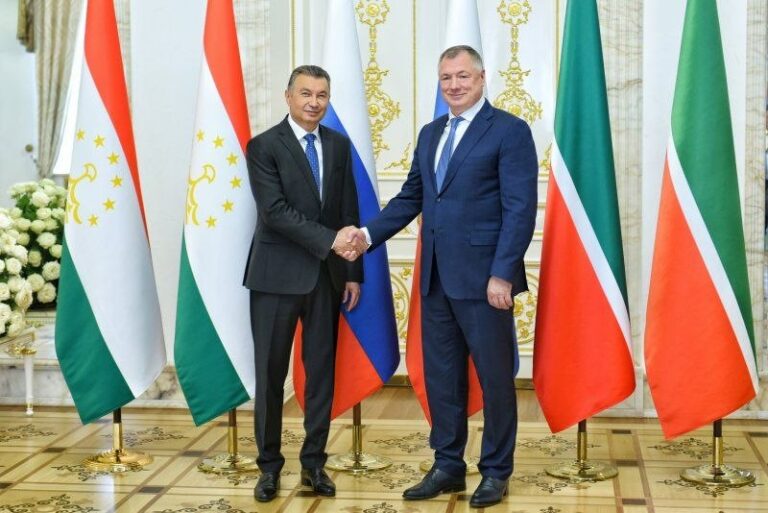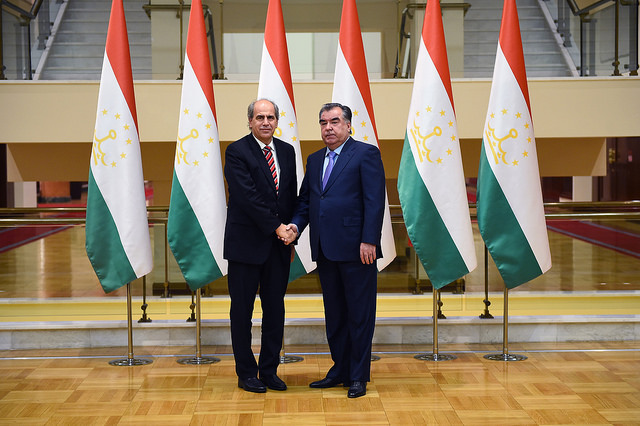
On Tuesday January 24, Tajik President Emomali Rahmon received visiting European Union (EU) Special Representative for Central Asia, Ambassador Peter Burian.
According to the Tajik president’s official website, the two sides discussed state and prospects of further expansion of cooperation between Tajikistan and the European Union.
They reportedly highly appraised the current level of relations between Tajikistan and the European Union and expressed satisfaction with the trends marking expansion of political, economic and cultural cooperation.
The website says Rahmon and Burian also exchanged views on issues related to multilateral cooperation within the frameworks of the European Union and Central Asia, multi-annual indicative program for 2014-2020 and the EU regional strategy for Tajikistan.
They also discussed further expansion of cooperation in the fields of education and science, training of skilled new technology specialists for Tajikistan.
Besides, Tajik president and EU envoy for Central Asia exchanged views on a number of international and regional issues being of mutual interest, including regional security and the current military and political situation in Afghanistan.
According to the EU Delegation to Tajikistan, the visit of Ambassador Burian reflects continuous interest of the European Union to further develop the positive relations with Tajikistan and to maintain a fruitful and open dialogue in all spheres of cooperation between the European Union and Tajikistan.
The European Union began its engagement with Tajikistan in the early 1990s, following the country's independence from the Soviet Union. In 1992, a TACIS program office was opened in Dushanbe. Due to the Tajik civil war, the program office was largely non-operational until 2000, when direct project funding began in earnest. In 2001, the first annual EU-Tajikistan Joint Committee meeting was held in Brussels. In 2004, Commissioner Patten visited Dushanbe, and a Partnership and Cooperation Agreement (PCA) was signed by President Rahmon in Luxembourg; it entered into force following ratification in 2010.
EU-Tajikistan relations today are conducted within the framework of the EU Central Asia Strategy 2014-2020. Cooperation under the PCA is comprehensive and includes the facilitation of economic transition for Tajikistan, and the promotion of inclusive, sustainable human and economic development. The EU is assisting the government of Tajikistan with its structural reform process, notably through providing around one third of its assistance through budget support. The EU is also enhancing the capacity of civil society in the country, and does so in partnership with local and international NGOs.