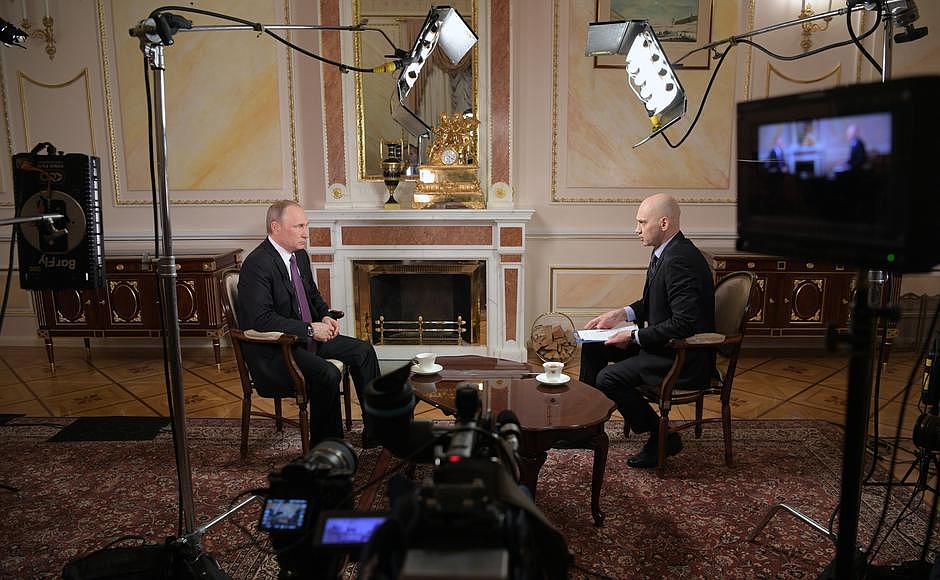
Russian President Vladimir Putin says the Russian military base deployed in Tajikistan is an important element of stability in the Central Asian region.
Putin, in an interview with the Mir Media Company published on April 12, said that terrorism and extremism of all kinds are the main threats for the Collective Security treaty Organization (CSTO) member nations.
“I would include drug trafficking and trans-border crime, and we cannot forget about the more global threats, of course. We know the various theories being tried out around the world, causing serious destabilization in the affected regions. We cannot allow such a thing to happen in our region, of course, and we will take the necessary measures in Russia itself and support our CSTO partners,” Putin said.
Asked how he assesses the CSTO’s efforts to address threats emanating from Afghanistan, the Russian president that it is a very dangerous area for all CSTO member nations. “We already know examples, tragic examples, when militants crossed the border from Afghanistan. I am not talking here about drug trafficking and criminals infiltrating our countries, but about large armed groups entering our territories. There was a case in Kyrgyzstan several years ago, for example, when the armed forces had to be deployed to fight these armed groups,” Putin noted.
“We are conscious of the great danger this poses to our own country, the Russian Federation. It is for this reason as well that we maintain our 201stmilitary base in Tajikistan,” he said.
Putin noted that the Russian military base deployed in Tajikistan is an important element of stability in the region. “The biggest threat is terrorism, and the terrorist threat coming from Afghanistan is very serious indeed. However, as far as the Taliban are concerned, many countries have contacts of one form or another with this organization [the Taliban]. Of course, they have many radicals in their ranks, but together with our partners, including UN representatives, we always take the view that we must develop relations with all forces in Afghanistan based on three main principles: recognition of Afghanistan’s constitution, disarmament, and reaching full national accord.”
“We strongly hope that we will never have to use our armed forces, including the units at our 201st base in Tajikistan. This is certainly an area of concern, like the Afghan border, which is long, more than 1000 kilometers, 1,300 kilometers. Our view is that by assisting Afghanistan’s legitimate government, together with other participants in the settlement process we will eventually achieve reconciliation there and will help to set Afghanistan on the track of a peaceful resolution of its internal problems and development,” Putin said.
According to him, drug trafficking is increasing in Afghanistan and production volumes are increasing too. “A third of Afghanistan’s rural territory is under Taliban control today. We see that ever more frequently the so-called international coalition (it is mostly made up of American troops) has to engage in various combat operations, and we even hear talk of plans for a full return of the US military contingent to Afghanistan. This is related to the complicated processes underway in that country,” the Russian president noted.
The Russian military base deployed in Tajikistan is Russia's largest non-naval military facility outside the country. It was officially opened in Tajikistan in 2004 under a previous agreement, which was signed in 1993, and hosts Russia’s largest military contingent deployed abroad.
A total of some 7,000 Russian troops are now stationed at two military facilities collectively known as the 201st military base – in Dushanbe and Qurghon Teppa, some 100 kilometers from Dushanbe.