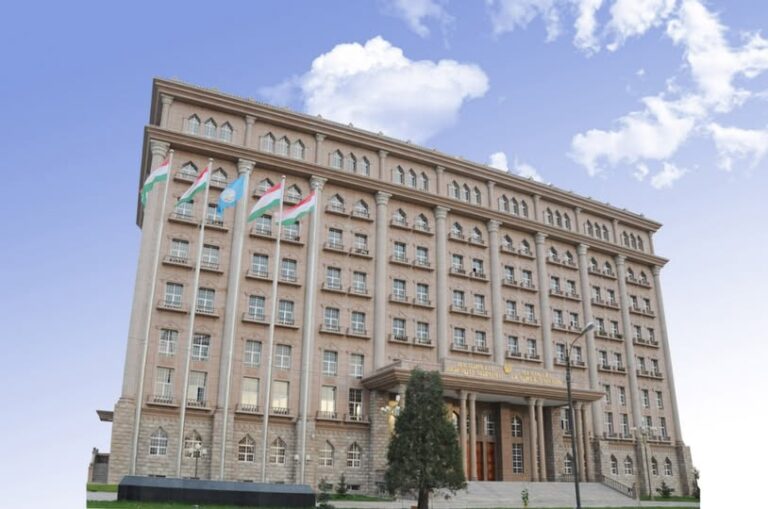
The National Bank of Tajikistan (NBT) says Tajikistan needs technical assistance to carry out reforms in the banking system.
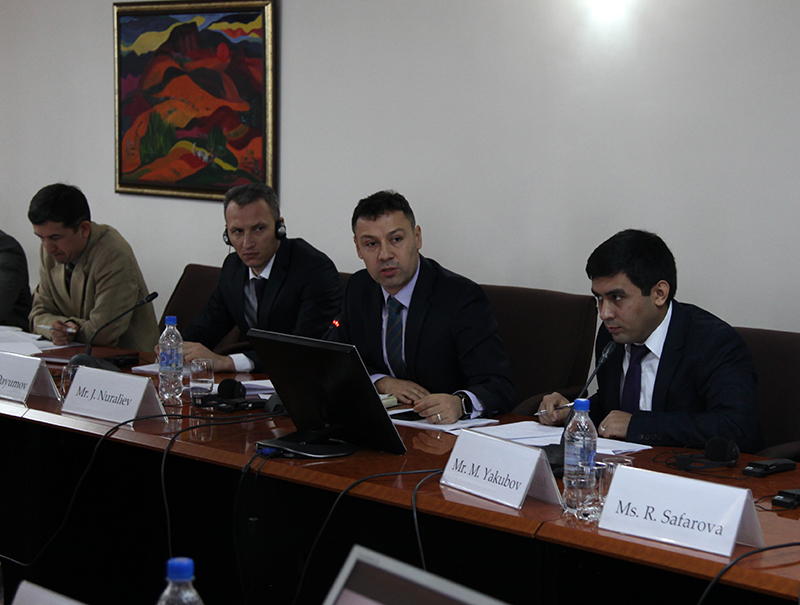
First deputy head of Tajik central bank, Jamoliddin Nouraliyev, noted this here on November 3 at a meeting with resident representatives of the international financial institutions in Tajikistan.
The meeting participants included resident representatives of the World Bank (WB) Jan-Peter Olters, the Asian Development Bank (ADB) Pradeep Shrivastava, the International Monetary Fund (IMF) Yuri Sobolev, the European Bank for Reconstruction and Development (EBRD) Ayten Rustamova, KfW Development Bank Manouchehr Bakoyev, as well as deputy head of GIZ Office in Dushanbe Thomas Lux.
Speaking at the meeting, Nouraliyev, in particular, noted that the NBT has been introducing a new monetary instrument for making gradual shift to the modern regime of the monetary policy – inflation targeting, according to the NBT press center.
The NBT deputy head added that Tajikistan needed technical assistance for involvement of consultants.
He briefed resident representatives of the international financial institutions in Tajikistan on shift from monetary targeting to inflation targeting.
For their part, resident representatives of the international financial institutions reportedly noted that they would jointly discuss issues related to the required technical assistance needed for improvement of infrastructure and involvement of consultants.
Monetary targeting is a simple rule for monetary policy according to which the central bank manages monetary aggregates as operating and/or intermediate target to influence the ultimate objective, price stability. Under monetary targeting, the inflation target is not announced and the central bank intervention is concentrated only on the money market. Typically, the central bank sets the interest rates to control monetary aggregates, which are considered the main determinants of inflation in the long run. Thus, controlling monetary aggregates would be equivalent to stabilizing the inflation rate around the target value.
Inflation targeting is a monetary policy regime in which a central bank has an explicit target inflation rate for the medium term and announces this inflation target to the public. The assumption is that the best that monetary policy can do to support long-term growth of the economy is to maintain price stability. The central bank uses interest rates, its main short-term monetary instrument. An inflation-targeting central bank will raise or lower interest rates based on above-target or below-target inflation, respectively.