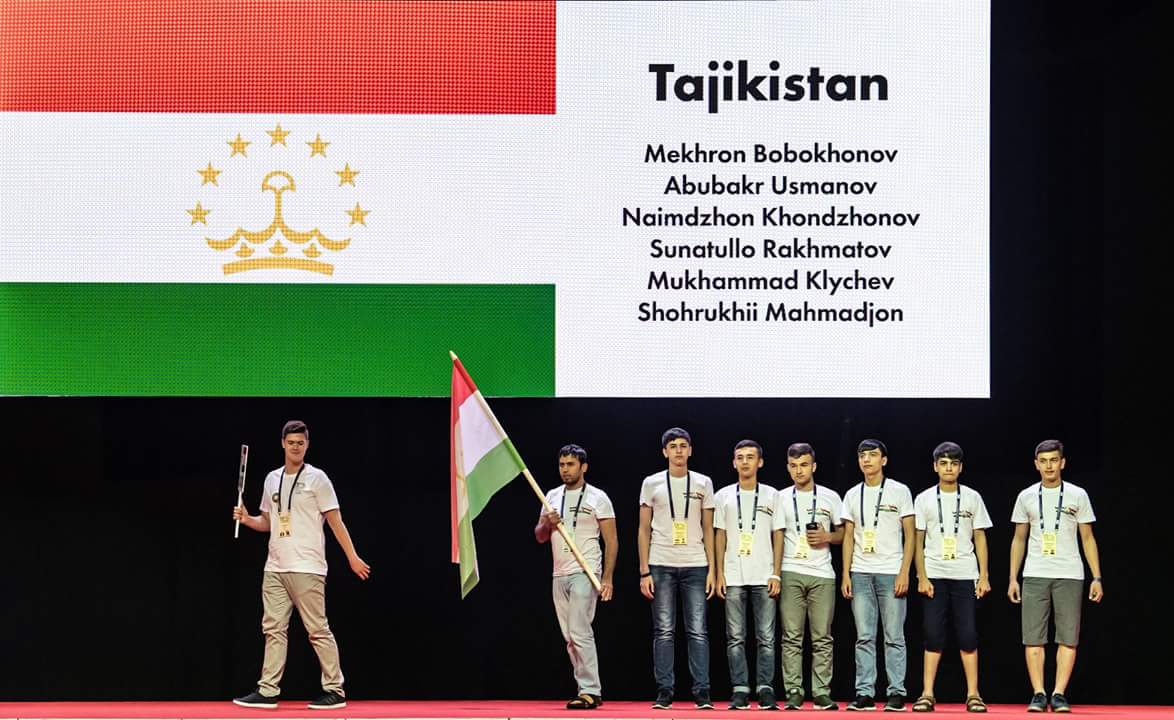
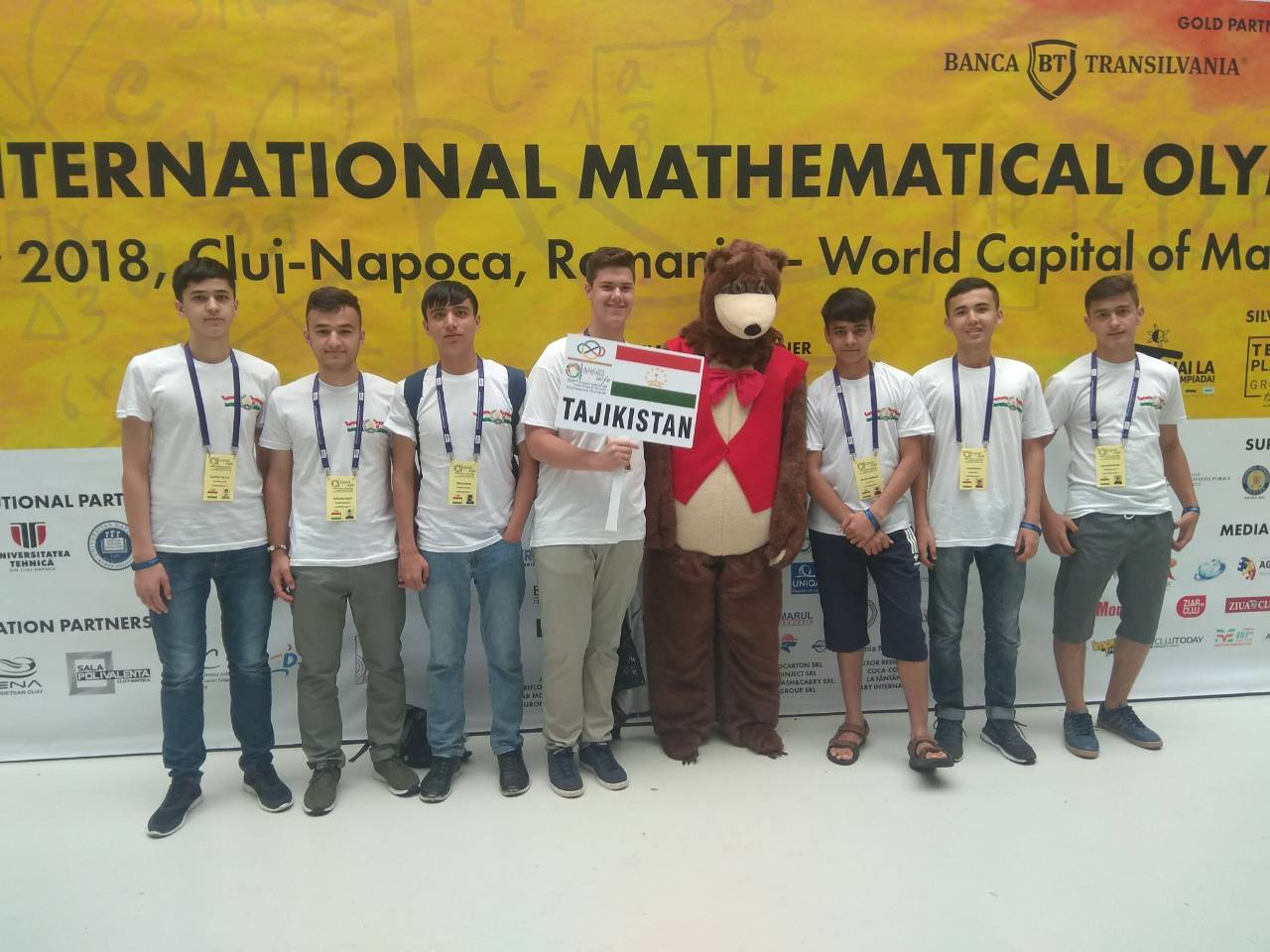
Tajik school students have won five bronze medals in the 59th International Mathematical Olympiad (IMO) that took place in Romania on July 13-14.
Five students from the Tajik-Russian Lyceum “Hotam and PV” and one student from the Dushanbe-based Lyceum for Talented Children represented Tajikistan in this prestigious international mathematical competition.
Shorukh Mahmadjon, Mehron Bobokhonov, Abubakr Usmonov, Naimjon Khonjonov (all of them are students at “Hotam and PV” Lyceum) and Muhammad Qlichev (student at the Lyceum for Talented Children) won bronze medals.
Sunatullo Rahmatov (“Hotam and PV” Lyceum) was awarded with a certificate of honorable mention. He just failed to win the sixth bronze medal for Tajikistan by two points.
Tajikistan with 103 scores was reportedly 43rd among 107 countries. 594 young mathematicians, aged 14 to 19, from 107 countries participated in the 59th International Mathematical Olympiad.
The International Mathematical Olympiad (IMO) is an annual six-problem mathematical olympiad for pre-college students, and is the oldest of the International Science Olympiads. The first IMO was held in Romania in 1959. It has since been held annually, except in 1980. More than 100 countries, representing over 90% of the world's population, send teams of up to six students, plus one team leader, one deputy leader, and observers.
The content ranges from extremely difficult algebra and pre-calculus problems to problems on branches of mathematics not conventionally covered at school and often not at university level either, such as projective and complex geometry, functional equations, combinatorics, and well-grounded number theory, of which extensive knowledge of theorems is required.
The selection process differs by country, but it often consists of a series of tests which admit fewer students at each progressing test. Awards are given to approximately the top-scoring 50% of the individual contestants. Teams are not officially recognized—all scores are given only to individual contestants, but team scoring is unofficially compared more than individual scores. Contestants must be under the age of 20 and must not be registered at any tertiary institution.
During the competition, contestants have to solve, individually, two contest papers on two consecutive days, with three problems each day. Each problem is worth seven points. Gold, silver, and bronze medals are awarded in the ratio of 1:2:3 according to the overall results — half of the contestants receive a medal. In order to encourage as many students as possible to solve complete problems, certificates of honorable mention are awarded to students (not receiving a medal) who obtained 7 points for at least one problem.
The International Mathematical Olympiad is one of the most prestigious mathematical competitions in the world.