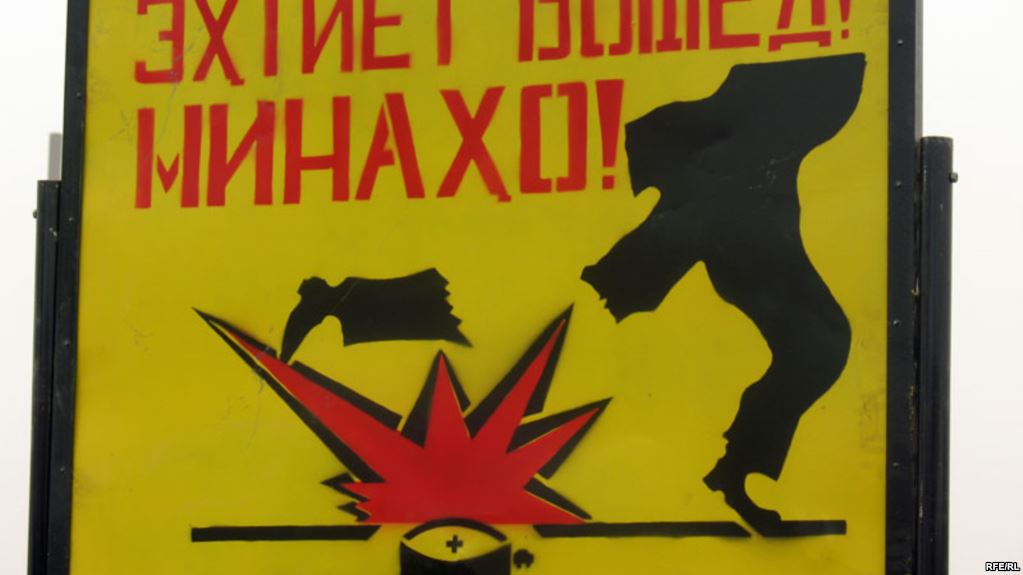
An article by Bruce Pannier, Putting an End to 20 Years of Death along the Tajik-Uzbek Border, which was posted on Radio Liberty’s website on October 13, notes that Khudoberdi Kholiqnazar, the head of the Center for Strategic Studies under the President of Tajikistan, noted on October 6 that demining work has started along the border with Uzbekistan.
"Work has already started on clearing the land mines, and very soon inhabitants of the border region will forget about the danger of land mines," Kholiqnazar said.
Dozens, certainly, possibly hundreds of people living in the border area have reportedly been killed or injured by land mines laid by Uzbek authorities along the border in 2000. Most of the victims were people gathering wood, usually children, or shepherds.
According to the article, the then-head of Tajik Mine Action Center (TMAC), Jonmahmad Rajabov, said at the start of February 2004 that 62 Tajik citizens had been killed by land mines near the Uzbek border and nearly the same number wounded since 2000.
Tajik officials repeatedly complained about the land mines to Uzbekistan, but without any obvious result. In November 2009, Uzbek Ambassador to Tajikistan Shokosim Shoislomov reportedly said his country had no intention of removing the land mines or of giving Tajikistan maps of where the land mines were laid. “These mines in mountains do not affect anybody, and there is nothing to do for a normal person in such remote places,” Shoislomov said. “Only those who want to cross the border illegally are going there. It is these people against whom mines were planted at certain sections of our border with Tajikistan.”
The article notes that fewer citizens of Tajikistan have been killed by land mines along the border with Uzbekistan in recent years simply because residents of the area have learned to fear straying into this region.
Tajikistan has been demining the border on its own. Two deminers have reportedly been killed and 20 more wounded over the course of nearly two decades.
Citizens of Uzbekistan have been killed by some of these land mines too, but their number is unknown, since it is never or rarely reported by Uzbek authorities.
Uzbek Prime Minister Abdulla Aripov announced a decision to work with Tajikistan to remove land mines along the Tajik border in January 2018 when he was visiting Tajikistan to prepare for Mirziyoev's visit in March, the first official visit by an Uzbek leader to Tajikistan in 18 years.
The press secretary for Tajikistan's Border Department, Muhammadjon Ulughkhojayev, told RFE/RL's Tajik Service, known locally as Ozodi, that a delegation from Tajikistan that included representatives of the Border Department, Defense Ministry, and the Mine Action Center had traveled on October 7 to Tashkent, where Uzbek officials handed over maps of where the land mines were placed.
TMAC released information to accompany Khliqnazar's announcement that showed in the past 20 years, 374 citizens of Tajikistan were killed and 485 wounded by land mines, although not all those casualties were from the Uzbek border area, according to the article. Land mines were planted further inside Tajikistan during the 1992-97 civil war and by border guards in areas along the frontier with Afghanistan.
Under agreements reached during Mirziyoev's visit to Tajikistan in March, the Tajik-Uzbek border area should be cleared of land mines by the end of 2019.