The Secretary-General of the Collective Security Treaty Organization (CSTO), Stanislav Zas, yesterday held phone talks with Tajik Defense Minister Sherali Mirzo and Tajikistan’s Security Council Secretary Nasrullo Mahmoudzoda. .
In the course of the talks, it was noted that Tajik power-wielding structure now fully controlled the situation along the country’s common border with Afghanistan and still there is no need to use the CSTO mechanisms, according to the CSTO press center.
The Organization reportedly closely monitors the development of the situation along the Tajik-Afghan border.
“The rapid offensive of the Taliban Movement and the transfer of the main part of the territory of Afghanistan, including state border and the capital city, under its control as well as the actual change of government in the country significantly affect the situation in the CSTO’s Central Asian collective security region and cause deep concern," says a statement released by the CSTO press center. “Under the prevailing circumstances, the main goal of the Organization remains to ensure the security of the CSTO member nations. At the same time, the priority in the activities of the Organization is still given to political and diplomatic means.”
“In the case of aggravation of the situation and in the event of a threat to security of the Republic of Tajikistan, all necessary collective measures, provided for in statutes, will be taken to assist the ally,” the statement notes.
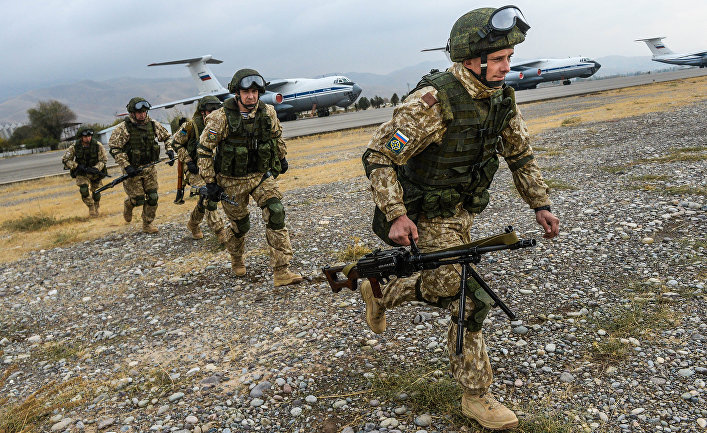
Meanwhile, preparations for the upcoming CSTO military exercises, which will take place near the Tajik-Afghan border within the next few months, are under way.
The CSTO is a regional security group comprising six countries – Armenia, Belarus, Kazakhstan, Kyrgyzstan, Russia and Tajikistan.
It was initially set up in 1992 at a meeting in Tashkent and Uzbekistan once already suspended its membership in 1999. However, Tashkent returned to the CSTO again in 2006 The regional security organization was initially formed in 1992 for a five-year period by the members of the CIS Collective Security Treaty (CST) — Armenia, Kazakhstan, Kyrgyzstan, Russia, Tajikistan, and Uzbekistan, which were joined by Azerbaijan, Georgia, and Belarus the following year. A 1994 treaty reaffirmed the desire of all participating states to abstain from the use or threat of force, and prevented signatories from joining any “other military alliances or other groups of states” directed against members states. The CST was then extended for another five-year term in April 1999, and was signed by the presidents of Armenia, Belarus, Kazakhstan, Kyrgyzstan, Russia, and Tajikistan. In October 2002, the group was renamed as the CSTO. Uzbekistan that suspended its membership in 1999 returned to the CSTO again in 2006 after it came under international criticism for its brutal crackdown of antigovernment demonstrations in the eastern city of Andijon in May 2005. On June 28, 2012, Uzbekistan announced that it has suspended its membership of the CSTO, saying the organization ignores Uzbekistan and does not consider its views. The CSTO is currently an observer organization at the United Nations General Assembly.