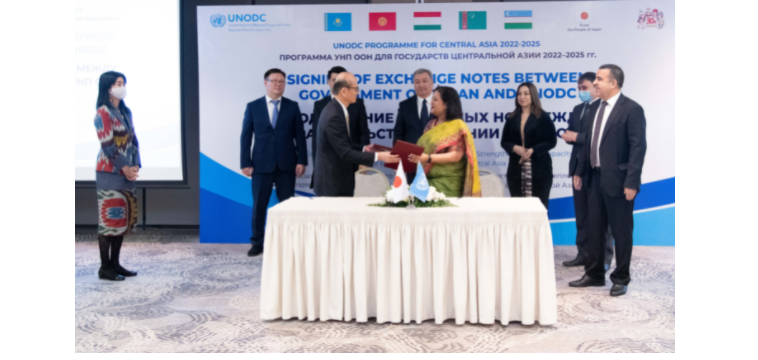
On Thursday February 17, the Government of Japan and the United Nations Office on Drugs and Crime (UNODC) signed a grant agreement for 4.1 million US dollars.
UNODC Regional Office for Central Asia says the grant will support the UNODC initiative on enhancing the capacity of border crossing points and improving regional cross-border cooperation by promoting the Border Liaison Offices’ concept and the development of information and communication networks for border agencies.
The agreement was inked by Mr. Yoshinori Fujiyama, Ambassador Extraordinary and Plenipotentiary of Japan to Uzbekistan and Ms. Ashita Mittal, UNODC Regional Representative for Central Asia. The event was reportedly attended by high-level representatives from the Government of Uzbekistan, the Ambassadors of Kazakhstan, Kyrgyzstan, Tajikistan and Turkmenistan to Uzbekistan.
“Through this new project, we expect that operations of Border Liaison Offices and border crossing points in the region to be much more strengthened, and to bring about tangible results. We are expecting officers to benefit from the provision of cutting-edge equipment, as well as capacity-building trainings. I sincerely hope they will gain knowledge and skills to serve more effectively and efficiently in combatting transborder crime,” said H.E. Mr. Yoshinori Fujiyama, Ambassador Extraordinary and Plenipotentiary of Japan to the Republic of Uzbekistan.
“I am sure that the practical implementation of this initiative will contribute to the creation of the necessary obstacles on the way of the incessant flow of drugs along the northern route which will undoubtedly have a positive impact on the sustainable development and security in the Central Asian states, as well as the countries of the West and far abroad,” said Olim Narzullaev, Director of the National Information and Analytical Center on Drug Control under the Cabinet of Ministers of the Republic of Uzbekistan.
Ms. Ashita Mittal thanked the Government of Japan and Central Asian countries for the continued and fruitful partnership with UNODC.
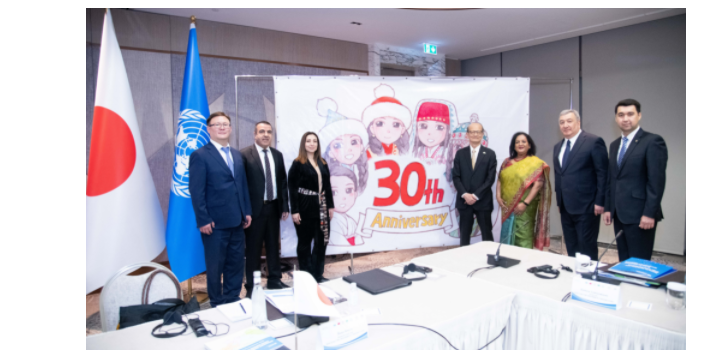
“Fostering greater cross-border and interagency cooperation is the way forward for achieving our shared vision to build a more inclusive, fairer, and healthy society, by making the region safer from the threats of drugs, crime and terrorism, for the benefit of the current and future generations. Supporting integrated border management is an integral part of the work of the UNODC Programme for Central Asia 2022-2025,” noted Ms. Ashita Mittal.
“This project aims to strengthen the capacities of international border crossing points in Central Asia, in particular of those stationed along the border with Afghanistan through the provision of technical expertise, equipment and enhancing the competencies and skills of the border officers,” said Mr. Yusuf Kurbonov, International Programme Coordinator, UNODC Regional Office for Central Asia and coordinator of the initiative.
The project will further strengthen the drug-interdiction capacities of the border law enforcement agencies of Central Asian countries. The beneficiaries of the initiative are the Ministries of Internal Affairs, Border Troops, Customs and Drug Control Agencies of each participating country.