Concerning economic prospects in Tajikistan, the Asian Development Bank (ADB)’s annual flagship economic publication, Asian Development Outlook (ADO) 2022, notes that the growth rate will depend on impact from the economic downturn in Russia and adverse external environment, that will likely force migrant workers to return home, reducing remittances and investment, disrupting trade, creating shortages of dollars in the banks, worsening fiscal and external debt positions, and raising global oil and food prices. Gains in industry and emergency assistance from development partners to support consumption should, however, keep growth positive in 2022, rising to 3.0% in 2023.
On the supply side, industry is forecast to expand by 10% in both 2022 and 2023 as efforts continue to boost electricity generation, mining, and manufacturing, the report says.
A new tax code in January 2022 reduced tax rates, created new tax incentives, and is expected to support entrepreneurship and growth. Agriculture should rise modestly by 5% each year as planted area expands.
Services are reportedly projected to contract by 20% in 2022 and a further 10% in 2023 as remittances drop by at least half in 2022.
On the demand side, public investment will remain the main growth driver, though at a slower pace, as continued weakness in the business climate suppresses private investment despite the new tax code. According to the report, private consumption will drop significantly as remittances diminish.
Inflation is projected to reach 15% in 2022, reflecting higher prices for fuel and imported food, more consumer lending, pressure on the somoni from a plummeting Russian ruble, public salaries and pensions by 20% in July 2022, higher electricity tariffs planned for November 2022, and increases for law enforcement authorities salaries up to 25% in January 2022. Inflation should decline to 10% in 2023 with moderating global food and fuel prices, but it could go still higher if currency depreciation accelerates in tandem with a depreciating ruble or if needs for budget financing from domestic sources exceed expectations, boosting money growth.
Fiscal policy will remain expansionary, with the budget deficit widening to equal 3.5% of GDP in 2022. Achieving the deficit target will require expenditure restraint and administrative reform as cuts in revenue under the 2021 tax code and falling remittances and imports cap revenue at 25.7% of GDP in 2022 and 27.2% in 2023, when the fiscal deficit is forecast to narrow to 2.5% of GDP.
Continued fiscal deficits from high investment spending could make an already heavy debt burden unsustainable while weakening Tajikistan’s external position through higher imports. Somoni depreciation threatens further debt increases in local currency terms.
Monetary policy will aim to combat inflationary pressures from currency depreciation linked to the plunge in the ruble, the currency of remittances, which equaled 20.5% of GDP in 2021. The central bank will try to contain inflation and limit currency depreciation by tightening liquidity, but tightening may be constrained by demand for budget financing. Lending to private firms may increase further with a recent decline in nonperforming loans. Given pressure from the plummeting ruble and depreciation of other trade partners’ currencies, the central bank may intervene to support the local currency.
The current account is forecast to revert to deficits, equal to 1.5% of GDP in 2022 and 2.5% in 2023, because of lower remittances, despite cuts in consumer imports by 15% in 2022 and 25% in 2023, as imports of capital goods for infrastructure projects will continue. Exports are projected to rise by 15% in 2022 despite lower gold sales and a further 10% in 2023 with higher electricity generation, including substantial exports of electricity to Afghanistan and Uzbekistan. Total imports are expected to drop by a third in 2022 as disposable income plunges, and by a further 20% in 2023 as a lagged effect of lower remittances. Remittances are projected to diminish in US dollar terms by 50% in 2022 as economic sanctions on Russia reduce employment for migrant workers, causing many to return home, and as ruble depreciation slashes the US dollar value of most remittances received. Remittances may recover by 10% in 2023 if the international situation revives the demand for migrant workers. Despite central bank purchases of domestically produced gold, foreign reserves may fall below US$2.0 billion to pay for currency interventions to support the somoni.
According to data from the Central Bank of Russia, physical entities last year sent 1.8 billion U.S. dollars through money transfer system to Tajikistan from Russia, which was 3.4 percent more than in 2020.
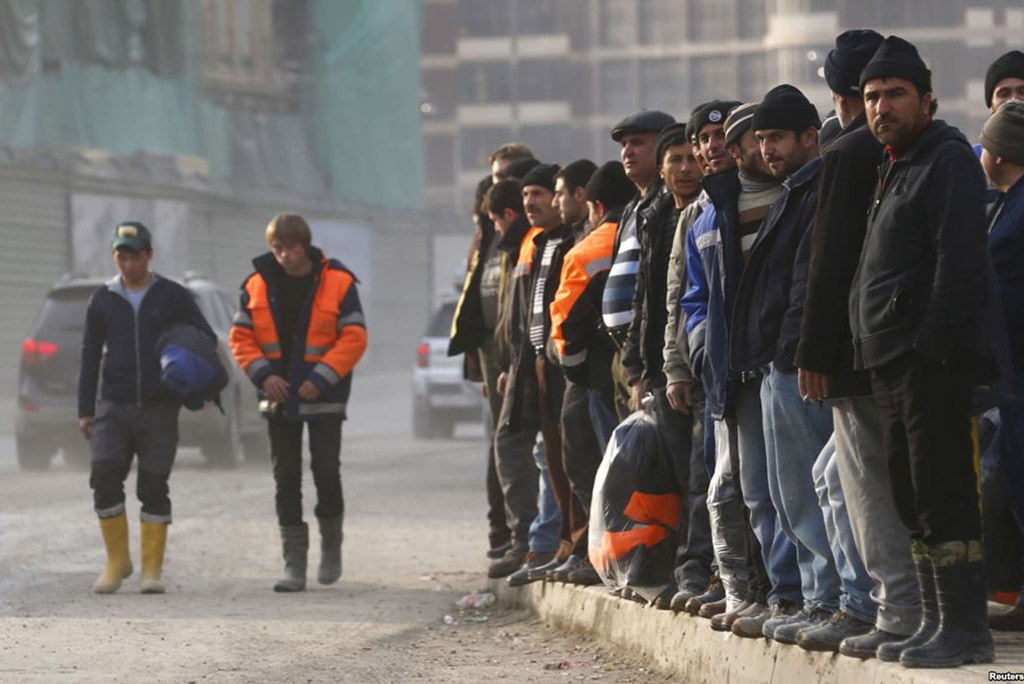
The Russian Federation is the major destination country for Tajik migrants (97.6% in 2019). Longstanding ties from the Soviet era, language commonalities, migrant networks, significant wage differentials, as well as visa-free and on-arrival visa options make the Russian Federation a popular choice.
According to figures provided by the Interior Ministry of the Russian Federation, more than 3 million Tajik citizens were officially registered in Russia last year. In 2021, 2,439,198 Tajik nationals reportedly stated “work” as their reason for entering Russia; that is about one-quarter of Tajikistan’s entire population.
The remittances to Tajikistan help the migrants’ families pay for their daily expenses and immediate needs. Migrant families use an overwhelming portion of remittances (94%) for private consumption, which is the most important component of GDP. However, remittances are rarely used for investments or to save for future contingencies.