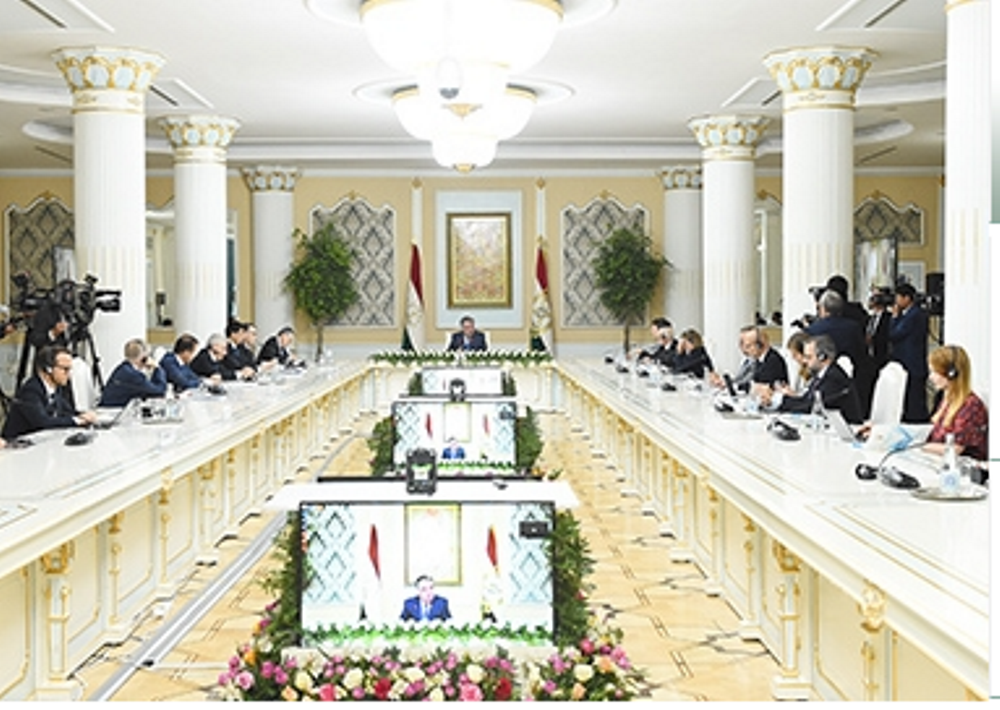
On Saturday June 4, Tajik President Emomali Rahmon took part and spoke at the Third Meeting of the Leaders of the Water and Climate Coalition that was held at the City Residence of the Government of Tajikistan.
The Tajik president’s official website says representatives of a number of countries and experts from leading international organizations participated in the meeting to address water and climate issues.
In a statement released at the meeting, Emomali Rahmon, in particular, noted that according to the analysis, despite numerous efforts, “we are far behind in achieving the Sustainable Development Goals, especially in the water sector, and new responsibilities and actions are needed to achieve these goals.”
“According to experts, the last three to five years have been the hottest for the entire period of meteorological observations in the world,” said the Tajik leader. “Obviously, the continuation of this process will have negative consequences, given the rapid increase in water demand as a result of population growth and economic development.”
Rahmon considered it necessary that the solution of this topical issue be in the center of attention of the world community.
In order to solve problems in this area, the Tajik president reiterated the initiative to declare 2025 the International Year for the Protection of Glaciers.
It was emphasized that water resources play an important role in adaptation. They are also important for reducing and achieving resistance to this process. At the same time, Rahmon drew the attention of the meeting participants to the need to develop hydropower as a producer of "green energy".
He noted that along with the production of environmentally friendly and affordable electricity, power plants will also make a significant contribution to the sustainable management of water resources, the reduction of floods and droughts, as well as the reduction of greenhouse gas emissions.
At the end of his speech, the President of the country, Emomali Rahmon, highly appreciated the role of the Coalition Leaders in promoting a comprehensive agenda on water and climate issues, and expressed confidence that the Leaders' Action Plan would make a worthy contribution to this process.
The Water and Climate Coalition is a multi-stakeholder initiative under the SDG 6 Accelerator framework: providing tangible action, activities, and policy support, for integrated water and climate agenda; focusing on data, information, monitoring systems, and operational capacity; and ensuring the focus on action by being a non-bureaucratic coalition.
The main objectives of the Coalition are to provide: a platform for its Members to partner on joint activities and implement solutions that address the gaps of operational water and climate challenges with a focus on data and information; and guidance for high-level policy development through its panel of Water and Climate Leaders.
Its partners include the World Health Organization (UN), United Nations Environment Programme (UN), United Nations Development Programme (UN), United Nations Economic Commission for Europe (UN), Food and Agriculture Organization (UN), United Nations Educational, Scientific and Cultural Organization (UN), United Nations University (UN), United Nations Children’s Emergency Fund (UN), International Fund For Agricultural Development (UN), Global Water Partnership (Intergovernmental organization).