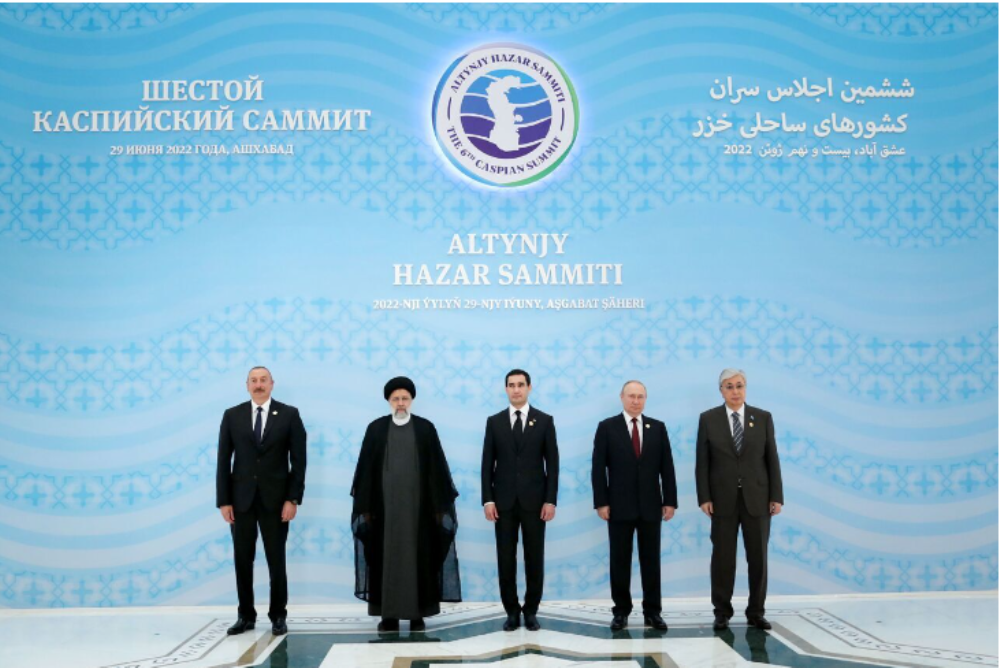
The presidents of Azerbaijan, Iran, Kazakhstan, Russia, and Turkmenistan discussed topical issues of cooperation in the Caspian Sea in relation to various spheres, as well as the implementation of resolutions made during the previous meetings of the heads of the Caspian “five”.
Media reports say the meeting began in a restricted format and then continued in an expanded format.
The summit participants reportedly positively assessed the current level of cooperation and noted that their countries are ready to maintain security and stability in the region.
They agreed to expand economic ties as well as cooperate in jointly providing environmental safety and expanding scientific and cultural cooperation.
The leaders agreed to use the resources of the region for peaceful purposes.
Speaking at the meeting, Kazakh President Kassym-Jomart Tokayev, in particular proposed to set up a food hub that would help increase mutual trade with minimal costs.”
“The strengthening of food security in the region is becoming particularly relevant. Last year, the volume of mutual food trade between Kazakhstan and the other Caspian littoral states stood at US$3.4 billion, around 70% of which were with Russia via the land route […]. In order to enhance trade cooperation between our states, we will have to consistently develop a modern logistics infrastructure. Therefore, we propose creating a Caspian food hub, which will help increase mutual trade with minimum expenses," Tokayev was cited as saying by Interfax.
Kazakhstan has begun building state-of-the-art wholesale distribution centers with a high technology system of food product warehouses and storage and distribution facilities, Tokayev said.
"The systemic integration of these centers with the Caspian food hub could open up new opportunities for effective cooperation between farmers, buyers, shipping companies, vendors, and consumers, and, most importantly, could ensure reliable guarantees of the sale of all delivered products," the Kazakh president said.
Iranian media reports say several bilateral talks were reportedly held by the leaders on the sidelines of the Caspian Summit.
The summit ended with adoption of a communique.
"Use of the Caspian Sea for peaceful purposes, it should be the zone of peace, good neighborhood, friendship and cooperation, all arising issues related to the Caspian Sea will be addressed peacefully," the communique reads, according to Iran Press.
The next Caspian summit will be held in Iran.
The five Caspian littoral states are Azerbaijan, Iran, Kazakhstan, Russia and Turkmenistan.
Recall, Russian President Vladimir Putin flew to Ashgabat from Dushanbe on June 29. On June 28, he held face-to-face talks with Tajik President Emomali Rahmon. The official agenda for Putin’s June 28 working visit sounded mostly unexceptional.
The Kremlin said in a pre-trip statement that talks with Tajik President Emomali Rahmon would dwell on the strategic alliance between Moscow and Dushanbe and on the situation in Afghanistan. No details were provided. Yury Ushakov, an advisor to Putin on foreign affairs, said that Russia would again try to make the case for Tajikistan joining the Eurasia Economic Union (EAEU).
Radio Liberty’s Tajik Service, known locally as Radio Ozodi, speculated that some other, more delicate, topics might be discussed.
Eurasianet says these hypothetical agenda items included the “internal situation” in Tajikistan, possible assistance Dushanbe could offer Moscow in avoiding the full impact of Western sanctions, the need for Rahmon to come to terms with Taliban rule in neighboring Afghanistan, and the fraught question of the succession process.