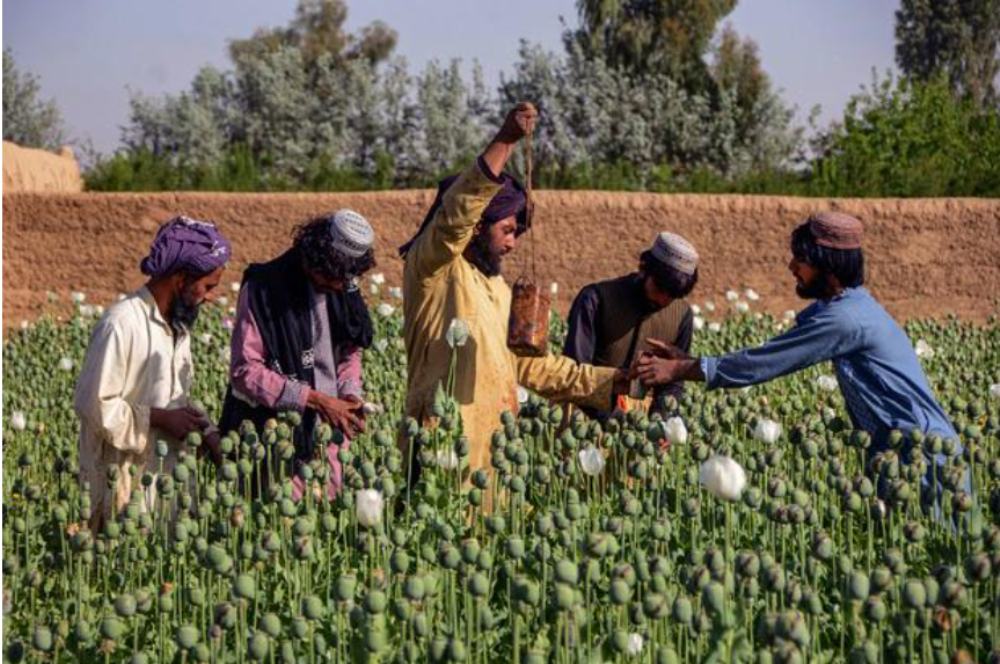
Opium cultivation in Afghanistan jumped 32% during 2022 despite the ruling Taliban regime's ban on narcotics, says an annual report released by the United Nations Office on Drugs and Crime (UNODC) on November 1.
“The 2022 opium crop in Afghanistan is the most profitable in years, with cultivation up by one-third and prices soaring even as the country is gripped by cascading humanitarian and economic crises,” the report says.
The area under opium poppy cultivation in 2022 was estimated at 233,000 hectares, a 32 percent or 56,000 hectares increase from 2021, making this year the third largest cultivation year since 1994, when UNODC monitoring first began. Only 2017 and 2018 saw more Afghan soil used to cultivate opium poppies, according to the report.
“Cultivation continued to be concentrated in the south-western parts of the country, which accounted for 73 percent of the total area and saw the largest crop increase,” the UN report said, noting that an estimated 80% of the world's total opium crop comes from Afghanistan.
The report says the 2022 increase in cultivation was offset by a decrease in opium yield per hectare due to drought conditions in the country. Opium yields declined from an average of 38.5kg/ha in 2021, to an estimated 26.7 kg/ha in 2022.
Estimated opium production in 2022 was 6,200 tons or 10 percent less than in 2021. In absence of a field based survey, UNODC used information retrieved from satellite imagery to estimate yields, which increased the uncertainty around the yield estimates.
According to the report, the opiate trafficking from Afghanistan has been ongoing without interruption since August 2021.
Meanwhile, the Taliban regime rejected the report’s findings, telling CBS News it was part of a "politically motivated" international pressure campaign.
"I reject the claim," Suhail Shaheen, the head of the Taliban's political office in Doha, Qatar and a designated ambassador to the United Nations, told CBS News. "There is total ban on poppy cultivation in Afghanistan. Those who are making such baseless claims while sitting behind their desks 20,000 kilometers from Afghanistan should know they are being used as an instrument of pressure against IEA [Islamic Emirate of Afghanistan] and their report reflects a plethora of politically motivated claims."
However, Afghanistan reportedly remained the leading producer of the lucrative drug even during the U.S.-led invasion, despite its own government and partnering nations spending millions of dollars in a bid to eradicate the crop.
Southern Afghanistan, the birthplace of the Taliban where thousands of U.S. troops were based during the two-decade war with the Islamic extremist group, has been seen as the hub of opium cultivation since 2001.