The so-called “special military operation” launched by Russia in Ukraine in February heightened the risks of the use of nuclear weapons in the war, says an article entitled “Does Central Asia Support Nuclear Disarmament?” that was posted on CABAR.asia’s website on November 28.
President Putin has repeatedly resorted to atomic blackmail, threatening any countries who would dare to intervene in the war in Ukraine. He had also conducted sham referenda to annex occupied territories, while hinting at an atomic retaliation if those newly incorporated regions were “attacked.” Andrey Baklitsky, the UN expert on nukes, has claimed that it can be considered as meeting the nuclear use condition under vague Russian interpretation. As of 2022, the risk of nuclear war is at an all-time high since the Cuban Missile Crisis of 1962.
Therefore, the relevance of the Treaty on the Prohibition of Nuclear Weapons (TPNW) is at its peak. Entered into force in January 2021, it is the only Treaty that has finally achieved the prohibition of nuclear weapons and strives for complete and irreversible disarmament.
The latest Stockholm International Peace Research Institute (SIPRI) annual report concludes that nuclear disarmament might be over, as all nine nuclear powers are said to be enhancing or increasing their arsenals.
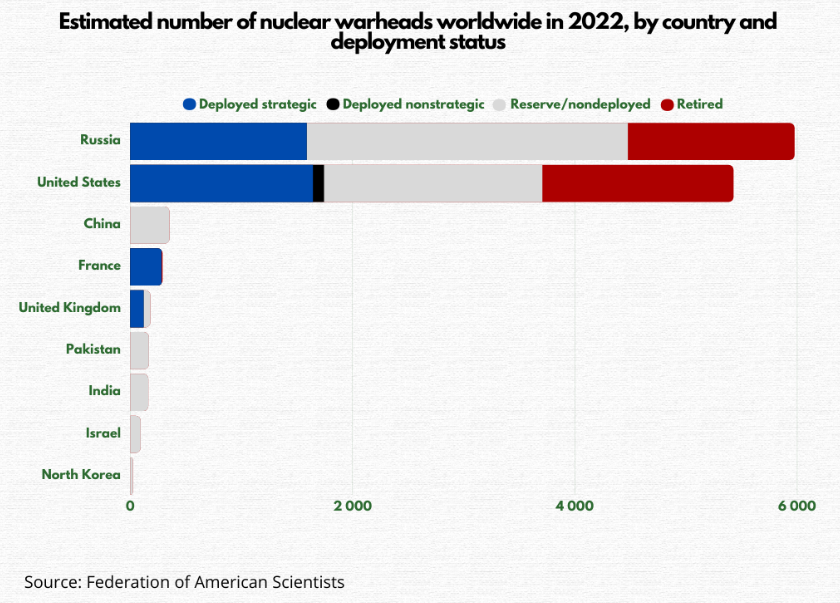
According to the document, the Russian Federation, with 5,977 warheads, and the US, with 5,428, still possess about 90 percent of all nuclear warheads in the world, and SIPRI expects a further increase in the coming decade. Non-NPT states, such as Pakistan, also continue expanding their nuclear stockpile.
The author notes that Central Asia’s nations have a different perception of nuclear disarmament; on the one hand, one nation in the region has experienced the devastating humanitarian impact of those weapons, and on the other hand, no atmospheric atomic tests were conducted in other Central Asian counties. Therefore, public discussion on nuclear disarmament is not common in those nations.
Thus, Kazakhstan’s nuclear legacy is synonymous with the environmental and societal scars from forty years of nuclear tests in the infamous Semipalatinsk Polygon, the home of the Soviet nuclear program, where 456 nuclear tests had been conducted. This testing ground was finally closed in August 1991. However, public opinion remained strongly anti-nuclear, which might have guided Kazakhstan’s decision to voluntarily dismantle more than 1400 atomic warheads and join the Treaty on the Non-Proliferation of Nuclear Weapons (NPT).
Central Asia is already one of the few regions of the world that had agreed to never “research, develop, manufacture, stockpile, acquire, possess or have any control over any nuclear weapon” and established a Central Asian Nuclear Weapon Free Zone (CANWFZ) in 2006, commonly known as the Treaty of Semipalatinsk, founding one of the five nuclear-weapon-free zones (NWFZ) in the world.
That unfortunate development is peculiar since the TPNW mostly repeats the language of the CANWFZ regarding prohibitions. Albeit, the Treaty only goes a step further in nuclear disarmament. Thus, the divergence is apparent, as one of the Central Asian countries has entirely accepted the TPNW and promotes it internationally. At the same time, four others have refrained from it, although they have previously acted together to establish a nuclear-weapon-free zone in their region.
All five Central Asian countries had voted approvingly for the “humanitarian pledge” resolutions at the UNGA both in 2015 and 2016, which had urged “all States to identify and pursue effective measures to fill the legal gap for the prohibition and elimination of nuclear weapons.” To pursue those goals, another resolution was passed that settled to convene a UN conference to negotiate a legally binding instrument to prohibit and eliminate nuclear weapons. However, by that time, unanimity within Central Asia had started to fracture as only Kazakhstan and Tajikistan had voted in favor of this resolution. Nevertheless, even Tajikistan had not formally participated in the negotiation for TPNW and did not vote on the Treaty, joining three other reluctant states of the region.