President Emomali Rahmon has invited leaders of the Eurasian Economic Union (EAEU) member nations to jointly develop Tajikistan’s hydropower capacity.
The meeting of the Supreme Eurasian Economic Council took place in an expanded format at the Grand Kremlin Palace in Moscow on May 25.
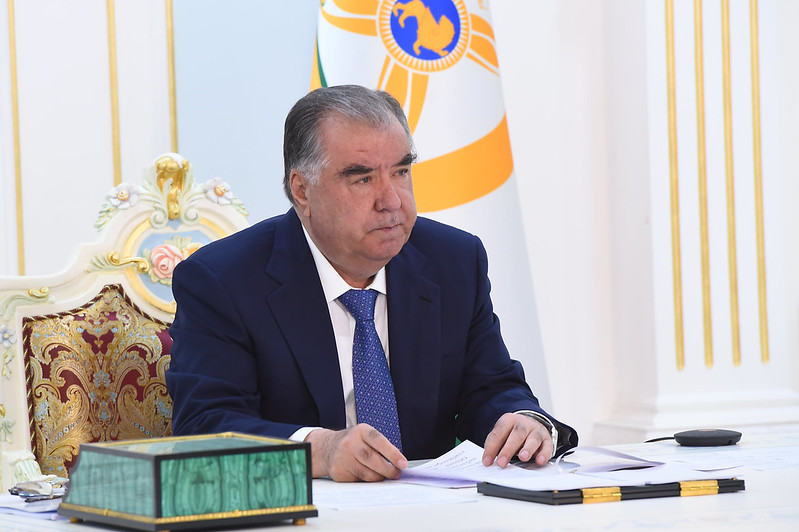
The Tajik president’s official website says Emomali Rahmon participated in the forum as an invited guest in online mode.
Speaking at the forum, Tajik leader noted that Tajik is ready to further increase exports of its goods to the EAEU member countries.
Rahmon reportedly outlined sectors like mining (non-ferrous, rare and precious metals), industry (textile and cotton processing), and agriculture (vegetables and fruits), as areas which could drive the bilateral trade between Tajikistan and the EAEU member countries. He especially invited EAEU’s investments in hydropower.
“EAEU member nations are traditional trading partners of Tajikistan. We are interested in consistently expanding bilateral cooperation with your countries in all areas being of mutual interest,” Rahmon said, noting that EAUE member nations’ share in Tajikistan’s external trade last year amounted to more than 42 percent.
Speaking about problems, Tajik leader reportedly underlined barriers existing in the transportation area.
“This is, first of all, the limited capacity of border crossings between our countries. Besides, there is a need for new road and rail communications, including rolling stock, to carry out transportation in conditions of imbalance in the volume of cargo traffic,” Rahmon noted.
He also noted the agrarian sector as an important component of cooperation with the EAAEU member countries.
“The annual growth of the gross output of our country’s agrarian sector is at least seven to eight percent. This creates the necessary basis for increasing the export of the organic agricultural products to the EAEU member nations,” said Rahmon. “However, the difficulties existing in the issues of registration procedures, transportation and customs clearance and double certification are serious obstacles in the way of the uninterrupted supply of these products to markets of the EAEU member countries.”
“In this regard, we consider it necessary to jointly work out and implement mechanisms to simplify the process of the supply of agricultural products from Tajikistan to the EAEU member nations, including through the creation of logistics centers in our countries,” Emomali Rahmon emphasized.
He also noted that joint development of Tajikistan’s hydropower capacity and cooperation in development digitalization and artificial intelligence (AI), banking sector and financial markets and in the field of industry and cooperative system are of mutual benefit.
The Supreme Eurasian Economic Council is the highest supranational body of the Eurasian Economic Union (EAEU). The Supreme Eurasian Economic Council, which consists of the Heads of State or Government of the EAEU Member Nations, meets at least once a year. Decisions are taken by consensus. The decisions are binding on all parties. The Board determines the composition and powers of other regulatory agencies.