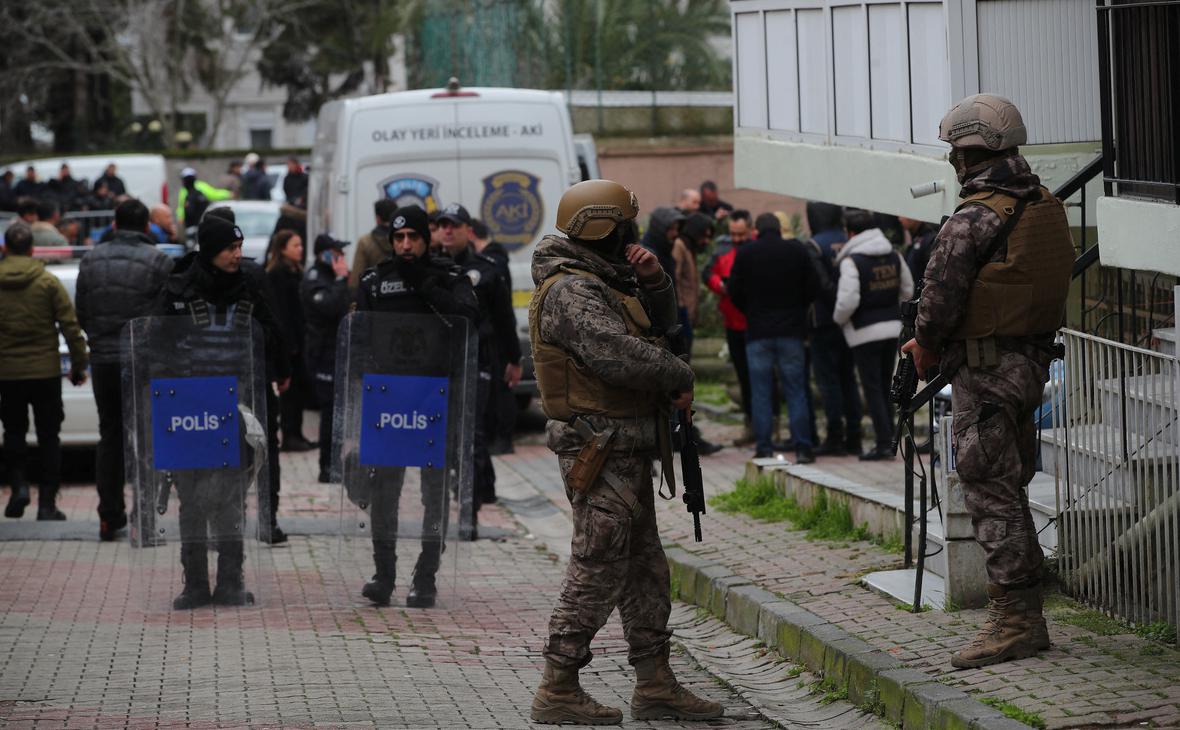
Citing Turkiye’s Yeni Safak newspaper, Russia’s state-run news agency TASS reported on January31 that militants from the so-called Tajik "Vilayat Khorasan" cell of the Islamic State (IS) terrorist group carried out a shooting attack in a Catholic church in Istanbul on January 28.
According to Yeni Safak newspaper, citing Istanbul police, those arrested in the attack are Tajik citizens, except for three Turkish nationals.
Earlier, it was reported that a Russian and a Tajik national who opened fire were arrested a few hours after the incident at the Italian Church.
Investigators were cited as saying that IS terrorist group used so-called sleeper cells to carry out the violence. The attackers received orders to carry out the armed assault via social networks controlled by the terrorist group.
Police reportedly seized digital media confirming IS involvement in the temple shooting, and a car without number plates was found in a forest in the Gokturk district near Istanbul's international airport. One of the pistols used in the shooting was also found dismantled, having been converted from a gas pistol to a combat pistol.
Citing Yeni Safak, TASS reports that according to the security services, those involved in the attack had rented a house in the Guvercintepe district of Istanbul three months ago. Tajik nationals who were detained after the attack reportedly also live there illegally.
According to Yeni Safak, some of the 28 suspects detained by the Istanbul Security Directorate were planning New Year's Day attacks on Istanbul's Orthodox churches, a synagogue and the Iraqi embassy. Local police reportedly foiled the attacks on December 29 by arresting 32 people.
Recall, the shooting happened at the Church of Santa Maria during last Sunday mass at around 11:40 local time.
Turkey's Interior Minister Ali Yerlikaya said later on X, formerly Twitter that two gunmen who shot one person dead on Sunday during a service at a church in Istanbul and who are believed to be tied to Islamic State (IS) terror group.
BBC’s Russian Service cited Yerlikaya as saying that both suspects are citizens of other nations; one of them is reportedly from Tajikistan and another one is Russian.
Shortly before, the IS terror group had reportedly claimed responsibility for the attack in a statement on Telegram, saying it was in response to a call by the group's leaders to target Jews and Christians.
France 24 reported that local officials said around 40 people attended the mass, and suggested that there could have been more casualties.
Media outlets note that attacks like this on Turkiye's Christian minority are rare.
It is to be noted that the Islamic State-Khorasan (IS-K) extremist organization is a regional branch of the IS terrorist group active in South and Central Asia, primarily in Afghanistan. IS-K has been active in Afghanistan and its area of operations includes Pakistan, Tajikistan and India where they claimed attacks, as well as Sri Lanka, the Maldives, Bangladesh and China where individuals have pledged allegiance to it. The IS-K and Taliban consider each other enemies.
The group was created in January 2015 by disaffected Taliban in eastern Afghanistan, although its membership includes individuals from various countries notably Pakistan, Bangladesh, India and Myanmar. Its initial leaders, Hafiz Saeed Khan and Abdul Rauf Aliza, were killed by US forces in July 2016 and February 2015, respectively. Subsequent leaders have also been killed; its leader Abdullah Orokzai was captured in April 2020 by Afghanistan's intelligence service.
Turkish Anadolu Agency (AA), citing Turkish security sources, reported on June 22, 2022 that police in Istanbul detained Tajik citizen Shamil Hukumatov on suspicion of being one of leaders of the IS-K extremist organization.
According to media reports, IS-K head Sanaullah Ghaffari, also known as Shahab al-Muhajir, was killed in the northwestern Kunar province of Afghanistan in the first week of June of 2022. According to AA, he was responsible for a number of deadly attacks in Afghanistan, including a suicide bombing at Kabul Airport in August 2021 that killed over 180 people.
The threat from IS-K and Afghanistan-based Tajik militants has led official Dushanbe to try to consolidate its security ties with powerful neighbors.