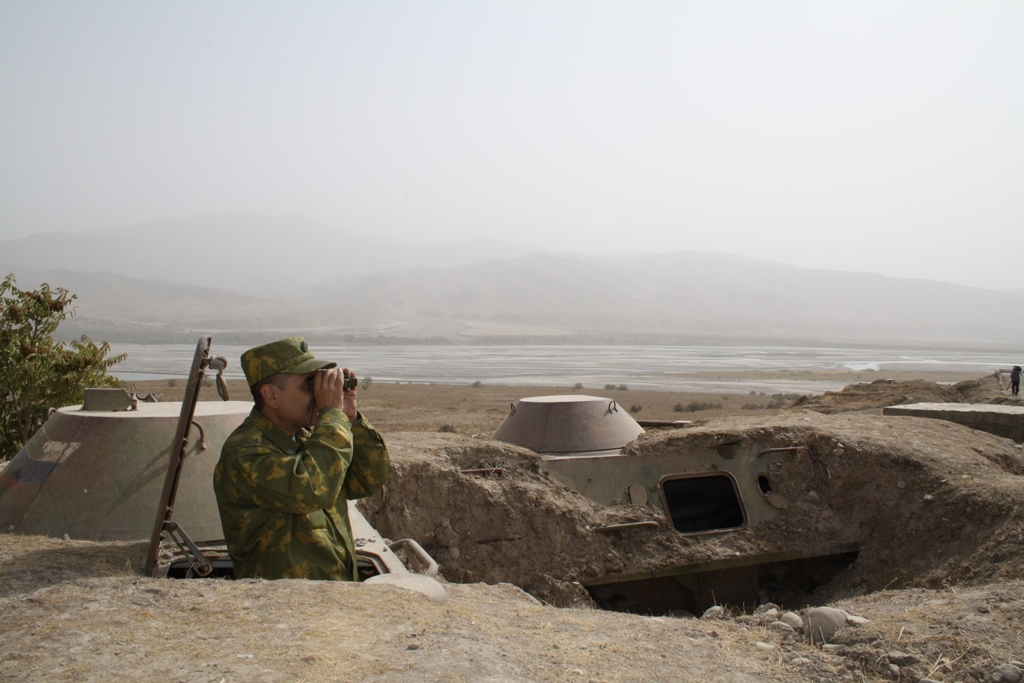
The Collective Security Treaty Organization (CSTO) has promised to approve this month a Targeted Program to strengthen the Tajik-Afghan border, a proposal first introduced in 2013. Experts suggest that the program's goals are deliberately vague, indicating they may either be symbolic or allow for future changes.
An old project with new, uncertain objectives?
CSTO Secretary General Imangali Tasmagambetov announced the adoption of this program ahead of the Collective Security Council meeting, scheduled for November 28 in Kazakhstan’s capital, Astana. According to Tasmagambetov, the program has already been agreed upon by the CSTO councils of foreign affairs, defense ministries, and security council secretaries, although the decision to create this program was made eleven years ago.
“It has been possible for the Secretariat to reach a consensus,” Tasmagambetov said, as quoted by Eadaily.
However, the nature of this consensus remains unclear, and details about the program are sparse.
The CSTO Parliamentary Assembly website just notes that the program is set for five years and will be implemented in three stages. In the first stage, lasting one year, Tajikistan is to submit proposals for reinforcing specific border sections. During this time, member states are expected to identify the material and other resources they can provide to support Tajikistan’s border security. This would be followed by stages two and three, during which specific measures for border security will be developed and implemented.
Despite high-level statements, concrete actions under the program are only in the initial planning stages.
The Ministry of Foreign Affairs of Tajikistan has confirmed this conclusions, emphasizing that implementation of the Targeted Program does not involve the deployment of CSTO border troops along the Tajik-Afghan border.
A decision that the CSTO will develop an interstate program to help Tajikistan strengthen control of its common border with Afghanistan was made at a meeting of the CSTO heads of state that took place in Sochi, Russia on September 23. A joint plan to protect Tajikistan’s border with Afghanistan was among major topics of the meeting.
In 2017, the CSTO promised once again to assist Tajikistan with reinforcing its common border with Afghanistan. The then Secretary-General of the CSTO, Valery Semerikov, discussed this issues during phone talks with the then Secretary of Tajikistan’s Security Council Abdurahim Qahhorov on February 9, 2017.
According to the SCTO official website, Semerikov noted that a group of specialists from the CSTO Secretariat would arrive in Dushanbe “to work through the target program for reinforcement of Tajikistan’s national border with Afghanistan.”
However, the Russia-led bloc has not rendered any serious assistance to Tajik border guards over the past eleven years.
Is the threat real?
News of the program’s approval came amidst reports that militants from Jamaat Ansarullah and Uighur jihadist groups in Afghanistan are planning an incursion into Tajikistan. This information was shared by Russian Afghanistan expert Andrey Serenko, citing sources in Dushanbe and Afghanistan.
“Until recently, several hundred foreign militants, primarily from Tajikistan and China’s Xinjiang Uighur Autonomous Region, were stationed in Afghanistan’s Baghlan province. Recently, however, they have begun moving to Afghanistan’s Badakhshan province, where weapons and ammunition are also being actively delivered. The militant commanders have reportedly grown tired of inactivity and are now seriously planning an invasion of neighboring Tajikistan,” Serenko reported.
According to these sources, the radical group consists of 300 to 500 fighters, but could potentially receive significant reinforcements.
An attack on Tajikistan by foreign terrorists would pose a serious threat not only to Dushanbe but also to Moscow, as it could open a “second, southern anti-Russian front,” complementing the existing western front in Ukraine.
Tajik journalist and political analyst Nouriddin Davlatov believes this threat is real, given that the ranks of extremists are increasingly being filled by Tajik citizens.