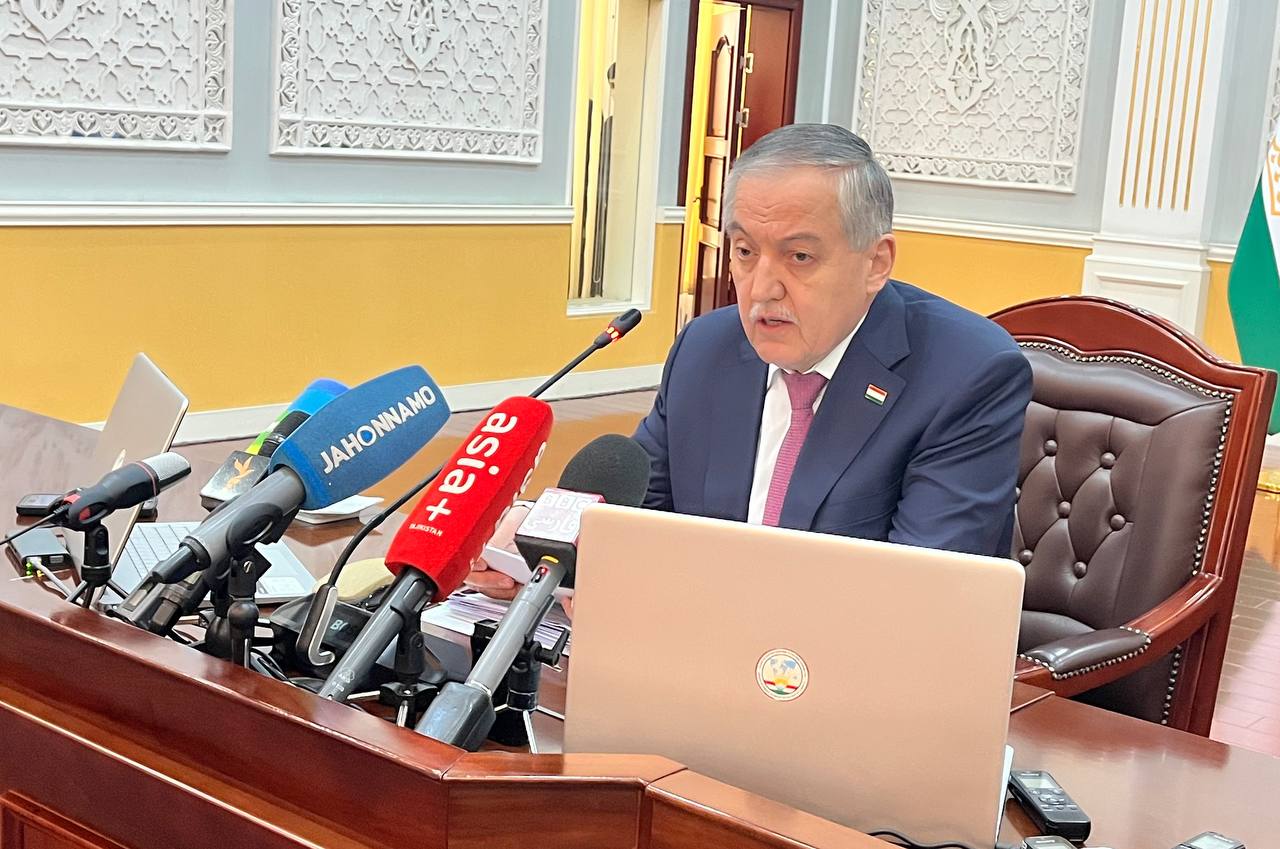
Although the state border between Tajikistan and Kyrgyzstan has been fully delineated, two pressing issues—the road and water facilities, which have previously been sources of conflict—remain under discussion, Tajikistan's Minister of Foreign Affairs, Sirojiddin Muhriddin, stated at a news conference in Dushanbe on February 11.
In response to a question from an Asia-Plus journalist, he noted that the intergovernmental working groups have not yet completed their work.
“The border issue has been resolved; only its official documentation remains. The working groups meet almost every week—either here (in Tajikistan) or in Kyrgyzstan. As far as we know, two or three important issues still need to be settled,” the top Tajik diplomat said.
According to him, among these “two or three important issues” are the construction of a direct road between Vorukh, an exclave some 20 kilometers inside Kyrgyzstan, and the city of Isfara in the Tajik northern province of Sughd, several water facilities, the discussion of which is ongoing, though the corresponding protocol has not yet been signed.
"In addition to the border agreement, two more intergovernmental treaties—on the road and water facilities—are planned to be signed," Sirojiddin Muhriddin stated.
He did not specify when exactly these documents would be signed, emphasizing that they must first be prepared and agreed upon.
The Vorukh–Isfara road and the dispute surrounding it
Currently, there is no direct road between Isfara and Vorukh, forcing local residents to cross Kyrgyz territory to travel between these two settlements.
Although this route and the Aksay area have historically belonged to Tajikistan, the neighboring side has considered them part of its territory since gaining independence.
The road to Vorukh has been a key issue in border conflicts between Tajikistan and Kyrgyzstan. Several times, it has been blocked by residents of Kyrgyz border areas, leading to clashes.
Additionally, during other border disputes and confrontations, this route was also blocked, cutting people off from major roads.
Water facilities—a key cause of conflicts
Although Sirojiddin Muhriddin did not specify which “water facilities” are under discussion, it is assumed that they include the “Golovnaya” water distribution facility, the “Dousti” canal (referred to as “Tortkul” in Kyrgyzstan), and several other irrigation structures.
Water distribution has been one of the main causes of conflict, particularly during the September 2022 clashes.
Previously, these two issues—the road and water facilities—were discussed by the heads of the national security committees of Tajikistan and Kyrgyzstan, Saimumin Yatimov and Kamchybek Tashiyev.
They lead the governmental delegations from both countries on the delimitation and demarcation of the state border.
During a December 4, 2023 meeting, the two sides reached a "fundamental agreement" on these key issues.
Following the deadly conflicts in April 2021 and September 2022, both sides have made significant efforts to resolve disputes through negotiations, with dozens of intergovernmental meetings held between Tajikistan and Kyrgyzstan.
Ultimately, on December 4, 2024, the border line between the two countries was fully determined.
It is worth noting that the total length of the Tajikistan-Kyrgyzstan border is approximately 980 kilometers.
Border negotiations have been ongoing since December 2002, but unresolved territorial disputes have repeatedly led to conflicts between local residents and military forces on both sides, including incidents involving firearms.