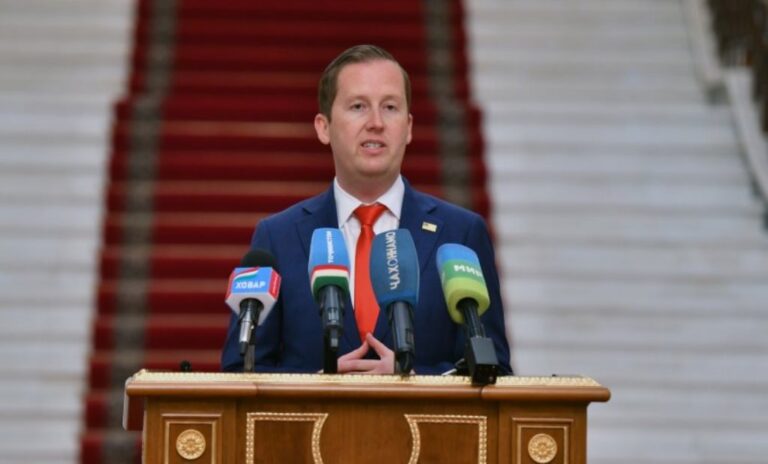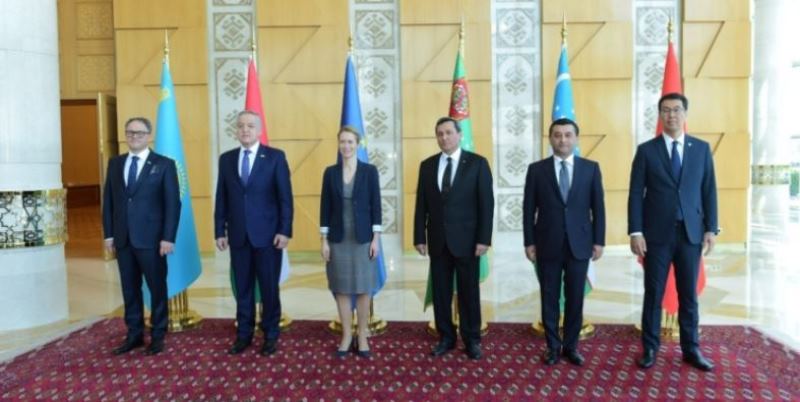
On March 27, 2025, the Foreign Ministers of Tajikistan, Turkmenistan, Uzbekistan, the Deputy Foreign Ministers of Kazakhstan and Kyrgyzstan, as well as the European Union’s High Representative for Foreign Affairs and Security Policy (‘The Participants’) held their 20th European Union-Central Asia Ministerial meeting in Ashgabat.
The adopted Joint Communiqué of the 20th Ministerial Meeting "Central Asia – European Union", in particular, notes that the Participants reiterated their commitment to work together for peace, security, promotion of fundamental rights and sustainable development.
They noted the significance of the UN General Assembly Resolution proclaiming March 5 as the International Day for Disarmament and Non-Proliferation Awareness and emphasized the need to strengthen global efforts in promoting peace, security, and international stability.
The Participants reiterated their commitment to strengthening the multilateral trading system and working towards the necessary reforms of the World Trade Organization (WTO), including having a fully and well-functioning dispute settlement system. The EU reaffirmed its support for Uzbekistan’s and Turkmenistan’s accession to the WTO. The Participants noted the role of the EU Generalized Scheme of Preferences (GSP) for Tajikistan and EU GSP Special Incentive Arrangement for Sustainable Development (GSP+) for Kyrgyzstan and Uzbekistan to increase access to the EU market and reinforce the link between international trade and respect of human rights including labor rights, environmental protection and good governance.
The Participants stressed the need to continue scaling up cooperation under the EU’s Global Gateway Strategy on sustainable connectivity between the EU and Central Asia in the areas of trade, transport, water, energy, climate change, digitalization and critical raw materials, as well as people-to-people contacts, including in education, research and sustainable tourism.
The Participants welcomed the increasing importance given to critical raw materials (CRMs) in EU-Central Asia relations, following the signature of Memoranda of Understanding establishing Strategic Partnerships in the field of CRMs between the EU and Kazakhstan as well as between the EU and Uzbekistan. They acknowledged the EU’s support in strengthening local value chains in Central Asia, aligning with European and international standards for decent work and environmental protection, and fostering sustainable investment projects.
The Participants reiterated the importance of advancing the rule of law, democracy, good governance and accountability, gender equality and universal human rights, including labor rights and fundamental freedoms.
The Participants also welcomed the commitment of the international community for the remediation of uranium legacy sites at seven uranium tailings sites in three Central Asian countries, acknowledged the progress made in Kyrgyzstan and Uzbekistan, and agreed to jointly seek donor funding for the remaining part of the program in Tajikistan.
The Participants called for continued regional cooperation on water issues when climate change is putting additional strain on water resources in Central Asia.