U.S. President Donald Trump’s decision to introduce so-called “retaliatory” tariffs on imports has sparked global criticism. Both Europe and Asia are speaking out about the negative consequences of Washington’s declared trade war and their readiness to respond, BBC’s Russian Service says, noting that for some U.S. allies, the introduction of new duties came as a surprise.
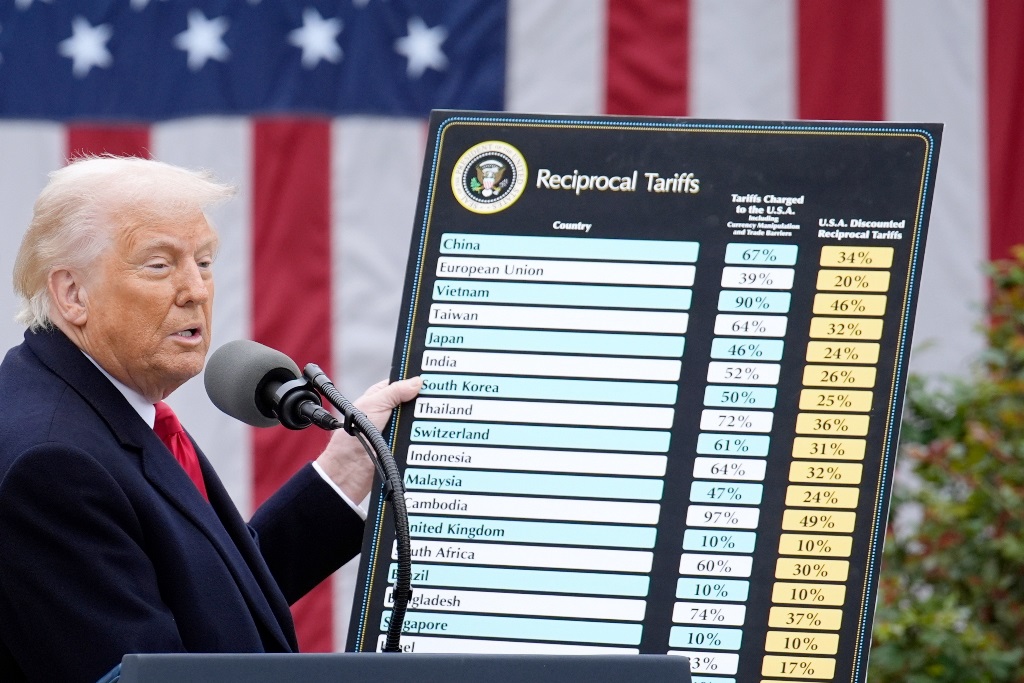
According to Trump’s order, the new tariffs will apply to all countries worldwide. The base, or minimum, customs duty on imports into the U.S. will be 10%.
Some countries face significantly higher tariffs: 34% against China, 20% against the EU, 24% against Japan, and 26% against India.
French President Emmanuel Macron called Trump’s decision “cruel and unjustified,” stating that it will seriously impact the European economy.
He met at the Élysée Palace with representatives of economic sectors most affected by the tariffs—particularly the wine industry—and promised them state support. Many of these sectors had already suffered from Chinese tariff hikes.
“Out of the €500 billion worth of goods that Europeans export to the United States, it seems that more than 70% will be affected by the tariffs. But this still needs to be confirmed,” Macron said.
He emphasized that EU countries must act as a united front to protect themselves. Macron noted that the EU’s strength lies in its market of 450 million consumers—larger than the U.S. market.
The French President also urged a suspension of French investments in the U.S. until the next steps in this new environment are developed.
Other global reactions
European Commission President Ursula von der Leyen said the U.S. president’s decision “is a serious blow to the global economy.” “The consequences will be devastating for millions of people around the world,” she said at the EU–Central Asia summit in Samarkand.
Von der Leyen warned that Europe would take countermeasures if the U.S. refused to negotiate. “We are finalizing our first package of retaliatory measures in response to the steel tariffs. And now we are preparing further countermeasures to protect our interests and our businesses if negotiations fail,” she said.
Ireland’s Deputy Prime Minister Simon Harris said the EU “must remain calm and measured in its response,” adding that “the EU and Ireland are ready to find a solution through negotiations with the U.S.”
Italian Prime Minister Giorgia Meloni—the only European leader who attended Trump’s inauguration in January—called the tariff decision “wrong” and pledged to “do everything possible to reach an agreement with the U.S. and avoid a trade war.”
“We don’t want increased trade barriers. We don’t want a trade war. That will only make our people poorer and the world more dangerous in the long term,” warned Swedish Prime Minister Ulf Kristersson.
China’s Ministry of Commerce issued a statement condemning the American president’s move and threatened countermeasures to defend its rights and interests.
“There are no winners in trade and tariff wars, and protectionism is not the answer,” the statement read. “The U.S. should correct its misguided actions and resolve trade disputes with all countries, including China, through consultations based on equality, mutual respect, and mutual benefit.”
Japanese Prime Minister Shigeru Ishiba said Tokyo was “deeply disappointed” not to have been exempted from the new tariffs, which would “negatively affect bilateral economic ties, the global economy, and the multilateral trade system.” Ishiba promised that he would personally ask President Trump to reconsider the measures if given the opportunity.
“Friends don’t act this way,” said Australian Prime Minister Anthony Albanese, describing the tariffs. “The Trump administration’s tariffs are illogical and go against the foundation of our partnership,” he added.
Canadian Prime Minister Mark Carney stated that Canada “will fight these tariffs with countermeasures” and will act “decisively and forcefully.”
Israel, which recently eliminated all customs duties on imports of American goods, was “shocked” by Washington’s imposition of 17% tariffs, according to local media. “We were confident that lifting all duties on U.S. imports would prevent this move,” an Israeli official was quoted as saying.
What about Russia?
Russia was not mentioned in Trump’s tariff decree or in the additional materials published by the White House regarding import duties.
White House Press Secretary Karoline Leavitt told Axios that this is because existing anti-Russian sanctions already “exclude the possibility of any significant trade.” Cuba, Belarus, and North Korea also escaped Trump’s new tariffs, as these countries are already subject to strict U.S. sanctions, she added.
However, Axios notes that the U.S. trades more with Russia than with countries like Mauritius or Brunei, which were hit by the new tariffs.
Sources from the White House, including an anonymous official cited by The New York Times and U.S. Treasury Secretary Scott Bessent in a Fox News interview, confirmed that Russia was excluded from the new duties due to the existing sanctions.