This question was answered by Tajik scientists, led by Professor Yarash Pulatov from the Institute of Water Problems, Hydropower, and Ecology of the National Academy of Sciences of Tajikistan. Over the course of more than 25 years, these scientists conducted research on water-saving technologies. They presented over 20 methods of water conservation specifically designed for Tajikistan's agricultural sector.
If farmers implement these techniques, they could achieve maximum profits through increased crop yields while also conserving water and fertilizers. However, investing in these technologies requires funding starting from $5,000, with a payback period of at least 6 years or more.
Why conserve irrigation water?
Given the limited water resources in Central Asia (the average annual surface runoff of rivers is 115.6 km³), water deficits are growing annually with increasing demands. This situation requires a fundamental change in how water is viewed—as the foundation of life and a key factor in peace, stability, and development for the countries surrounding the Aral Sea and Central Asia as a whole.
An analysis of water resource usage by sector and across all categories of water users revealed that over 90% of the region's water resources are used for irrigated agriculture, which accounts for up to 30% of GDP and employs over 60% of the population.
In Tajikistan, flatlands make up only 7% of the country's area, and it has the lowest ratio of irrigated land per capita in the Aral Sea basin—only 0.08 hectares per person. By 2030, this figure is expected to decrease to 0.06 hectares. This will affect the country’s food security. Of the 762,000 hectares of irrigated land, 20% experience water shortages. Around 40% of the land is irrigated using pump stations. Salinization affects 15%, and rocky lands make up 18%, with about half of these lands still in agricultural use.
Why is there a water deficit?
The water deficit is a result of several factors, including rapid population growth, increasing pressure on water resources, and the expanding use of irrigation systems as the primary consumer of water.
Due to technological violations in the irrigation process, the ecological and land-reclamation condition of irrigated lands is deteriorating. Water and land resource efficiency is low, as various crops are grown using mainly furrow irrigation methods that are not economically justified. Irrigation is done with large amounts of water and long intervals between irrigations, leading to massive non-productive losses (surface runoff, filtration, and evaporation). Consequently, the water use efficiency and productivity of furrow irrigation sometimes drop to as low as 0.3. This limits crop yield growth and leads to the inefficient use of irrigation water.
Two groups of water-saving technologies
Scientists at the Institute of Water Problems, Hydropower, and Ecology of the Academy of Sciences of Tajikistan have categorized water-saving irrigation technologies into two groups.

Group 1: Low-Cost Water-Saving Technologies include various irrigation methods such as short furrow irrigation, deep soil loosening, creating artificial screens, and using hydrogels and polymers. These technologies are already partially used in Tajikistan.
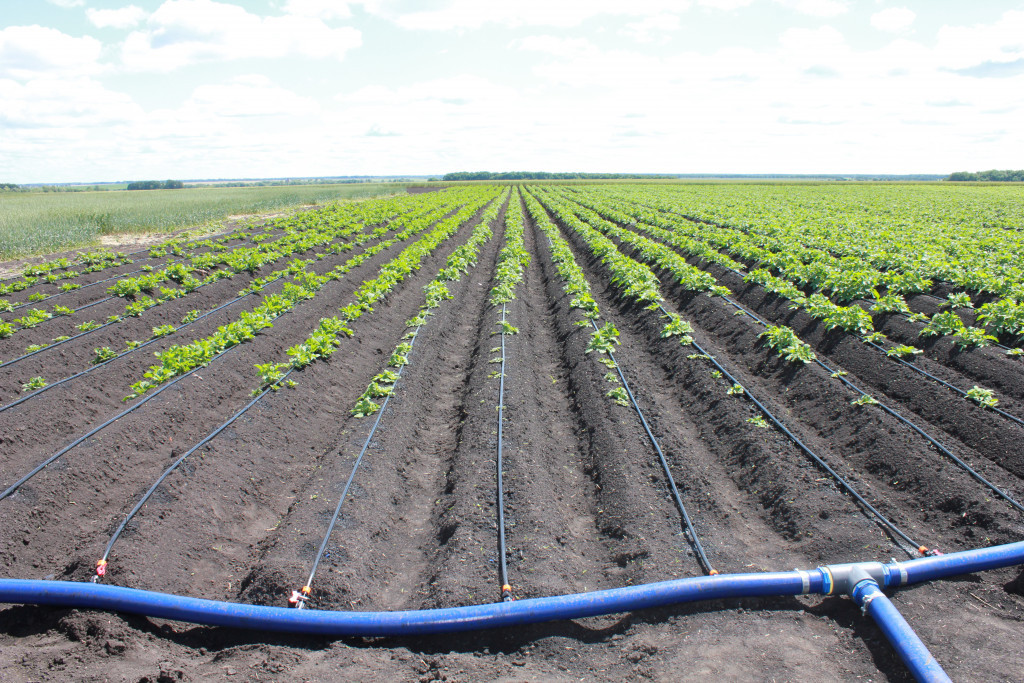
Group 2: High-Cost Water-Saving Technologies include drip irrigation, sprinkling, subsurface irrigation, and others, which provide greater benefits but require more significant investment.
Tajik scientists conducted a comparative evaluation of drip irrigation and furrow irrigation methods for wheat crops in 1997-1999. With a water norm of 1930 m³/ha for furrow irrigation, drip irrigation (with a water norm of 1100 m³/ha) led to maximum wheat yields. The study showed that the specific water cost per unit of crop production was, on average, 14 m³ per 0.1 ton in drip irrigation, compared to 51 m³ per 0.1 ton with furrow irrigation.
Water savings with drip irrigation for winter wheat were 889 m³/ha, or 45.6%, and yield increased by 52.4%-78.6%. For vegetables, drip irrigation used 3700-3900 m³/ha, while furrow irrigation required 5100 m³/ha.
Drip irrigation can boost vegetable yields significantly, with tomatoes averaging 62.37 tons/ha, cucumbers 51.07 tons/ha, and bell peppers 48.33 tons/ha. This method increases vegetable yields by 46%-92%.
Conclusion
Adopting water-saving irrigation technologies in Tajikistan not only helps conserve precious water resources but also offers a path to higher agricultural productivity and greater financial return for farmers. The investment in more advanced, high-cost technologies like drip irrigation can result in significant long-term economic benefits, offsetting the initial investment by boosting crop yields and reducing water usage.
By integrating these methods into agricultural practices, Tajikistan could address both its water scarcity issues and improve the livelihoods of farmers, all while contributing to the broader goal of sustainable development in Central Asia.