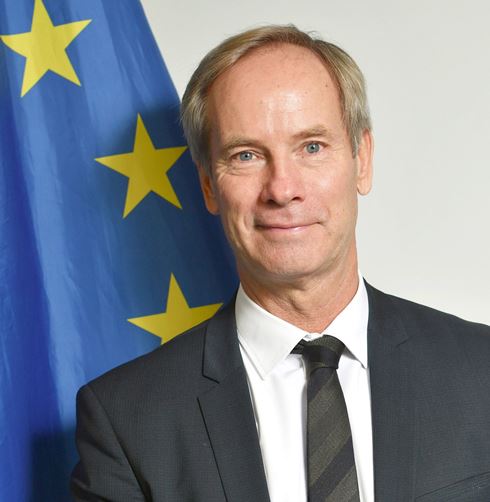
Interview with Mr. Olof Skoog, Deputy Secretary-General of the European External Action Service for Political Affairs.
Q. Mr. Skoog, you came to Dushanbe to chair the 12th European Union – Central Asia High Level Political and Security Dialogue, hosted by Tajikistan on 11 July 2025. What was the objective of this meeting? Has it been met? How do you assess the outcomes of this high-level meeting?
A. The main objective of our High-Level Political and Security Dialogue is to deepen the partnership between the European Union and the countries of Central Asia, including Tajikistan, on matters of shared strategic interest – regional stability, sustainable development, and resilience. The fact that we have been meeting regularly in this format for 12 years now is a testimony to our good cooperation, which is growing even closer.
At the first ever EU-Central Asia Summit in Samarkand in April this year, our leaders elevated our relations to a strategic partnership. Kaja Kallas, the High Representative for Foreign Affairs and Security Policy and Vice-President of the European Commission, is equally committed to fostering closer ties with the region, as her participation in the EU-Central Asia Ministerial Meeting in Ashgabat in March this year and her bilateral visits in that context showed. We believe the EU has a lot to offer and that deepened cooperation will serve both our regions.
In our High-Level Political and Security Dialogue, I listened carefully to our Central Asian partners in order to understand regional priorities, and jointly identify ways to strengthen our collaboration even more, especially in today’s increasingly complex geopolitical environment. I am pleased to say that the meeting fully met its goals. It confirmed the mutual interest in stronger cooperation on issues such as border management, the fight against terrorism and organized crime, water and energy cooperation. We also had open and constructive discussions on how to support regional dialogue and connectivity.
Together with the Deputy Foreign Ministers of Kazakhstan, the Kyrgyz Republic, Tajikistan, Turkmenistan and Uzbekistan, we confirmed our ambition for a more robust and forward-looking partnership At the Summit back in April this year, our leaders also committed to establishing a dedicated EU-Central Asia dialogue on counterterrorism. And just a few months later we held the first meeting of this kind (10 July 2025), clearly showing that we follow words with action. The positive and engaged tone of our dialogues makes me confident that we are moving forward in the new, strategic phase of our partnership with practical steps and deeper mutual understanding.
Q. Tajikistan is close to initialing the Enhanced Partnership and Cooperation Agreement (EPCA) with the European Union. What does the new EPCA bring to Tajikistan and what to the EU?
A. The Enhanced Partnership and Cooperation Agreement (EPCA) marks a major step forward in EU–Tajikistan relations. For Tajikistan, it means a stronger, more modern framework for engaging with the EU in areas like economic development, education, energy, climate resilience, digital transformation, and rule of law.
The EPCA brings real, practical benefits to Tajik citizens. It will help attract investment, expand trade opportunities, support job creation, and improve standards across sectors – from public administration to agriculture. It will also provide a structured platform for dialogue and cooperation, helping Tajikistan advance its own development goals.
For the European Union, the EPCA reflects our growing commitment to Central Asia and to Tajikistan in particular. It allows us to work together more closely on regional and global challenges, through an enhanced engagement built on mutual interests and shared values. Central Asia continues to play a pivotal role in connecting Europe and Asia. That is why the European Union is considering issues surrounding trade, transport and connectivity with the region as a major priority.
Q. What role do Human Rights issues and the freedom of media play in the High-Level Political and Security Dialogue?
A. Human rights and media freedom are important components in our relations with Central Asia. That also applies to our dialogue this week. Human rights are not a secondary matter, but essential elements of a strong and resilient society. In fact, stability and security can only be sustainable when human rights are respected, institutions are transparent, and citizens have the space to engage and be heard.
We have regular dedicated Human Rights Dialogues with all five Central Asian countries. In our dialogues, we speak openly and constructively with our partners about these topics. We acknowledge progress, and we also share concerns where needed – always with respect and in a spirit of cooperation. In my previous role as EU Special Representative for Human Rights I have had very meaningful collaboration in Central Asia and found our exchanges to our mutual benefit. The EU is committed to supporting Central Asian countries in their reform efforts. This includes strengthening the rule of law, promoting inclusive governance, and supporting independent media and civil society. We want to accompany our partners in achieving their own ambitions for a more just, open, and prosperous future.