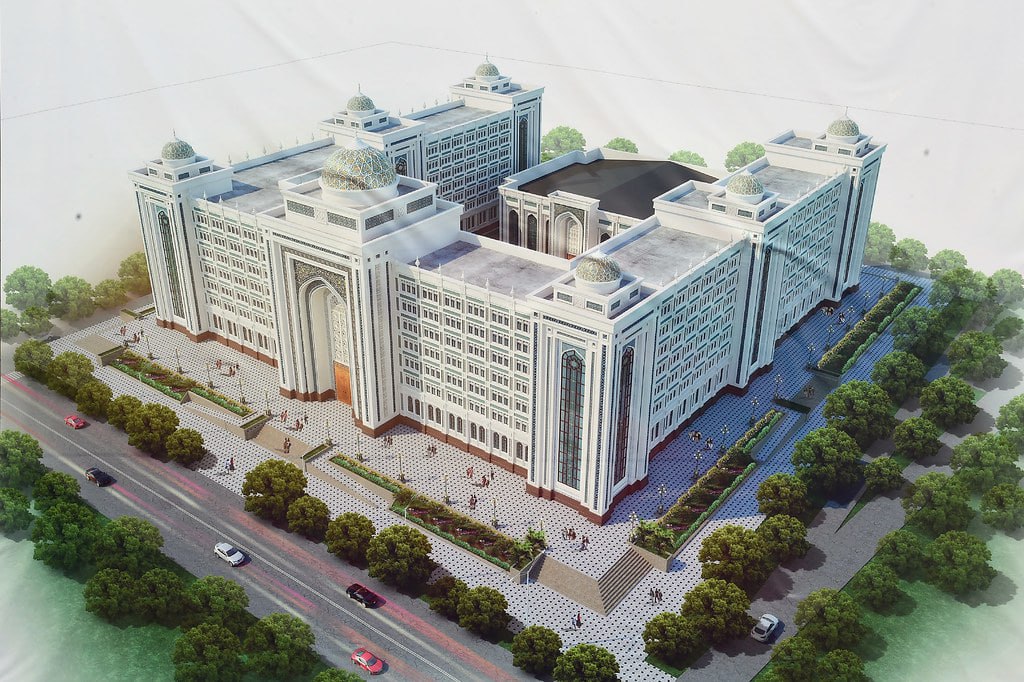
The new building of the Islamic Institute of Tajikistan, construction of which began in 2018 near the new mosque in Dushanbe, is set to open in September. The Islamic Institute Rector, Nusratullo Zokirzoda, shared this update at a news conference held at the Committee on Religion Affairs (CRA) on July 29.
"Starting in the 2025-2026 academic year, students of the Islamic Institute will study in the new building," said Zokirzoda.
The new building is located on Nizami Ganjavi Street in Dushanbe, next to the largest mosque in the country. Construction of the building began in 2018, and the facility will span 3 hectares, designed to accommodate 1,500 students per shift. The cost of the project, funded by the Tajik government, amounts to 136 million somonis (TJS).
The main structure consists of five seven-story buildings. Three of these will primarily house educational and administrative spaces, while the other two will feature modern dormitories, a gymnasium, a cafeteria, a conference hall, and a library.
It remains unclear whether the current building will be demolished after the institute relocates. Some sources suggest that after moving to the new premises, the Islamic Institute may transform into a university. However, the institution's leadership has stated that they do not have any information on this matter.
Illegal religious education abroad
Despite the presence of the Islamic Institute in Tajikistan, authorities report that dozens of Tajik citizens are traveling abroad to pursue religious education illegally. To date, 36 such individuals have been identified.
Farrukhullo Olimzoda, Deputy Chairman of the CRA, revealed at the news conference that three individuals were recently repatriated to Tajikistan.
"Of the three individuals who returned to Tajikistan, two are from Tursunzoda, and one is from Kulob," said Olimzoda.
The CRA Chairman Sulaymon Davlatzoda did not specify which countries these citizens were traveling to for unauthorized religious education but emphasized that they regularly engage with their families in efforts to bring them back home.
It is important to note that higher religious education in Tajikistan is currently only available at the Islamic Institute. Previously, the country had dozens of religious madrasahs, but most were closed after 2010. Many citizens were punished for engaging in unofficial religious education.
Religious materials failing extremism checks
During the press conference, it was noted that the CRA conducts annual government examinations of religious materials to identify extremist content. Over the first six months of this year, of the 557 materials submitted for review, 364 received a negative conclusion from the Committee.
The materials analyzed included: 2,878 religious literature titles; 4,884 social media posts; 601 cassette tapes; 51 mobile phones; 10 flash drives; and 1 laptop containing video and audio recordings.
“Out of these, 364 materials were deemed to contain signs of extremism, while 193 materials received positive conclusions,” said Davlatzoda.
The following items did not pass the extremism check: 333 titles of religious literature; 1,807 social media pages; 284 cassette tapes with video and audio recordings; 37 mobile phones; 7 flash drives; and1 laptop.
Over 5 million somonis in fines for legal violations
According to the CRA, Tajik courts have fined citizens a total of 5.156 million somonis over the first months of this year for violating legislation related to ceremonies and rituals. Of this sum, 2.691 million somonis has been collected to date.
Davlatzoda reported that in the first half of the year, courts handled 630 cases (compared to 885 in the first six months of 2024) related to violations of the law "On the Regulation of Traditions, Celebrations, and Rituals."
"Of these, fines were imposed in 615 cases, while 15 cases were dismissed during the proceedings," said Davlatzoda.
The CRA chairman also reported that, in the first half of 2025, Tajikistan conducted 41,630 raids, during which 9,607 inspections were carried out.
The "Law on the Regulation of Traditions, Celebrations, and Rituals", passed in 2007 and amended a year ago, regulates public ceremonies, celebrations, and events. It aims to combat wastefulness and improve the quality of life for citizens.