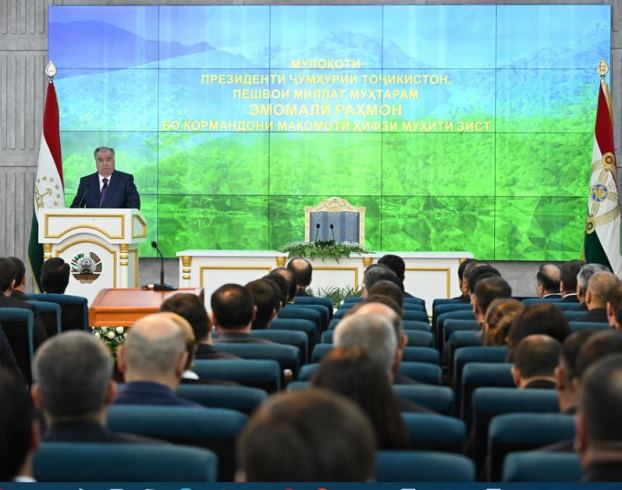
Tajikistan President Emomali Rahmon has emphasized the global and national importance of ecological security, the sustainable use of natural resources, and proactive climate action.
He stated this on September 17 while presiding over the official opening of the new headquarters of the Committee for Environmental Protection under the Government of Tajikistan.
He stressed that these priorities require urgent, coordinated efforts, and tasked the Committee with modernizing legislation, including the drafting of a new Environmental Code and sectoral development programs.
The President also drew attention to Tajikistan’s international climate initiatives, particularly in water resource management and glacier protection, urging national bodies to expand the hydrometeorological network and upgrade water monitoring systems with modern equipment.
Expanding biodiversity and conservation efforts
Reinforcing the importance of biodiversity, President Rahmon instructed the Committee to develop a National Biodiversity Conservation Strategy and a Protected Areas Development Program (2026–2030). He also announced plans to seek UNESCO designation for the Romit Biosphere Reserve, underscoring Tajikistan’s commitment to international conservation standards.
Authorities were further directed to restore and protect endangered species listed in the national Red Book and to develop eco-tourism routes in natural reserves and environmentally significant zones.
Toward a greener and smarter future
In a push for greener urban development, the President ordered full implementation of the State Greening Program through 2040, with proper agro-technical practices for planting and maintenance.
He also called for improvements in waste management infrastructure, emphasizing the need for new processing facilities and sustainable reuse mechanisms. Mobilizing international climate finance was identified as a strategic priority, with the Committee encouraged to pursue grants from global environmental funds.
It was noted that the regulation of waste-related issues, including the collection, storage, transportation, sorting and processing of solid household waste in the country, requires serious improvement.
In this regard, the establishment of large-scale waste processing enterprises and incentive mechanisms for waste processing and reuse was considered an important task.
Education and innovation as strategic priorities
To elevate environmental education, President Rahmon proposed a new national program for Environmental Education Development (2026–2030) and highlighted the need to train globally competent specialists proficient in foreign languages. He also proposed establishing a Scientific and Research Institute for Environmental Protection, Climate Change, and Ecosystems to support innovation and knowledge development in the field.
In closing, President Rahmon expressed confidence that environmental professionals across Tajikistan will continue their mission with dedication and patriotism, leveraging their expertise to address the country’s environmental challenges.