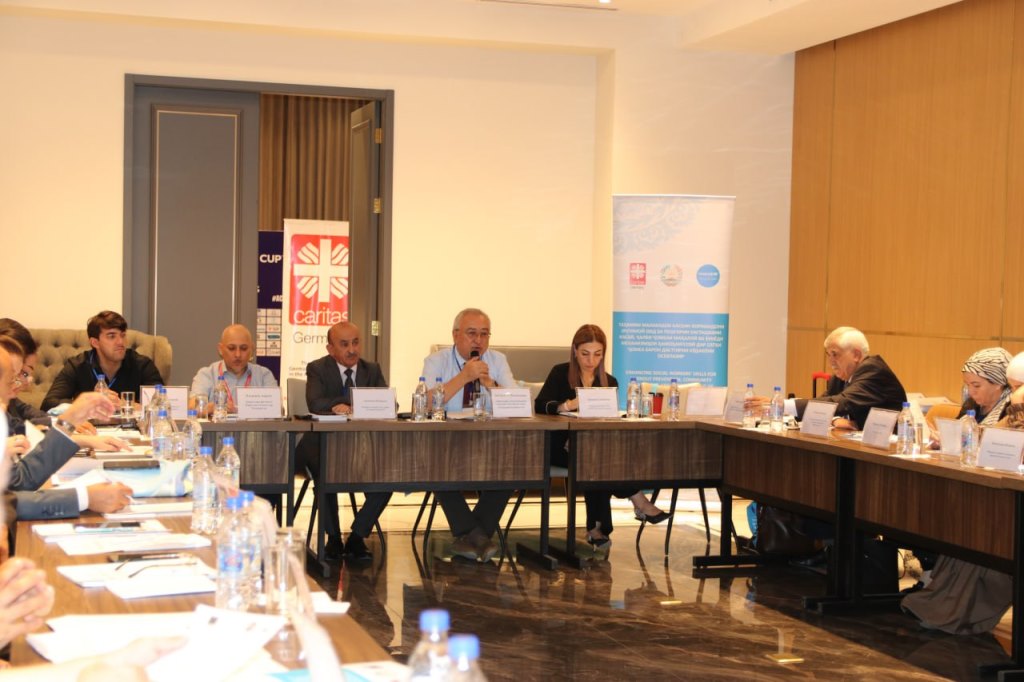
A final conference titled "The Contribution of Social Work to the Protection of Vulnerable Children's Rights" was held in Dushanbe, bringing together over 40 representatives from government bodies in Sughd, Khatlon, and Dushanbe, as well as public organizations and educational institutions.
The primary aim of the conference was to review the outcomes of the intersectoral working groups' activities, exchange experiences, and discuss sustainable methods of protecting vulnerable children’s rights and supporting social workers. This initiative is part of a broader project aimed at creating a professional environment capable of effectively protecting children's rights and assisting families in crisis.
The project, led by the Caritas Germany branch in Tajikistan with support from the Ministry of Health and Social Protection of the Population and the National Association of Schools of Social Work in Tajikistan (NASW), was implemented under the State Program for the Rehabilitation, Reintegration, and Education of Women and Children Returned from Conflict Zones (2023–2027) and the 2023–2025 Action Plan.
Government and social protection programs
Nazarkhudo Dilshodov, a represen tative of Tajikistan's Ministry of Health, emphasized that government social protection programs and intersectoral cooperation are providing vulnerable children with access to education, healthcare, and rehabilitation.
However, during panel discussions, several challenges that hinder the implementation of programs for vulnerable children were highlighted. These included:
- Lack of proper education facilities for children with disabilities
- Documentation issues
- Shortage of qualified staff
- Professional burnout among social workers, with more than 70% of specialists facing this challenge.
As Dilshodov pointed out, the training of new specialists has become a key focus. These trained professionals are critical in linking different stakeholders, ensuring that children receive the necessary care and protection.
“The project strengthened the social work system and provided the country with specialists who will protect children’s rights for many years,” he said.
The project comprises 23 components, covering medical and psychological assistance, housing, education, and employment. Its ultimate goal is to support citizens and reduce the number of people migrating to conflict zones by strengthening trust in state institutions.
The challenge of social reintegration
One of the major themes discussed was the role of social workers in helping women and children reintegrate into society. In areas such as Dushanbe, Sogd, and Kushoniyon, intersectoral working groups were formed with the support of local authorities and international organizations. These groups have provided social, psychological, and educational support to hundreds of children and their families.
Umida Munavvarova, project coordinator for Caritas Tajikistan, stressed that after working with vulnerable women and children, social workers themselves need support. "Social workers are one of the key pillars in child protection. To help others, they also need support and protection," she explained.
Social workers are key players in assisting the reintegration of families returning from conflict zones, especially as many families face societal rejection—a global issue that needs addressing through a comprehensive intersectoral approach. Subkhon Ashurov, director of the National Association of Social Work Schools in Tajikistan, noted that social workers act as the crucial link between children, their caregivers, and local communities.
“Social workers come from diverse fields such as healthcare, education, social protection, and justice. Their work involves preventive, supportive, and crisis services, and their role in the reintegration of children returned from conflict zones is invaluable, though often underappreciated,” he added.
Strengthening social work and community involvement
One of the conference highlights was the launch of a new project in October 2024, aimed at enhancing social workers’ skills in burnout prevention, engaging local communities, and creating coordination mechanisms at the community level to support vulnerable children. This project is funded by the European Union and partially by the U.S. Department of State, and aims to improve the capacity of social workers and local authorities to support women and children returned from conflict zones.
The project has already achieved notable success, and its efforts will continue even after its official end. The intersectoral groups remain active in the regions, and the system of supervision and support groups for social workers is being integrated into government structures, ensuring that support for children and families will continue long-term.
Lasting change and sustainable results
While the project has directly benefited hundreds of families, it also represents a step toward systemic change. It has elevated the status of social workers, strengthened public trust in state institutions, and fostered a culture of interagency cooperation—all critical elements for long-term sustainability.
The conference concluded with a call for the continued development of these initiatives and a commitment to sustaining support for vulnerable children through ongoing collaboration and the implementation of effective policies. The European Union and UNICEF’s role in funding these efforts remains crucial for their success, ensuring the durability of these programs for years to come.