Home Blog Page 84

New bridge across the Syr Darya River to be built in Khujand to ease traffic congestion

0

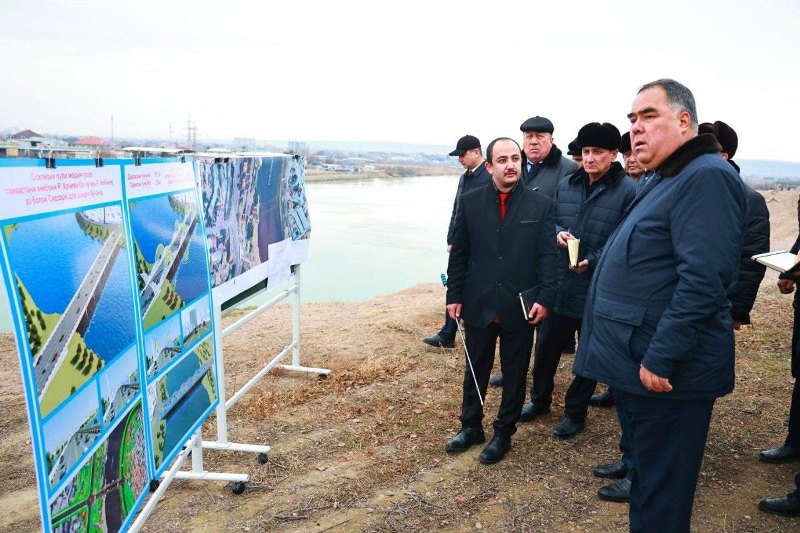
A new bridge is set to be built across the Syr Darya River in the city of Khujand, the capital of Sughd province. The bridge will connect Neighborhood unit No. 12 and the Razzoq neighborhood, according to the Sughd governor’s office.

Authorities say the project is driven by the steady annual increase in the number of vehicles and the growing traffic load on the city’s roads.

Under the project, the new bridge will be 310 meters long and 26 meters wide.

Pedestrian sidewalks will be constructed on both sides. In addition, circular access roads will be built on either end to ensure convenient traffic flow.

Regional officials note that the project will help reduce congestion in central Khujand and significantly ease traffic on the existing bridge.

The exact start date of construction has not yet been announced. However, the Sughd governor’s office emphasized that construction and reconstruction works on two key infrastructure facilities will be carried out as part of urban development and beautification initiatives dedicated to the 35th anniversary of the State Independence of the Republic of Tajikistan and will be completed on time and to a high standard.

It is reported that on January 19, Sughd Governor Rajabboy Ahmadzoda reviewed the design of the new bridge developed by the company Rohi Vahdat.

Currently, two bridges are in operation across the Syr Darya River in Khujand. In addition to the construction of the new bridge, the authorities plan to reconstruct the old bridge as part of a broader program to expand the city’s road network.

According to the project documentation, the width of the existing bridge will be increased to 16 meters, and the roadway will be widened. This will involve expanding an 818-meter stretch of road from the Ismoil Somoni monument to a bus stop near a major shopping center.

Uzbekistan to reward top-reading officials and students with cash bonuses

0

Uzbekistan will introduce cash incentives for government officials, school pupils, and university students who read the highest number of books. Citing the press service of the Ministry of Justice, Fergana News says the initiative is outlined in a decree signed by President Shavkat Mirziyoyev on January 15. 

Under the decree, all ministries and government agencies must compile lists of recommended reading relevant to their employees’ professional activities by March 1. In addition, at least three books by foreign authors will be translated into Uzbek each year, accompanied by expert commentary and a glossary.

By April 1, “book corners” will be established in all government institutions, and monthly “book reading hours” will be organized for staff.

An internal reading culture ranking will also be introduced within government bodies. Officials who read the most books will be eligible for a bonus equal to one month’s salary, funded through a Special Financial Incentive Fund.

There are also separate rewards for school pupils and students who make it into the top 100 most active readers. They will receive a cash prize equivalent to 25 times the base calculation value — 10.3 million soums (approximately $856).

The decree also provides for the creation of a Reading Culture Development Fund under the Youth Affairs Agency. The fund will support the publication of works by young authors, promote children’s literature, organize competitions, and provide monthly stipends of 50 base calculation values (20.6 million soums, or about $1,712) to talented writers for up to one year.

In addition, the fund will cover up to 50% of publishing costs for local authors and up to 80% of copyright expenses for translating leading foreign literary works into Uzbek and vice versa.

Starting February 1, 2026, the national program “The Book as a Source of Enlightenment” will be launched. Government advertising promoting books and reading culture will be classified as social information. Public transport — including buses, trains, and airplanes — will offer access to the Mutolaa online reading platform via QR codes.

Schools will also establish reading clubs titled “Jadidlar izidan” (“In the Footsteps of the Jadids”), whose members will be required to read at least 20 books per year. The most active participants will receive quarterly incentives from the Ministry of Preschool and School Education.

The main objective of the decree is to raise the country’s average annual reading level to 10 books per person between 2026 and 2030.

China records historic drop in birth rate in 2025

0
xc

China’s population declined by 3.39 million in 2025, falling to 1.404 billion, according to data from the National Bureau of Statistics of China. The figures cover mainland China only, excluding Hong Kong, Macau, and Taiwan, Meduza reports.

During the year, 7.92 million births were registered, while the number of deaths reached 11.31 million. The birth rate stood at 5.63 per 1,000 people, compared with a death rate of 8.04. CNN notes that this is the lowest birth rate ever recorded in the country.

China’s population has now declined for the fourth consecutive year. The previous record low was registered in 2023, when the birth rate fell to 6.39 per 1,000 people. A modest uptick in 2024 proved temporary and did not reverse the long-term downward trend that has continued since 2016.

According to CNN, the 2025 data indicate that government measures aimed at boosting births following the abandonment of the “one-family, one-child” policy have so far produced limited results.

The demographic decline increases economic risks by shrinking the workforce and expanding the elderly population, while also weighing on domestic consumption.

At the same time, China’s economy showed resilience in 2025, with GDP growth reaching 5% despite external pressures, including ongoing trade tensions with the United States.

China lost its status as the world’s most populous country in 2023, overtaken by India.


When patterns come to life: Mavzouna Jalolova and the secret of Panjakent embroidery

0

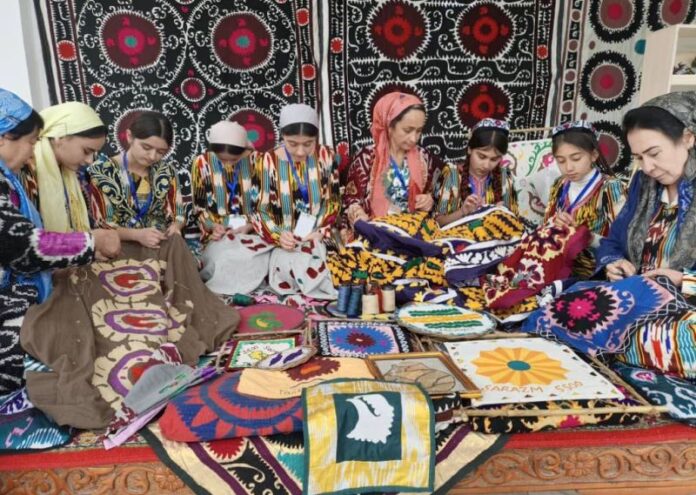
The city of Panjakent, long known as a center of traditional crafts, is witnessing a revival of one of its most iconic art forms — suzani embroidery. Increasingly, local brides are choosing richly embroidered traditional dresses for their weddings instead of European-style white gowns. For many, this choice is not only about beauty, but also about honoring ancestral heritage and long-standing traditions.

One of the guardians of this craft is Mavzouna Jalolova, an artisan with more than 30 years of experience. For her, embroidery is more than a skill — it is a family legacy. Five generations of her family have practiced this art, and today Jalolova continues the tradition by passing her knowledge on to her daughters.

Since 2014, she has led an embroidery workshop at the Panjakent Palace of Culture. Most of her students are schoolgirls and housewives.

Jalolova says her goal is not only to preserve traditional craftsmanship, but also to help women gain a source of income.

“It is hard to imagine a home in Panjakent without suzani,” she says.

According to Jalolova, interest in embroidery declined for a time, but in recent years the art form has experienced a strong revival. Traditional embroidered dresses are once again becoming popular, particularly for wedding ceremonies.

Jalolova creates embroidered dresses, vests, bedspreads, and prayer mats, and also skillfully depicts national symbols and historical scenes using needle and thread.

Thanks in large part to the work of artisans like her, Panjakent was officially designated a World Crafts City in October 2025.

Over three decades, Mavzouna Jalolova has trained dozens of skilled embroiderers. Her greatest hope is that this national art will never disappear and will continue to be passed down from generation to generation.

Suzani (or Suzane) is a famous, large, hand-embroidered textile traditionally made in Tajikistan and other Central Asian countries, known for its vibrant patterns representing nature and cultural symbols, historically created by brides as part of their dowry for weddings, and is a significant part of Tajik heritage. 

Trump invites Kazakhstan’s president to join the board of Peace for Gaza

0

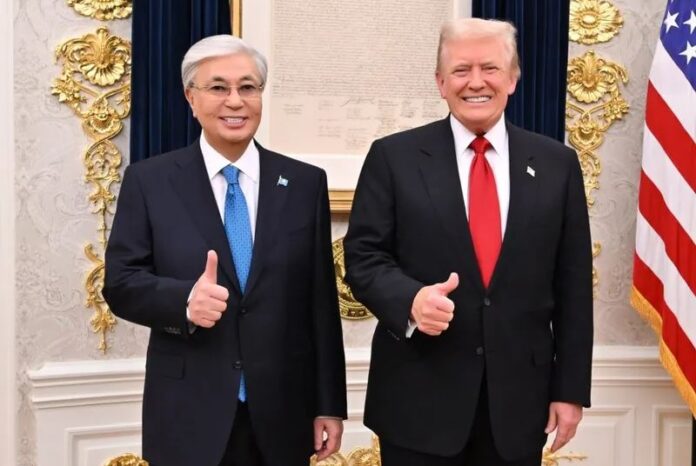
U.S. President Donald Trump has invited Kazakh President Kassym-Jomart Tokayev to join the Board of Peace for Gaza, Tengrinews reported, citing presidential spokesman Ruslan Zheldibay.

According to him, Tokayev was among the first leaders to receive the invitation, with Kazakhstan offered the status of a founding member of the new body.

In response, Tokayev reportedly sent a letter to Trump expressing gratitude and confirming Kazakhstan’s readiness to participate, emphasizing the country’s commitment to contributing to lasting peace in the Middle East.

Trump announced the creation of the Board of Peace for Gaza on January 16, 2026, as part of his broader peace plan for Gaza, which also provides for the deployment of international forces.

The Board’s executive committee includes seven members, among them U.S. Secretary of State Marco Rubio, Trump’s special envoy Steve Witkoff, Jared Kushner, and former UK Prime Minister Tony Blair.

Bloomberg previously reported that countries seeking permanent membership are required to contribute at least $1 billion.

Under the draft charter, Donald Trump will serve as the Board’s first chair, with authority to determine its membership and approve or veto decisions.

Split within the Taliban: why Afghanistan’s internet was not fully shut down

0

Afghanistan’s brief nationwide internet blackout in September 2025, officially blamed on “technical problems,” was in fact the result of an internal power struggle within the Taliban leadership, according to an investigation by BBC Afghan Service.

Journalists report that two distinct factions have emerged within the movement: a hardline group led by Supreme Leader Haibatullah Akhundzada, and a more pragmatic camp based in Kabul.

Akhundzada favors strict isolation and rigid enforcement of Sharia law, while the Kabul-based leadership seeks to maintain basic state functionality and limited engagement with the outside world.

In late September, Akhundzada ordered a complete shutdown of internet access across Afghanistan, reportedly viewing it as a source of “unbelief.” The order was implemented, but within two days senior officials — including Deputy Prime Minister Abdul Ghani Baradar, Interior Minister Sirajuddin Haqqani, Defense Minister Mohammad Yaqoob, and Communications Minister Hamdullah Nomani — pushed for its reversal.

According to the BBC, they argued to Prime Minister Hasan Akhund that a prolonged blackout would cripple banking operations and essential state services. In an unprecedented move, they openly defied the supreme leader’s directive and took responsibility for the decision.

Internet access was subsequently restored, while the government publicly attributed the outage to damaged fiber-optic infrastructure. Notably, the Kandahar-based leadership chose not to escalate the confrontation.

Observers suggest Akhundzada may have avoided a direct clash with figures who control the country’s most powerful armed factions. The episode has fueled speculation that, at least on certain issues, the Taliban’s pragmatic wing is capable of restraining the movement’s most radical impulses.

Central Asia’s water resources are running out: what happens when the tipping point is reached?

0

For decades, water in Tajikistan was seen as something taken for granted. The Pamir glaciers and the country’s location at the headwaters of Central Asia’s major rivers created a sense of long-term security. Today, however, reality shows that these natural advantages are no longer sufficient.

Climate change, growing consumption, and systemic weaknesses in water governance are making the country increasingly vulnerable. Experts warn that without an urgent revision of water policy, the capitals of Central Asia could face a crisis comparable to the one already unfolding in Tehran.


Study warns: regional capitals on the brink of a water crisis

In late 2025, the foresight agency Nightingale Intelligence published a study presenting alarming projections. According to its analysts, Central Asian capitals could face a severe water crisis — similar to the situation in Tehran — unless urgent reforms in water supply systems are implemented.

The region’s water system largely depends on two rivers, the Amu Darya and the Syr Darya, which are fed by glaciers in the Pamirs and the Tien Shan mountains. Since the 1960s, however, these glaciers have already lost a significant share of their mass, while river flow patterns have become increasingly unpredictable, raising long-term risks of water shortages.

The authors stress that the problem is not limited to shrinking water resources driven by climate change. Equally critical is the extremely inefficient use of water, both in agriculture and in urban areas.


What the “Tehran scenario” means

In an interview with Asia-Plus, one of the study’s authors, economist and international development expert Sobir Kurbanov explained the essence of what he calls the “Tehran scenario.”

According to Kurbanov, the “Tehran scenario,” similar to the so-called “Mexico City scenario,” refers to a sharp reduction in the supply of fresh water to urban distribution systems.

“This outcome is driven by a combination of factors: depletion of water sources and reduced inflow into reservoirs, irrational consumption, high losses, aging infrastructure, and rapid urbanization without adequate investment in water supply and treatment,” he said.


Cities lose water before it reaches consumers

Even if cities such as Tashkent, Bishkek, or Dushanbe do not yet face a formal water deficit, the combination of aging infrastructure and rising demand makes them particularly vulnerable to disruptions.

In Dushanbe, Kurbanov notes, many elements of the “Tehran scenario” are already visible, albeit on a smaller scale. The city is growing rapidly, water consumption is increasing, while infrastructure remains outdated and losses remain high — all of which can be seen as warning signs of a potential future crisis.

“The greatest danger for Tajikistan is not a hypothetical ‘evacuation of the capital,’ but a cascading effect, when a water crisis ceases to be merely an urban issue and simultaneously affects drinking water supply, irrigation, and electricity generation. In such cases, it quickly turns into a socio-economic and sometimes political crisis,” the expert emphasizes.


When the problem is not water, but governance

According to the study’s authors, technical losses and high water demand are merely symptoms of a deeper, systemic issue — weak water governance.

Much of Central Asia’s water distribution system is inherited from the Soviet era, designed for a stable climate and centralized planning. Under today’s conditions, this model is increasingly failing.

Water management agencies remain chronically underfunded, while tariffs often do not reflect the real cost of services. As a result, utilities lack the resources to invest in network modernization or even basic maintenance. The situation is further aggravated by the absence of comprehensive monitoring of water withdrawals and losses, making effective management nearly impossible.

As Sobir Kurbanov notes, a water crisis can emerge even without a formal reduction in water availability.

“Tajikistan may face a crisis not because water physically disappears, but because of how the system is managed today: high losses, weak accounting, no incentives for conservation, and chronic underinvestment in operation and maintenance. The lack of coordination between water-energy policy and chaotic urbanization is particularly dangerous,” the expert explains.

When cities expand faster than infrastructure and losses remain high, Kurbanov adds, systems collapse not due to absolute water scarcity, but because of governance failures.


Agriculture: where most of the water disappears

Weak governance is most evident in agriculture — the largest consumer of water in Central Asia. According to the study, the sector accounts for 80–90% of total water withdrawals.

In many areas, outdated gravity-fed irrigation systems with open canals are still in use, where substantial volumes of water are lost through seepage and evaporation. In some locations, up to 40% of water disappears before reaching the fields.

As a result, countries long considered water-secure are facing what researchers describe as “hidden scarcity.” Groundwater levels are falling, soil quality is deteriorating, salinization is increasing, and ecosystems are degrading.

While these processes are most visible in the Aral Sea basin, researchers warn that their impacts will eventually reach urban areas as well.


Water vulnerability as a driver of social instability

In Tajikistan, water vulnerability is felt most acutely in everyday life, particularly in rural areas, where any instability quickly affects incomes and living conditions.

“Any reduction in irrigation water immediately hits farmers’ incomes, access to water, and electricity supply. Given the country’s heavy reliance on agriculture and hydropower, such disruptions trigger a chain reaction,” Kurbanov notes.

At the same time, Tajikistan possesses a strategic advantage that has not yet been fully realized — its location at the headwaters of the region’s major river basins.

“This gives Tajikistan the potential to become a leader in regional water governance, coordinating river and reservoir regimes and building a balanced ‘water–energy–irrigation’ system. Such a model could benefit both the country itself and its neighbors,” the expert says.


How water scarcity is emptying villages

One of the study’s most alarming conclusions is that water scarcity is gradually reshaping rural life. Falling crop yields and declining incomes are pushing people to leave — first seasonally, then permanently.

This scenario is particularly relevant for Tajikistan, where a large share of the rural population depends directly on water through household plots, orchards, small-scale farming, and seasonal agricultural work.

Outmigration rarely happens overnight. Instead, it takes the form of “quiet migration” — first from villages to cities, and later abroad. As water conditions deteriorate further, pressure on cities with already overstretched water systems is expected to intensify.

Similar trends are already being observed in several rural regions of Tajikistan.


When water also means electricity

Water stress in Tajikistan is directly linked to the energy sector. More than 80% of the country’s electricity is generated by hydropower plants, meaning that any fluctuations in river flows immediately affect electricity supply.

As climate change reduces snow reserves in the mountains, reliance on hydropower alone is becoming increasingly risky — particularly without the development of alternative energy sources and energy-efficiency programs.

“Any reduction in inflows to rivers and reservoirs immediately hits electricity generation. We are already seeing how low-snow winters and reduced water levels lead to power supply restrictions. In practice, authorities are forced to ‘save water’ in reservoirs in order to keep hydropower plants operating,” Sobir Kurbanov explains.

According to him, climate stress in Tajikistan simultaneously affects several critical sectors.

“Water, electricity, irrigation, and urban water supply all rest on the same hydrological foundation. This is why climate stress impacts them at the same time, amplifying the overall effect,” he says.


The Qosh Tepa Canal: a new risk factor

Another major concern highlighted by experts is Afghanistan’s construction of the Qosh Tepa Canal, designed to divert water from the Amu Darya to irrigate northern regions of the country.

Analysts estimate that once operational, the canal could divert between 6 and 10 cubic kilometers of water annually — up to one-third of the Amu Darya’s current flow. The effects of this diversion are already being felt in neighboring regions that depend on the river.

This development heightens geopolitical tensions and increases the risk of conflicts among countries within the Amu Darya basin.

“Uzbekistan may be the most vulnerable in this situation, as its irrigation systems rely heavily on Amu Darya water. Any major new withdrawals upstream significantly increase the risk of shortages downstream,” Kurbanov notes.

For Tajikistan, he adds, the risks are less about absolute volumes and more about political and systemic consequences.

“The likelihood of transboundary disputes over water allocation is increasing, especially during dry years. Such incidents have already occurred along the Tajik–Afghan border, and the emergence of a new active player in the Amu Darya basin only reinforces the need for continuous dialogue, transparent data, and agreed rules,” the expert says.


What comes next: can the ‘hour X’ be avoided?

As the authors of the study emphasize, the “Tehran scenario” is not inevitable — it is the result of prolonged inaction. Central Asian countries still have the opportunity to avoid this outcome if they move from broad statements to concrete measures.

According to Kurbanov, the coming years will be decisive for Tajikistan. Priority must be given to restoring order in urban water supply and irrigation systems, reducing losses, and launching systematic infrastructure modernization.

Equally important is a shift in agricultural policy, supporting farmers in transitioning to more water-efficient irrigation methods. The economic dimension of water — tariffs, user responsibilities, and rights — also requires urgent attention.

“Without clear and fair rules, modernization will remain out of reach for most farms and utility systems,” the expert warns.

Among the most critical mistakes, he lists managing water systems “blindly” without data or proper accounting, encouraging chaotic urban expansion without infrastructure investment, delaying tariff and financial reforms of water utilities, and neglecting regional water diplomacy.

“In such a scenario, every dry year will turn into a political crisis,” Kurbanov concludes.

The preparation of this material was made possible by the Communicating Climate in Central Asia project, implemented with financial support from the German Federal Ministry for Economic Cooperation and Development. 

Ministerial semiannual news conferences expected to start on January 26

0

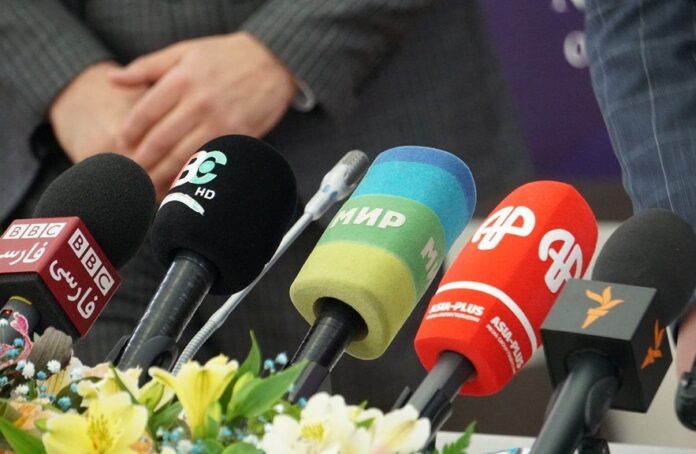
Heads of ministries and agencies of Tajikistan as well as heads of provinces and cities are expected to begin to give news conferences on the results of the past half-year’s work on January 26, 2026, according to the stte-run news agency Khovar..

Officials of ministries and organizations operating in Dushanbe must coordinate the timing of news conferences with Khovar news agency.

The news conferences are expected to run through February 12.

The news conferences’ plan has reportedly been approved by the head of President’s Executive Office, Ms. Ozoda Rahmon.    

Recall, President Emomali Rahmon on March 4, 2005 signed a decree obligating ministers, department heads, and local officials to give quarterly news conferences.

But by president’s decree issued in September 2011, ministers, department heads, and local authorities now give news conferences only twice a year – in January and July.

The decree also notes that in case of necessity, ministers and department 


Russia to introduce criminal penalties for Migrants using fake medical certificates

0

Russia is set to introduce criminal liability for migrants who use forged medical certificates. Three related bills addressing the monitoring of migrants’ health and the authenticity of medical documents have been submitted to the State Duma, TASS reports, citing Deputy Speaker Irina Yarovaya of the ruling United Russia party.

The initiatives have been supported by the Russian government, the Supreme Court, law enforcement agencies, and other relevant bodies. The bills were developed on the instruction of State Duma Speaker Vyacheslav Volodin, who had previously announced plans to tighten regulations in this area.

Under the proposed legislation, penalties for violations related to mandatory medical examinations for migrants would be significantly increased. Fines for evading medical screening are set to rise twelvefold, reaching 25,000–50,000 rubles, with courts given the authority to order deportation at their discretion.

For the first time, liability would also be introduced for failing to pay fines within the prescribed period, described as an additional disciplinary measure aimed at ensuring public safety.

Migrants found using forged medical certificates could face criminal charges, including up to four years in prison and fines ranging from 500,000 to one million rubles. Aggravating circumstances would apply if forged documents were produced or used via the internet or through abuse of official position. If such actions result in mass infection, the maximum prison sentence could be increased to eight years.

The bills also propose stricter criminal penalties for the production and circulation of fake documents certifying the absence of dangerous diseases.

In addition, administrative liability would be imposed on medical organizations that violate the procedures for conducting medical examinations of migrants. Penalties could include fines of 300,000 to one million rubles or suspension of operations for a period ranging from 14 to 90 days.

The proposed legislation would also reduce the mandatory period for migrants to undergo medical examinations from 90 to 30 days after entering Russia. Medical institutions would be required to upload medical conclusions to the unified state healthcare information system and submit the relevant data to the Russian Interior Ministry.

According to Yarovaya, the initiatives represent a “logical continuation” of comprehensive measures previously adopted by the State Duma to combat illegal migration.

“These measures will significantly improve the prevention and deterrence of crimes, while strengthening safeguards against abuses in the verification of foreign nationals’ health status and the issuance of medical documents,” she said.

Ayatollah Khamenei admits thousands killed in Iran protests, blames the United States

0

Iran’s Supreme Leader Ayatollah Ali Khamenei has publicly acknowledged for the first time that thousands of people were killed during recent mass protests in the country, placing responsibility for the events on the United States and its allies, the BBC’s Russian Service reports.

In a public address, Khamenei said that “individuals linked to Israel and the United States inflicted enormous damage and killed several thousand people.” According to him, protesters set buildings on fire, destroyed public property, and spread chaos across the country.

The Iranian leader also directly accused the U.S. president of involvement in the events. “We consider the U.S. president a criminal, responsible for the casualties, the damage, and the slander against the Iranian people,” Iranian state media quoted Khamenei as saying.

Earlier, U.S. President Donald Trump called on Iranian demonstrators to “continue protesting” and warned Iran’s leadership that Washington could consider military intervention if security forces resorted to mass violence.

According to Human Rights Activists News Agency (HRANA), a U.S.-based Iranian human rights agency, at least 3,090 people were killed during the harsh crackdown on the protests. Some human rights organizations report significantly higher figures. The ongoing large-scale internet blackout across Iran has made it difficult to obtain reliable information. 

In his speech, Khamenei stated that Iran “will show no mercy to internal criminals,” adding that “international criminals will also not escape punishment.” In posts on social media, he further claimed that “America’s goal is to absorb Iran.”

Donald Trump has not yet commented on Khamenei’s remarks. Meanwhile, on January 17, the U.S. State Department said it had received information indicating that Iran was preparing possible strikes against American military bases. U.S. officials warned that any such attack would be met with a “very, very powerful response” and urged Tehran not to “play games with President Trump.”

Large-scale anti-government protests erupted across Iran in late December 2025. According to media reports and human rights groups, Iranian authorities responded with severe measures to suppress the demonstrations.

In recent days, reports of unrest have decreased, but the situation remains unclear due to restricted internet access. According to NetBlocks, Iran’s overall internet connectivity on Saturday was operating at about 2% of its normal level.