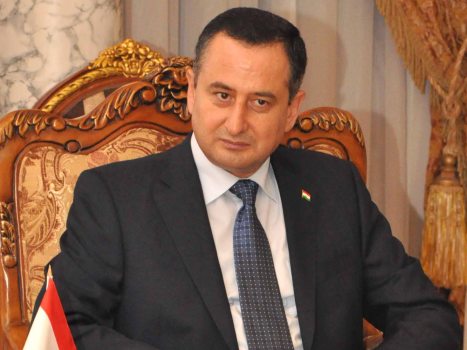
First Deputy Prime Minister, Davlatali Said, yesterday received seven customers of Tajprombank (Tajik Joint-Stock Commercial Industrial Bank for Reconstruction and Development) and promised that the bank will give their savings back.
“We said that we cannot receive our savings due to the liquidation of the bank. They tell us over and over again that they will give our money back after the sale of the bank’s property. But how they can sell the bank property, if a two-room apartment, previously 80,000 U.S. dollars, now costs 40,000 U.S. dollars?” one of Tajprombank customers told Asia-Plus in an interview.
According to him, the deputy prime minister said that he is aware of the situation and promised that their savings will be paid out. “He said the bank top manager Jamshed Ziyoyev was summoned to the Prosecutor-General’s Office for questioning. Davlatali Said promised that Ziyoyev’s property will be sold and our savings will be paid out completely,” the customer added.
According to the latest data, 2,070 debtors now owe a total of 266 million somoni to Tajprombank. Assets on Tajprombank’s books that include dozens of offices and an unspecified number of residential properties are estimated at 450 million somoni. Meanwhile, a total amount of the bank’s liabilities is about 550 million somoni.
Recall, parliament in December 2016 approved a government decree to issue bonds worth around half a billion dollars with which to recapitalize four distressed banks – including Tajprombank and Tojprombank.
However, Tajprombank never saw any of the $56 million earmarked for it as the National Bank on February 24 announced it was pulling the licenses of Tajprombank and Fononbank.
Customers at those banks have been paid out 17,500 somoni (around $2,000) out of the state’s Individuals Deposits Insurance Fund. Anybody with more than that amount of money in the bank is still waiting to see how much they will get in the end.
In April, it emerged that the government decided unilaterally to allocate the $66 million it had set aside as bailout funds for Tajprombank and Fononbank to construction work on the Roghun hydropower dam.
Meanwhile, EursiaNet.org reports a 50-year-old resident of Dushanbe, Khairddin Qodirov, who was customer at Tajprombank, hanged himself at the beginning of August. Before hanging himself, Qdirov reportedly left a suicide note blaming the owner of Tajprombank for his misfortunes.
Two years ago, Qodirov, a railway worker, deposited $84,000 in the bank, raised from the sale of his late parents’ home. He was hoping to use the money to renovate a new house and to pay for the weddings of his sons.
And then on February 24, the National Bank withdrew Tajprombank’s operating license along with that of another distressed lender, Fononbank. Many of Tajikistan’s banks have been teetering on the edge of ruin for years – in part as the result of a reckless lending policy unjustified by a chronically weak economy.
In an instant, Qodirov’s money was gone. Courtesy of insurance companies, Tajprombank accountholders were given back 17,500 somoni, but that was scant consolation for many.
Qodirov’s relatives told EurasiaNet.org that they believe the suicide may have been an attempt to force the bank’s hand into returning more money. Indeed, the day after Qodirov’s funeral, Tajprombank’s former owner, Jamshed Ziyoyev, got in touch directly.
“He asked us not to worry and he promised to give our money back. Then we never saw him again, although there is talk that they plan to return the money in September. We’ll see,” said Qodirov’s son, Sadriddin.
Qodirov’s family said they have no intention of pursuing legal action against the bank, although they have little doubt about what has brought them to this point. As various family members agitatedly told stories, they spoke over one another.
Tajikistan is full of such stories of desperate depositors who now find themselves with barely a penny.
Tajikistan’s hopes of heading off another crisis hinge in great part on the prospect of a $500 million assistance package from the International Monetary Fund, according to EursiaNet.org. The National Bank has in an apparent confidence-building measure invited the IMF to station a resident advisor to help build the regulator’s banking supervision capacity.
Agreeing to provide Tajikistan with any money would mark a remarkable leap of faith for the IMF, which has been badly stung in the past by Dushanbe’s creative bookkeeping.
IMF expert Edward Nolan, as part of a project financed by Switzerland’s State Secretariat for Economic Affairs, would be tasked with monitoring the sector. Specifically, he would “assist in strengthening capacity in bank regulation and supervision, with a particular focus in three areas – off-site data reporting and financial analysis; on-site banking supervision; and consolidated bank supervision,” IMF mission chief for Tajikistan, Paul Ross, told EurasiaNet.org in an emailed statement.
Ross indicated that progress in advancing talks on the assistance package was being made in view of macroeconomic reforms undertaken in the past two years.
They “include revisions to the 2016 budget, targeting a lower budget deficit in 2017, removing exchange system restrictions and aligning official and market exchange rates, and measures to manage money growth,” he wrote.
Ross conceded that more banking reforms are needed, however.
That is something of an understatement. As one well-placed industry insider explained to EurasiaNet.org, on condition of anonymity, dubious and sloppy practices are a dominant feature of Tajikistan’s banking system. Huge amounts of credit have been given to would-be entrepreneurs on purely political grounds.
“Banks will on the instructions of high-ranking figures, and not on the basis of a bilateral commercial agreement, hand out loans [to people so they can] build something or other,” the source said. “It is this that has driven our banks to the sad state that they are in now. The banks simply don’t have the power to force these people to pay back their debts.”