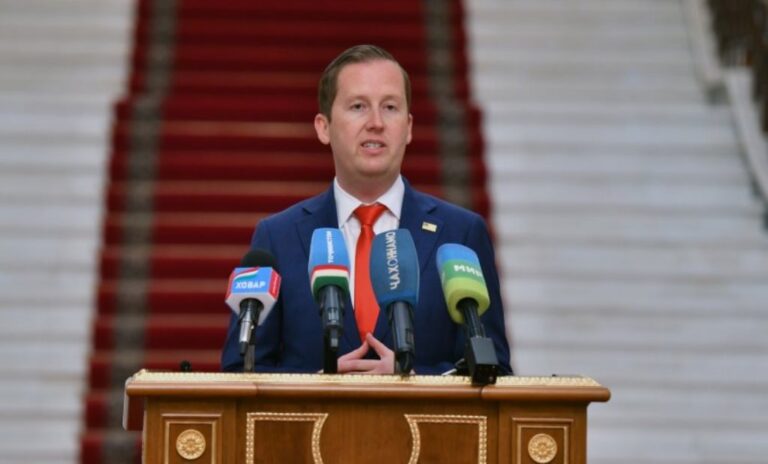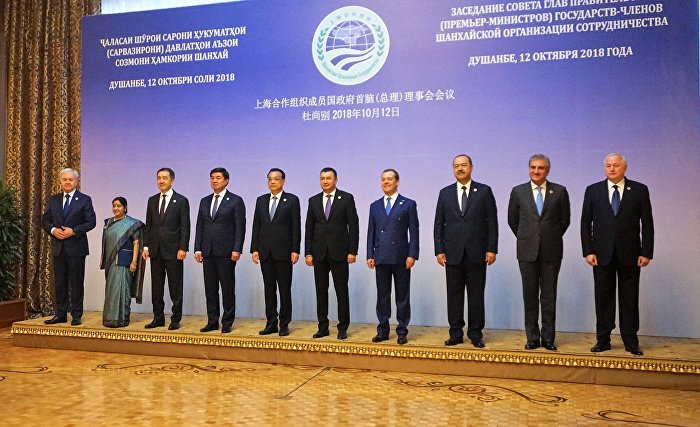
Presided over by Tajik PM Qohir Rasoulzoda, the 17th meeting of the Shanghai Cooperation Organization (SCO) Council of Heads of Government took place in Dushanbe on October 11-12. The meeting resulted in issuing the joint communique.
The joint communique, in particular, says that the Heads of delegation noted that the situation in the world economy, despite some improvement, remained fragile, the process of economic globalization was facing an increase in unilateral and protectionist measures, a continuing decline in the pace of development, volatility of financial markets, as well as other challenges in international trade.
The additional negative impact on global economic prospects entails risks associated with international terrorism, the aggravation of conflict situations in a number of regions, as well as epidemics, climate change, and natural disasters.
The Heads of delegation stressed the importance of the continued commitment of the Member States to the goals and objectives enshrined in the SCO Charter, the further implementation of the SCO Development Strategy until 2025 in order to deepen and expand cooperation in the field of politics, security and trade, promoting the construction of a new type of international relations based on mutual respect, justice, equality and mutually beneficial cooperation, as well as the formation of a common vision of the idea of creating a community of a common destiny of mankind.
They affirmed the need for the SCO to adopt joint effective measures in the field of economic cooperation, which is an important part of ensuring socio-economic development and stability in the SCO space.
The Heads of delegation advocate facilitating the creation of an enabling environment for trade and investment with a view to the progressive realization of the free movement of goods, capital, services and technology, as envisaged by the SCO Charter.
In this regard, they consider it important to ensure implementation of the Joint Statement of the heads of SCO Member States on trade facilitation (Qingdao, 10 June 2018), continuing to discuss approaches to solving the problem of trade facilitation in the region, taking into account the importance of joining efforts in supporting and strengthening the multilateral trading system, based on the norms and principles of the WTO.
The Heads of delegation noted the important role of E-commerce in promoting economic and trade growth, as well as in improving industrial sectors. They expressed their readiness to deepen exchanges and cooperation in this area.
Reaffirming their support for the Belt and Road Initiative (BRI) of the People's Republic of China, the Heads of the delegation of the Republic of Kazakhstan, the Kyrgyz Republic, the Islamic Republic of Pakistan, the Russian Federation, the Republic of Tajikistan and the Republic of Uzbekistan, noted the efforts taken towards its joint implementation, including efforts to interlink project of the Eurasian Economic Union and the BRI and advocate the use of the potential of the countries of the region, international organizations and multilateral associations to create a broad, open, mutually beneficial and equal partnership in the SCO space.
They believe that the development of a single effective transit system, including electronic document flow, guarantee mechanisms and the ability to monitor the movement of goods, can contribute to achieve this task.
The Heads of delegation welcomed the results of the International Conference "Central Asia in the system of international transport corridors: strategic prospects and unrealized opportunities" (Tashkent, 20-21 September 2018) as an important contribution to promote multilateral dialogue on the formation and development of transport corridors in the SCO Region.
They underlined the importance of existing and under construction energy infrastructure facilities in the region, including hydropower facilities to achieve sustainable development goals, and expressed their readiness to increase cooperation in this area.
The Heads of delegation noted the significant role of SCO Business Council and SCO Interbank Consortium in the interaction of business and financial circles of the SCO Member States for the development of business, trade and investment cooperation in the SCO space, including by attracting the potential of Observer States and Dialog Partners.
A positive assessment was also given to the accession of "Habib Bank Ltd." of Pakistan to the SCO Interbank Consortium and continuation of the process of increasing number of the participants of the Consortium.
The Heads of delegation support further active cooperation in the field of agriculture, in such areas as processing and trade of agricultural products, scientific research in the field of agriculture, implementation of joint projects in various areas of the agricultural sector.
The Heads of delegation welcomed the establishment of the Silk Road University of Tourism in Samarkand and called for the establishment of cooperation between the University and interested higher education institutions as well as relevant structures of the SCO Member States.
The next meeting of the SCO Council of the Heads of Government will be held in 2019 in Uzbekistan.