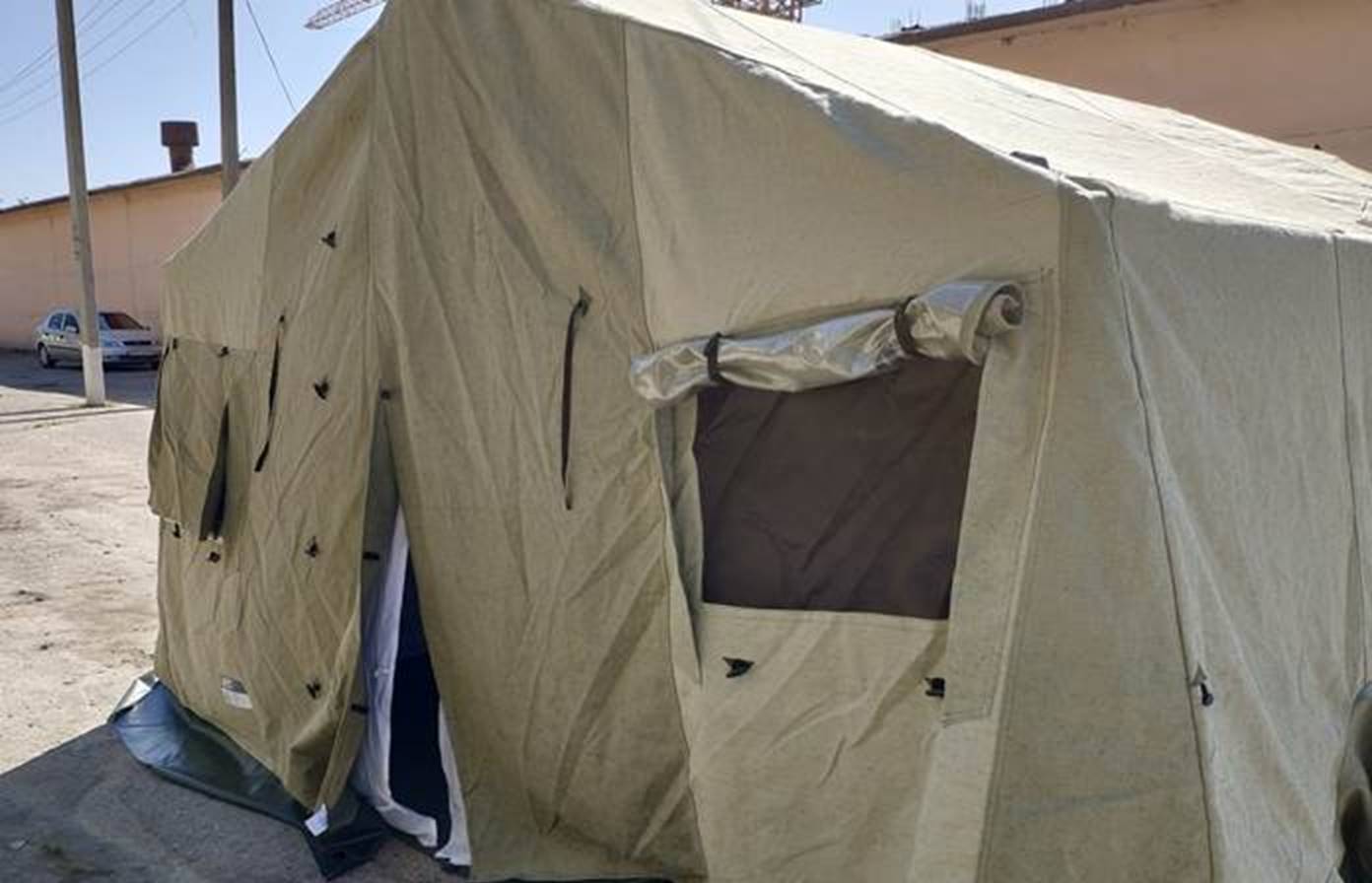
The Food and Agriculture Organization of the United Nations (FAO) recently handed over sets of camping equipment including 37 water tanks of 2 000 liters each, 37 electric power generators of 5 kilovolt ampere capacity and 37 big tents to the State Entity “Locust Control Expedition” of the Ministry of Agriculture of Tajikistan, according to FAO Office in Tajikistan.
The delivered field equipment will improve living and working conditions of locust specialists during the locust season, from early spring to late summer, when they monitor the locust situation and identify highly infested areas. In turn, the field teams will be in a better position to reduce risks associated with locust crises on agricultural production, food security, livelihoods, human health and environment. It is crucial that locust specialists have convenient conditions and means to properly conduct locust surveys.
How the system of local monitoring works? Data collected in the field is transmitted to the central level on a regular basis and upon completion of data analysis, reports including information on locust situation, forecast and recommendations are sent to the highest authorities for decision on control operations. In other words, appropriate locust monitoring allows improving early warning and response mechanisms to locust outbreaks, as well as establishing proper and timely control operations.
The delivery of camping kits is part of the program to improve national and regional locust management in the Caucasus and Central Asia, namely Afghanistan, Kyrgyzstan and Tajikistan. It is funded by the Government of Japan and the Japan International Cooperation Agency. The ultimate goal of improved locust management is to support farmers through the protection of crops and pastures.
One of the main and important objects of the program is regional cooperation, vital for the successful management of such transboundary plant pests. Cross-border locust surveys, as well as other joint activities are carried out with neighboring countries, Kyrgyzstan and Afghanistan. Continuous and timely exchange of information between partners, and environmentally friendly control are other important factors.
“This year the locust was spread on 107 thousand hectares area in 37 districts of the Republic of Tajikistan. The senior specialists of the State Entity “Locust Control Expedition” work in each district,” said Saidmurod Khairiddinov, the head of the State Entity “Locust Control Expedition”. “All these branches will receive one set of camping equipment, consisting of one tent, one generator and one water tank.”
“Control operations and chemical processing are performed out of populated areas, where camps will be temporary installed for field staff and seasonal workers. As well all other equipment and machines that have been received within the project are used purposefully, ” added Khairiddinov.
Locust infestations are severe and serious agricultural threat in Tajikistan, particularly in three out of four regions of the country – Khatlon and Sughd provinces and districts subordinate to the center (RRP). Locust outbreaks and upsurges are very destructive as locusts attack a wide range of crops and plants. Crops and pasture damages and losses caused by locusts often adversely impact livelihoods of vulnerable farmers and food security in these regions, as well as in neighboring countries.
After collapse of the Soviet Union and the civil war, locust management was implemented with limited available resources that were insufficient for effective control. Indeed, there were difficulties to cope with locusts due to the lack of trained and experienced staff, shortage of modern equipment for monitoring, communication, positioning and control as well as inadequate resources for survey and control operations. In addition to the camping kits, the project has earlier provided the locust control expedition with 19 four wheel drive cars and over 40 pads to perform the proper monitoring using GIS tools.
“I hope survey and control equipment will allow our colleagues at the Ministry of Agriculture to manage locusts’ outbreaks in a better and more effective way with less harm to human health and the environment, which will in the end contribute to overall food security and to improvement of livelihoods of the local population,” – emphasized Oleg Guchgeldiyev, FAO representative in Tajikistan.
The three-year project started in December 2015 under the FAO multi-funded program to improve national and regional locust management in Caucasus and Central Asia, which was launched in 2011 to the benefit of ten countries (Afghanistan, Armenia, Azerbaijan, Georgia, Kazakhstan, Kyrgyzstan, Russian Federation, Tajikistan, Turkmenistan and Uzbekistan).