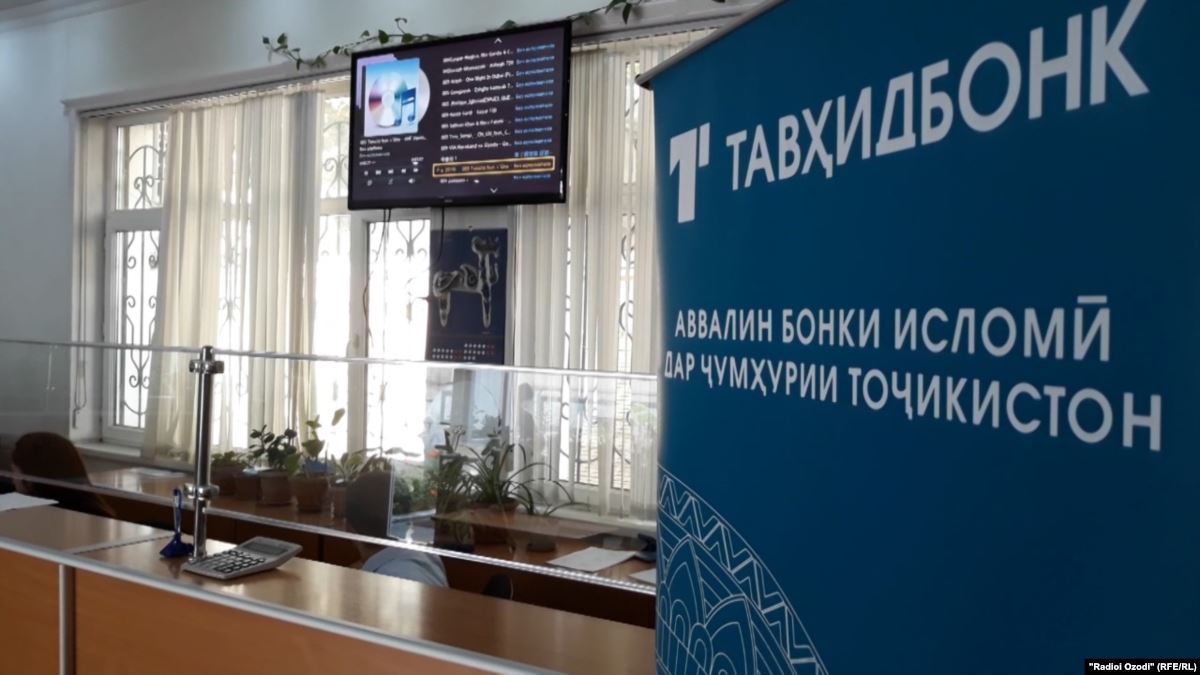
Tax and legislative barriers impede development of Islamic financing, says the press center of the Open Joint-Stock Company (OJSC) Tawhidbonk, the first full-fledged Islamic bank in Tajikistan.
The current tax regime reportedly impedes intensive growth in active financing by Tawhidbonk of economic entities in the country.
“Existing financial potential and free resources of Tawhidbonk are enough to actively financing economic entities, but imperfection of legal acts and taxation regime does not allow the bank to actively use its investment and financing capabilities for the good of our economy and people in such a difficult period,” the press center says.
Tawhidbonk managers are sure that if the mentioned problems are solved, the bank can become one of active investors for the national economy without attraction of external resources.
“Taking into account that under the conditions of COVID-19 pandemic and global economic stagnation the national economy is in urgent need of investment and loan resources, Tawhidbonk proposes to equate the procedure of taxation of Islamic bank to the procedure of taxation of traditional banks,” Tawhidbonk press center notes.
The bank, in particular, asks for not levying the value added (VAT) on banking transactions of Islamic banks related to purchase and sale of assets (Murabahah, Tawarruq, Ijarah, Salam, Istisna’ and others).
Several Islamic contracts have been used by Islamic banks to cover the financial needs of their customers. The contracts include Murabahah, Ijarah, Tawarruq, Mudarabah, Musharakah, Salam, and Istisna'.
Besides, Tawhidbonk proposes, pending adoption of relevant amendments to the country’s tax code, to temporarily equate transactions of Islamic banks to financial transactions, the list of which is determined by the Ministry of Finance upon the agreement with the National Bank of Tajikistan and the authorized government body.
Recall, Tawhidbonk, which had been established on the basis of OJSC Sohibkorbonk, was granted the license for banking operations in September last year.
Sohibkorbonk began converting operations to become a full-fledged Islamic bank in October of 2017. Chairman of Sohibkorbonk Board Sherali Zardov and the Islamic Corporation for the Development of the Private Sector (ICD) chief executive Khaled Al-Aboodi signed a memorandum of understanding (MoU) in Dushanbe in early October of 2017.
The law on Islamic banking in Tajikistan came into force on August 5, 2014.
Islamic banking is a banking activity that is consistent with the principles of Sharia and its practical application through the development of Islamic economics. Sharia prohibits the fixed or floating payment or acceptance of specific interest or fees (known as riba, or usury) for loans of money. Investing in businesses that provide goods or services considered contrary to Islamic principles is also haraam ("sinful and prohibited"). Although these principles have been applied in varying degrees by historical Islamic economies due to lack of Islamic practice, only in the late 20th century were a number of Islamic banks formed to apply these principles to private or semi-private commercial institutions within the Muslim community.
Islamic banking has the same purpose as conventional banking: to make money for the banking institute by lending out capital. But that is not the sole purpose either. Adherence to Islamic law and ensuring fair play is also at the core of Islamic banking. Because Islam forbids simply lending out money at interest, Islamic rules on transactions (known as Fiqh al-Muamalat) have been created to prevent it. The basic principle of Islamic banking is based on risk-sharing which is a component of trade rather than risk-transfer which is seen in conventional banking.
Islamic banks reportedly have more than 300 institutions spread over 51 countries, including the United States through companies such as the Michigan-based University Bank, as well as an additional 250 mutual funds that comply with Islamic principles.