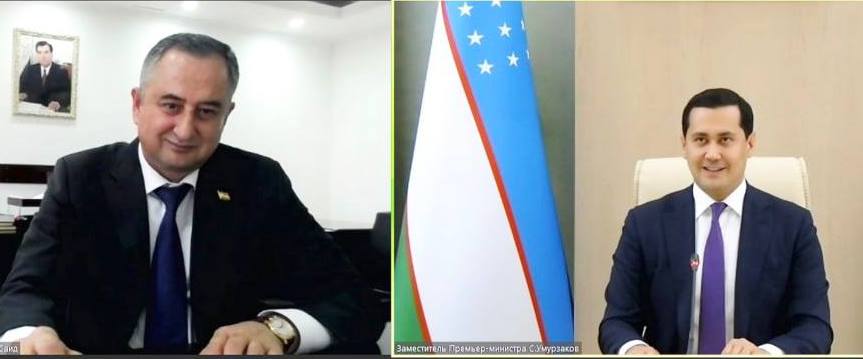
Deputy prime ministers of Tajikistan and Uzbekistan have held a virtual meeting to discuss prospects of further expansion of multifaceted cooperation between the two countries.
The press center of the Uzbek Ministry of Investment and Foreign Trade (MoIFT) says Uzbek Deputy Prime Minister Sardor Umurzakov, who is also Minister of Investment and Foreign Trade of Uzbekistan, on February 15 held a videoconference with Davlatali Said, Deputy Prime Minister of Tajikistan.
The parties reportedly made a special emphasis on the expansion of cooperation ties between relevant industrial enterprises with a focus on the production of technological products in electrical and mechanical engineering industries.
The MoIFT press center notes that they outlined the joint implementation of projects on the implementation of automated control systems and electricity metering as well as remote control of outdoor lighting at industrial enterprises in Tajikistan as the priority of the bilateral economic cooperation between the two countries.
The parties also agreed to intensify the joint work on improvising conditions for further development of a two-way trade between the two countries by sequential cancellation of existing technical barriers and ensuring favorable access of goods of Uzbek and Tajik production to the markets of both countries.
This, among other things, will allow increasing the bilateral trade between the two countries to 1 billion U.S. dollars in the near future.
They reportedly also agreed to expand cooperation on modernization of a number of hydraulic facilities by attracting financial and technical assistance from international financial institutions and donors.
The parties also discussed issues of working out a mechanism to ensure the stable and timely supply of water to Uzbekistan from reservoirs in Tajikistan.
Following the negotiations, the parties reached an agreement to set up a joint group to monitor the implementation of bilateral agreements, analyze unused potential for expansion of investment cooperation and review market conditions of the two countries to develop specific proposals for increasing the volumes of the mutual trade.
They also agreed to develop a roadmap to promote joint initiatives on investment, trade, transportation and energy cooperation.
Recall, information about water breaching the dam of the Qayroqqum reservoir in Tajikistan that appeared on Uzbek social networking on January 14 caused panic in Uzbekistan.
The Emergencies Committee under the Government of Tajikistan says the reservoir powering the Qayroqqum hydropower plant is safe and sound and operates normally. Emergency management agencies of both countries call on the population to be calm and not believe rumors.
The Qayroqqum reservoir is a large artificial lake in the Tajik northern Sughd province powering the Qayroqqum hydroelectric power plant (HPP). In 2016, the reservoir was renamed Tajik Sea (Bahri Tojik in Tajik) by the country's parliament. The reservoir lies in the western part of the Ferghana Valley on the Syr Darya River.
Recall, the tragic failure of the Sardoba dam in Uzbekistan has sparked fresh debate around water conflicts and the need for cooperation between Central Asia’s countries.
At 5.55 am on May 1, 2020, after five days of severe storms, a dam wall at the Sardoba reservoir in Uzbekistan’s Syr-Darya oblast collapsed and water poured through a breach onto cotton fields and villages. To reduce water pressure on the walls of the reservoir and prevent further collapse of dam walls, its gates were opened. Water spilled into the Southern Golodnostepsky Canal and its offshoots, with the intention of sending it to the Aydar-Arnasay lakes – a wetland of international ecological importance. The capacity of the canal was overwhelmed, and the flood expanded. According to some sources, the volume of water lost could exceed 500 m3 of the 922 million m3 the reservoir was designed to hold.
The flooding reportedly affected more than 35,000 hectares of land in Uzbekistan and Kazakhstan. Six people died and at least 111,000 were evacuated from the Syr Darya River basin.