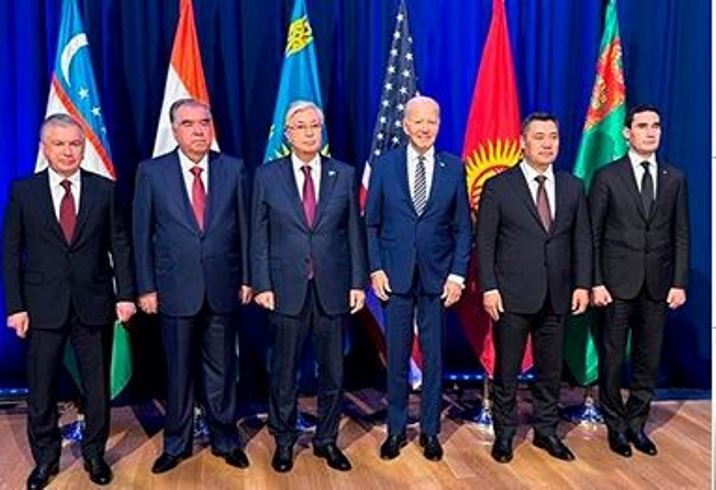
Tajik President Emomali Rahmon yesterday participated in an inaugural summit of leaders of Central Asia and United States. The meeting place at UN headquarters in New York.
According to the Tajik president’s official website, the leaders in attendance included Kazakhstan’s President Kassym-Jomart Tokayev, Kyrgyzstan’s President Sadyr Japarov, Tajikistan’s President Emomali Rahmon, Turkmenistan's President Serdar Berdimuhamedow, Uzbekistan’s President Shavkat Mirziyoyev and US President Joseph Biden.
The summit marked the first-ever C5+1 presidential gathering and occurred on the sidelines of the 78th session of the UN General Assembly.
The summit started with the welcoming of the heads of the states of Central Asia by the President of the United States of America and a commemorative photo-taking ceremony of the participants.
The work of the summit was inaugurated with opening remarks by the President of the United States of America, Joseph Biden.
The Tajik president’s official website says during their speeches, the leaders of the Central Asian countries made a number of proposals regarding the important issues on the agenda of the meeting and further strengthening of the beneficial cooperation of the countries of the summit.
According to The White House, the leaders discussed a range of issues, including security, trade and investment, regional connectivity, the need to respect the sovereignty and territorial integrity of all nations, and ongoing reforms to improve governance and the rule of law.
Because US President Biden recognizes that the countries must cooperate to have resilient, secure supply chains that can support the future energy landscape, the United States reportedly proposed launching a C5+1 Critical Minerals Dialogue to develop Central Asia’s vast mineral wealth and advance critical minerals security. These efforts are part of continued U.S. support to drive investment in and development of the Trans-Caspian Trade Route (the so-called “Middle Corridor”) through the Partnership for Global Infrastructure and Investment that will help facilitate regional economic integration and resilience.
According to the results of the meeting of the heads of state in the C5+1 dialogue format, the Declaration of the Heads of State was adopted, in which the important global and regional issues and the main directions of cooperation between the countries of this format were reportedly pointed out.
Some experts note that the summit underscores Washington's growing interest in Central Asian countries.
According to them, Biden met with Central Asia presidents with both Russia and China in mind.
In the last year, there has been a steady stream of U.S. officials filtering through Central Asia.
Assistant Secretary of State for South and Central Asian Affairs Donald Lu stopped in Kyrgyzstan and Tajikistan in April this year, followed that same month by Assistant Secretary for Terrorist Financing and Financial Crimes Elizabeth Rosenberg from the Treasury Department, and the Commerce Department’s Assistant Secretary for Export Enforcement Matthew S. Axelrod.
In late August, Michigan Senator Gary Peters, chairman of the U.S. Senate Committee on Homeland Security and Governmental Affairs paid visits to Kyrgyzstan and Kazakhstan.
The C5+1 has for almost a decade now brought together the foreign ministers of the five Central Asian countries — Kazakhstan, Kyrgyzstan, Tajikistan, Turkmenistan, and Uzbekistan — with their U.S. counterpart. In November 2015, then-Secretary of State John Kerry became the first secretary of state to visit all five Central Asian countries in one trip, a jaunt that began with his bypassing Uzbek capital Tashkent to meet with the Central Asian foreign ministers in the Uzbek city of Samarkand. The new format had been previewed in September that year, when Kerry met with the region’s foreign ministers on the sidelines of the U.N. General Assembly. In 2016, the C5+1 met in Washington in early August.
Then there was a change of administration, and although the C5+1 platform chugged along it was diminished in part by repeated absences of top U.S. diplomats.
The Central Asian foreign ministers met with Donald Trump’s first secretary of state, Rex Tillerson, in September 2017 on the sidelines of UNGA. Earlier in the year, a C5+1 branded security working group met in Dushanbe, but below the minister level.
In July 2018, the C5+1 met again in Uzbekistan — this time in Tashkent, under new leadership — but without the U.S. secretary of state. The U.S. delegation was led by Acting Deputy Assistant Secretary of State for Central Asia Henry Ensher. The group gathered in Kazakhstan’s capital, Astana, in August 2019, where once again, the U.S. secretary of state was absent from what was branded a “C5+1 High-Level Security Discussion.” On the sidelines of the UNGA that year, U.S. Secretary of State Pompeo finally hosted his first C5+1 meeting. On February 3, 2020, Pompeo made the trek to Central Asia where he met his regional counterparts in Tashkent.
In 2021, a new U.S. administration took up the C5+1. The group met with new Secretary of State Antony Blinken virtually in April 2021. An in-person meeting was held in July that year, with the U.S. delegation led by Deputy National Security Advisor Elizabeth Sherwood-Randall.
In 2022, U.S. interest in Central Asia was transformed by the war in Ukraine. The C5+1 met on the sidelines of UNGA once again and by November the United States had announced a new $25 million economic initiative focused on the region.