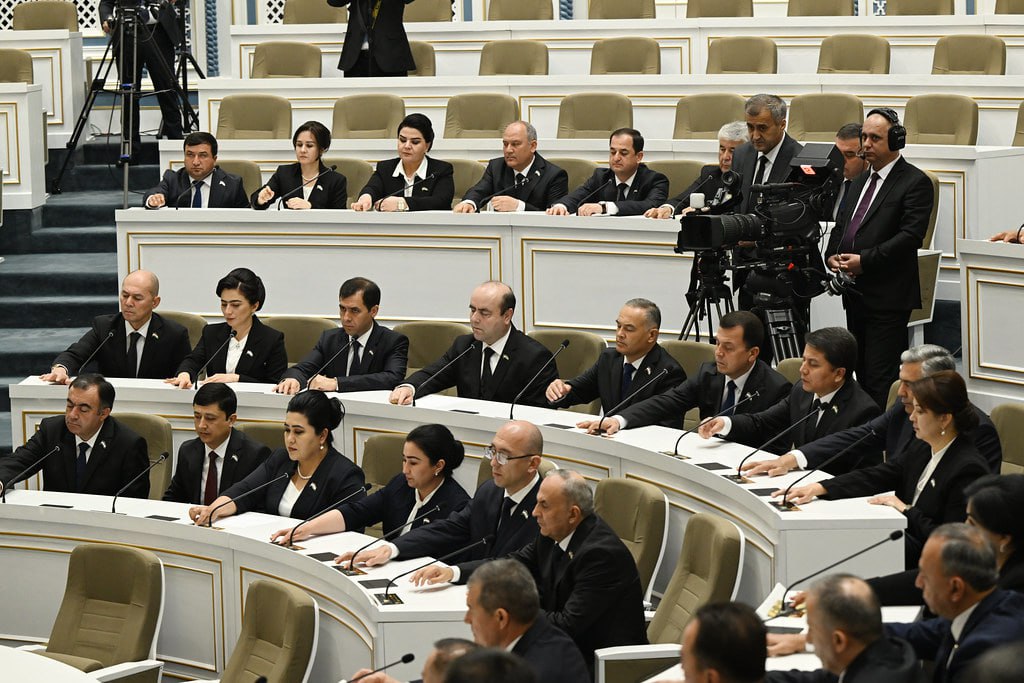
The heads of committees and commissions of the Majlisi Namoyandagon (Tajikistan’s lower chamber of parliament) have been elected. The lower house of Tajikistan’s parliament consists of several committees and commissions.
Muhammadato Sultonov, a spokesman for the Majlisi Namoyandagon, says the newly elected chairs of the Majlisi Namoyandagon committees are:
- Rustam Shohmurod, member of the ruling People’s Democratic Party of Tajikistan (PDPT) – Chair of the Committee on Legislation and Human Rights
- Nasrullo Mahmoudzoda (PDPT) – Chair of the Committee on Law Enforcement, Defense and Security
- Ghiyosiddin Ashourzoda (Head of the Party of Economic Reforms of Tajikistan) – Chair of the Committee on Economy and Finance
- Rustam Latifzoda (Head of the Agrarian Party of Tajikistan) – Chair of the Committee on Agrarian Issues, Water Resources and Land Affairs
- Mahmadsho Gulzoda (PDPT) – Chair of the Committee on International Affairs, Public Associations, and Information
- Muhammad Shodiyon (PDPT) – Chair of the Committee on Science, Education, Culture and Youth Policy
- Mujibakhon Javhari (PDPT) – Chair of the Committee on Social Issues, Family Affairs, and Health Protection
- Ilhom Kamolzoda (PDPT) – Chair of the Committee on State-Building and Local Self-Government
- Muhammadullo Sheralizoda (PDPT) – Chair of the Committee on Energy, Industry, Construction and Communications
The heads of the commissions were also elected:
- Orif Amirzoda – Chair of the Environmental Commission
- Parviz Shodizoda – Chair of the Commission on Deputies’ Ethics
- Shuhrat Ghanizoda – Chair of the Commission on Regulation and Organizational Work
Muhammadato Sultonov further noted that no parliamentary factions have yet been formed in the lower house of Tajikistan’s parliament.
According to Article 53 of the Law “On the Majlisi Oli of the Republic of Tajikistan,” a faction or group in parliament can be formed with at least five MPs. Every member of the Majlisi Namoyandagon deputy has the right to participate in a faction and be its member.
Recall, Mr. Fayzali Idizoda, who was elected to the Majlisi Namoyandagon from single-mandate constituency No 12 (Rasht district), was elected as new speaker of the Majlisi Namoyandagon.
Mr. Shermuhammad Shohiyon, a MP from the nationwide electoral district, was elected as First Deputy Chairman of the Majlisi Namoyandagon.
Mr. Aziz Giyozoda, who was elected to the Majlisi Namoyandagon from single mandate constituency No 41 (GBAO’s capital, Khorog), was elected as Deputy Chairman of Majlisi Namoyandagon.
Ms. Mavsouma Muni, who was elected to the Majlisi Namoyandagon from single mandate constituency No 13 (Sughd’s capital, Khujand), was elected as Deputy Chairperson of the Majlisi Namoyandagon.
The parliamentary elections were held in Tajikistan on March 2 and the voter turnout was reportedly 85.3 percent.
The elections to the Majlisi Namoyandagon resulted in a victory for the ruling PDPT, which secured 49 out of 63 seats in the Majlisi Namoyandagon—two more than in the previous convocation.
Among the participating parties, PDPT received 51.9% of the votes, the Agrarian Party gained 21% (7 seats), the Party of Economic Reforms secured 12.7% (5 seats), the Democratic Party received 5.1% (1 seat), and the Socialist Party garnered 5.3% (1 seat).
The Communist Party of Tajikistan, for the first time, failed to win any seats in parliament.
Notably, the Social-Democratic Party, the only Tajik party to explicitly oppose President Emomali Rahmon, did not participate in the elections. While it had taken part in previous elections, it never secured any mandates.
Members of the Majlisi Namoyandagon (Tajikistan’s lower chamber of parliament) are directly elected for a five-year term according to a mixed majoritarian-proportional system. Of the 63 MPs, 41 are elected from single-mandate districts, with the winning candidate requiring a majority of votes cast. If no candidate receives a majority, a second round is held within two weeks between the two leading candidates. More than 50 per cent of registered voters must participate for the election to be valid; otherwise, repeat elections must be held. The other 22 MPs are elected from a single nationwide district under a proportional, closed-list system with a five percent threshold.