The upcoming European Union-Central Asia summit, to be held in the Uzbek city of Samarkand from April 3-4, is seen by some European observers as a potential watershed moment that can establish Brussels’ Global Gateway strategy as a genuine competitor to China’s Belt & Road initiative for regional influence. Initial responses to a pre-summit Central Asian tour by EU foreign policy chief Kaja Kallas, however, indicate that Central Asian leaders are cautious about the EU’s bid to raise its regional profile, Eurasianet reported on March 31.
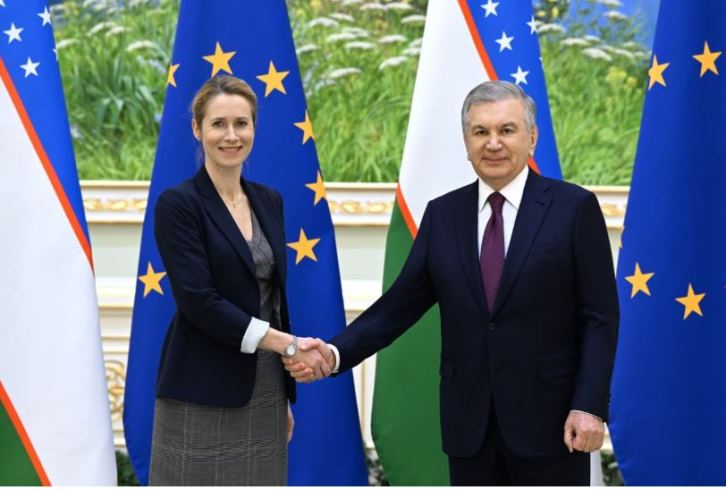
Kallas made a lightning visit to Central Asia on March 27-28, first stopping in Turkmenistan for a meeting with the foreign ministers of all five Central Asian states, followed by quick stops in Uzbekistan and Kazakhstan for talks with those countries’ respective presidents, Shavkat Mirziyoyev and Kassym-Jomart Tokayev.
A major aim of Kallas’ tour reportedly was to lay the groundwork for a successful summit. But judging by the desultory, diplomatic jargon used in the bevy of official statements about the discussions, the chances that the Samarkand meeting will turn out to be a momentous occasion seem slim.
A 23-point joint communique issued following the foreign ministerial meeting in Ashgabat contained lots of pro-forma provisions focusing mainly on promoting trade and addressing global warming-related issues, but also including one on preventing sanctions circumvention and another on “the importance of advancing the rule of law, democracy, good governance and accountability, gender equality and universal human rights.”
An EU statement reportedly did little to raise expectations, noting dryly that Kallas explored possibilities to expand trade and economic cooperation under the auspices of the Global Gateway program, adding that the upcoming summit “will confirm the political resolve for closer strategic cooperation between the two regions at the highest political level.”
Statements issued by Mirziyoyev and Tokayev about their discussions with Kallas were similarly restrained in their assessments, Eurasianet said, adding that Central Asia was long a diplomatic backwater for the EU, but Brussels’ interest in developing trade relations with regional states spiked following Russia’s unprovoked invasion of Ukraine in 2022. The EU’s heightened interest is reportedly driven in large part by its need to diversify its energy supplies.
Since the start of the Ukraine war, the EU and Central Asian states have adopted a road map for expanding relations in 2023, followed by a groundbreaking investors’ forum in early 2024, during which the EU pledged a 10-billion euro investment to develop the Trans-Caspian trade network. Brussels has also offered Central Asian states the prospect of signing enhanced partnership deals. The upcoming Samarkand summit aims to inject fresh momentum into trade relations.
Some regional analysts say the hard part for Brussels in expanding its economic and diplomatic footprint in Central Asia is yet to come.
“The EU will have to compete for influence not in a vacuum, but in the context of the already established presence of Russia and China – players that clearly do not intend to give up their positions in this historically key region,” wrote regional analyst Merkhat Sharipzhanov in a commentary published by Radio Liberty.