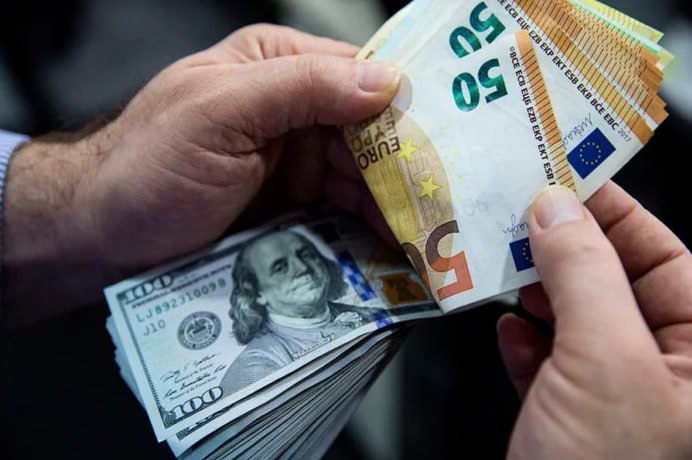
Tajik banks often refuse to exchange foreign currency banknotes that have the slightest damage — a problem raised by Asia-Plus readers. In response, our newsroom conducted its own experiment to find out which foreign bills Tajik banks are required to accept, and which they are allowed to reject.
The bank tour
One reader reported that several currency exchange offices in Dushanbe had refused to accept €50 notes with minor defects. He provided the bills in question, and indeed, the damage was extremely minimal — just four pinholes, each about 0.3 mm in diameter, in the central part of the two banknotes. That’s roughly the thickness of a fine needle.
According to the Instruction No. 211 of the National Bank of Tajikistan (NBT), exchange points are required to accept foreign banknotes with pinholes up to 0.5 mm in diameter.
To investigate why these bills were rejected, an Asia-Plus reporter visited several currency exchange offices in Dushanbe.
At the nearest locations — Alif Bank, IMON International MDO, and Moliyа MDO — staff refused to exchange the slightly damaged banknotes without providing any explanation.
At a branch of Eskhata Bank (near Asia Grand Hotel), one of the country’s top three systemic banks alongside Amonatbonk and Orienbonk, staff verified the authenticity of the bills and agreed to exchange them — but with a 10% commission.
The head office of Orienbonk also confirmed they would accept the notes but charge a commission. In this case, they offered 100 somonis less than the exchange rate for €100.
In contrast, branches of Amonatbonk, which controls nearly a quarter of the banking sector in Tajikistan, advised visiting their head office, which accepts such banknotes without any commission.
And that turned out to be true: at Amonatbonk’s main branch, staff confirmed there was no reason to reject or apply a commission to the notes.
The NBT press office told Asia-Plus that the rules for determining the authenticity and legal status of foreign banknotes are outlined in Instruction No. 211, available on the central bank’s website.
What kind of banknotes are banks required to accept?
According to the appendix of Instruction No. 211, foreign currency banknotes are considered acceptable if they meet the following criteria:
- They retain the main security features;
- b) They show signs of wear and dirt;
- c) They have reattached or torn corners/pieces (no larger than 1–2 cm²) that clearly belong to the note;
- d) They have taped tears that are less than 25% of the note's width;
- e) They have small stains, markings, or stamps (excluding stamps indicating the note is counterfeit), as long as these do not obscure over 50% of the key security features;
- f) They have pinholes no larger than 0.5 mm in diameter;
- g) They are still officially in circulation until the withdrawal date announced by the issuing country’s central bank.
What kind of banknotes can be rejected?
Banknotes may be classified as non-acceptable if they meet any of the following criteria:
- Torn into pieces and glued back together;
- b) Lacking main security features;
- c) Discolored or faded;
- d) Burnt or charred;
- e) Soaked in ink, paint, or oil;
- f) Deliberately damaged (e.g., portraits altered, security thread removed, excessive markings — including those visible under UV light);
- g) Size altered by more than 3 mm in any direction;
- h) Banknotes that have been withdrawn from circulation after the date specified by the central bank of the respective foreign country as their last valid day of use.
If possible, damaged notes may still be exchanged for equivalent undamaged notes or somoni — but with a commission fee.
The National Bank clarified that commercial banks are free to set their own fees, including exchange commissions, without involvement from the regulator.