Russian parliament approves new rules for deportation of migrants and restrictions on citizenship

Migrants in Russia face new restrictions

Asia+

The State Duma (Russia’s lower chamber of parliament) yesterday approved n the first reading two bills that significantly tighten migration policy.

As announced at the meeting by State Duma Speaker Vyacheslav Volodin, these bills are aimed at “further improving migration policy.”

One of them, according to him, prohibits foreigners with an outstanding or unexpunged criminal record “for committing any crime on the territory of Russia or beyond” from acquiring Russian citizenship, a residence permit, or a temporary residence permit, regardless of the severity of the crime.

“Also in such a case, it is proposed to annul the previously issued temporary residence permit or residence permit,” Volodin added.

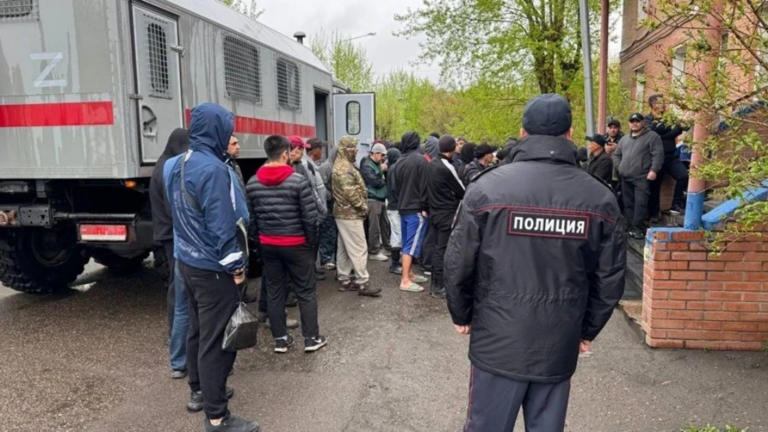
The second bill concerns “doubling – from 22 articles of the Administrative Code to 43 – the list of administrative offenses for which foreign citizens will be subject to expulsion.”

The list of new grounds for expulsion includes articles related to political activity and expression of position, Fergana writes.

Specifically, this refers to the “discrediting” of the Russian army, calls for the imposition or maintenance of sanctions against Russia, demonstration of Nazi or extremist symbols, dissemination of extremist materials, as well as abuse of media freedom.

In addition, grounds for deportation may include participation in unauthorized rallies, violation of the state of emergency or martial law, creating obstacles to transport infrastructure, and minor hooliganism associated with disobedience to the police. For 20 new articles, mandatory expulsion is proposed without the possibility of considering the violator’s personal circumstances, Kommersant noted.

The authors of the initiative explain the need for tightening by the increase in the number of offenses among foreign citizens. According to the State Duma speaker, about 72,000 migrants were expelled from Russia last year..

Join us on social media!

Article translations:

Related Article

Оби зулол
Оби зулол

Most Read

Акика Алиф

Recent Articles

Donald Trump arrives in Beijing

Trump will spend three days in China.

In Tajikistan, a unique surgery was performed for the first time on a child with an extremely rare pathology

Tajik and Russian surgeons successfully performed the most complex reconstruction of the bladder and abdominal wall for a child with recurrent exstrophy.

The ministry of health states that hantavirus does not threaten Tajikistan

Cases of infection with this virus were detected on board the cruise liner Hondius near the Canary Islands.

Tajikistan lags behind other Central Asian countries in number of chain hotels – study

The Republic remains a niche market with a limited number of quality hotels.

Climate risks threaten food security in Central Asia – FAO

Land degradation reduces agricultural productivity. The loss of biodiversity weakens the ecosystems that farmers, livestock breeders, and rural communities depend on.

Potential or illusion? Why the world overlooks Tajikistan’s mineral wealth

The republic may indeed possess significant reserves of rare metals, but there is a catch...

The case of ousted Kyrgyz security boss classified and moves to court

The former head of the GKNB is charged with violent seizure of power and abuse of official position.

Trump states that Iran’s nuclear program is a higher priority than U.S. citizens’ economic issues

Fluctuations in energy prices led to record inflation in the United States in April, the highest in the past three years.

Foot-and-mouth disease, plague, and flu: Central Asia threatened by transboundary animal diseases

FAO urges Central Asian countries to strengthen coordination and epidemiological surveillance.

Tajikistan approves the second phase of the Electric Transport Development Program; $95 million will be allocated for its implementation.

At this stage, the authorities are focusing on charging infrastructure, services for electric vehicles, and the expansion of the electric bus fleet.