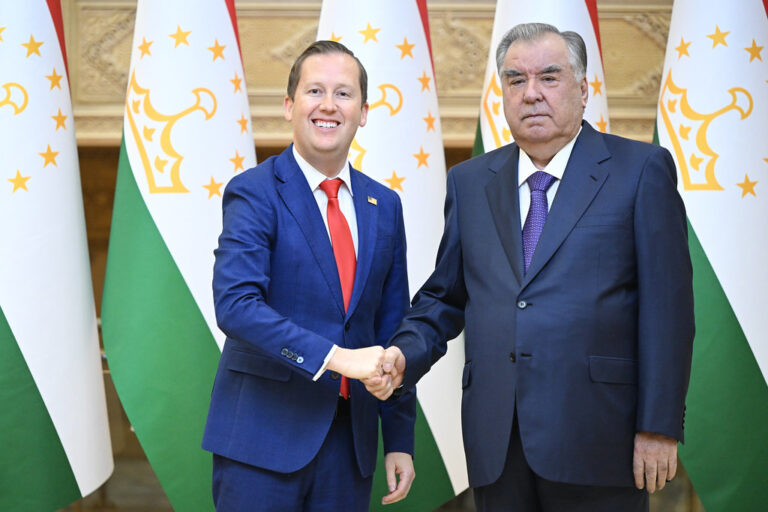
DUSHANBE, June 1, Asia-Plus — On Saturday May 30, President Emomali Rahmon received participants of the EU-CA FM Troika Meeting that was held in Dushanbe on May 29-30, according to presidential press service.
Speaking at the meeting, Tajik leader noted that in relations with the European Union (EU), Tajikistan proceeded from the necessity of covering the most important directions and spheres of cooperation, including the process of democratization, rule of law, border management, the fight against drug trafficking, development of transport and energy sectors, in particular development of renewable energy sources, as well as management of water resources, environmental protection, education, trade and investments, assistance for Tajikistan’s admission to the World Trade Organization (WTO), and demining assistance.
According to Rahmon, three strategic goals will determine development of Tajikistan’s economy, namely providing energy security, bringing the country out of the transport deadlock and providing food security.
Implementation of projects for development of the country’s water-and-energy resources is the most vitally needed for Tajikistan to overcome energy crisis, the president noted. “To meet the country’s annual requirements in electricity we now need 5 billion kWh of electrical power or 1,500 MW capacities,” Rahmon said.
“We adhere to principle line based on the necessity of keeping balance of both national and regional interests. In this connection, I would like to emphasize two essential points: firstly, hydropower is not water user – it does not use water irrevocably but just runs it through turbines of hydropower plants. In contrast to it, the irrigated agriculture takes river flow irrevocably; secondly, if other countries of the region have an opportunity to develop their economies due to irrigation of new lands, development of rich oil, gas and coal resources, we do not have enough such resources,” Rahmon said.
According to him, regional approach to development of water-and-energy resources in Central Asia gives an opportunity of integrated management of them that would meet interests of all states of the region.
“We are interested in unbiased and independent examination of water problems in Central Asia. I have repeatedly stated that no one of Tajikistan’s project in this sphere will be aimed against our neighbors,” stressed President Rahmon. “Unfortunately, they purposefully try to give political tinge to the water-and-energy problems in Central Asia. We consider that the issue may be solved only through constructive dialogue at the negotiating table. I personally for reaching agreement without mediators and we are ready for open dialogue. I believe we will be able to come to an agreement.”