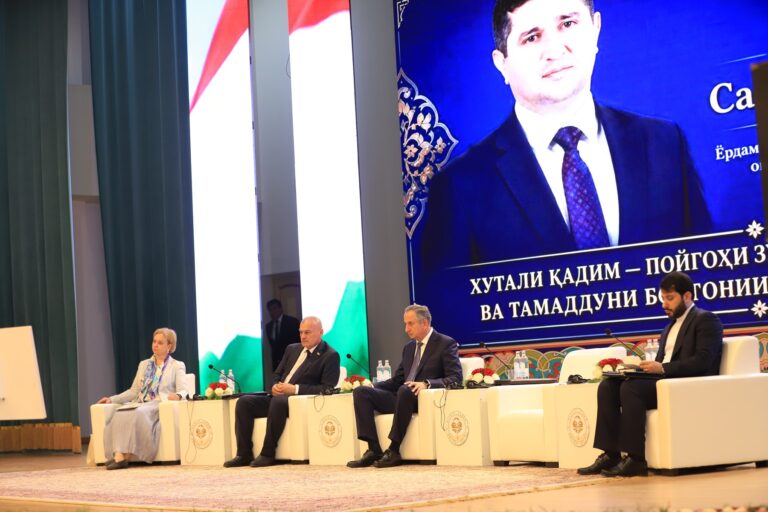
DUSHANBE, September 28, 2012, Asia-Plus — Some 80 members of the Public Council under the President as well as invited experts and stakeholders discussed the switchover to digital terrestrial TV broadcast in Tajikistan at an OSCE-supported Social Partnership Club meeting on September 27.
Though the issue of the transition, planned for 2015, has been discussed in several expert and stakeholder meetings under the aegis of the OSCE, this was the first time that a high-level forum also including a wide range of experts from culture, science and art, as well as representatives from parliament, government and civil society focused on the digital future of television in Tajikistan, the OSCE Office in Tajikistan said.
Ambassador Ivar Vikki, the Head of the OSCE Office in Tajikistan, said: “Because almost every home has a TV the digital switchover is something that will involve everybody. However, there is also a concern that many TV screens could go black after the switchover in 2015. It is a process that cannot be managed single handedly by the government.”
Saidmurod Fattoyev, State Adviser on Social and Political Issues said: “Digital broadcast allows for greater pluralism in broadcast media because it uses the frequency space more efficiently. This allows for more information to reach the viewers and improves information access and security in Tajikistan.”
Katrin Nyman-Metcalf, a Professor at Tallinn University of Technology and one of the broadcasting experts at the meeting, said: “This transition has many social and economic effects and consequences, and needs therefore an inclusive process, with planning and discussion involving all stakeholders.”
Much of the discussion centered on the challenges and opportunities of the transition, and highlighted the interest of civil society in participating in the process.
The Social Partnership Club meetings are an OSCE-supported activity of the Public Council, which itself was established based on the Agreement on National Accord in March 1996 and is an important forum for discussion of topical issues between top government officials and civil society. Its 90 members include government officials and representatives of political parties, religious organizations, national minority, public organizations and media.