
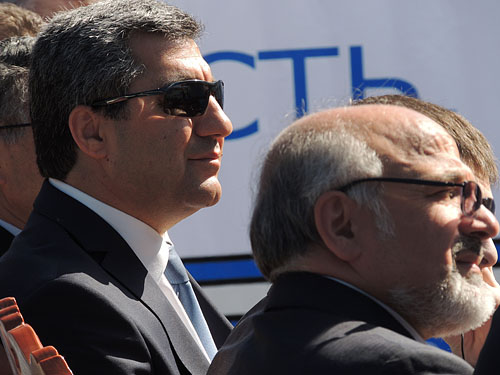
DUSHANBE, May 15, 2013, Asia-Plus – The Islamic Revival Party of Tajikistan (IRP) has applied to the Ministry of Interior (MoI) with solicitation to provide its leader Muhiddin Kabiri with personal guard.
According to IRP’s headquarters in Dushanbe, they sent an official letter on this subject to the Interior Minister Ramazon Rahimov on April 29. “However, we have not received reply from the minister yet,” the IRP representatives said, noting that the letter was sent to the interior minister following attacks on a number of the party members.
“The IRP deputy head Mahmadali Hayit was beaten by unknown assailants last month. Before that, some other members of party, including Hikmatullo Sayfullozoda were beaten,” said the IRP representatives. “We fear that the assailants now may attack our leader, and therefore, we applied to the minister, asking to provide him with personal guard.”
We will recall that Mahmadali Hayit was kicked and beaten by several unidentified attackers outside his home on the evening of April 19. He was taken to hospital after sustaining moderate and severe wounds.
Hikmatullo Sayfullozoda, who is a member of the IRP political council and editor of its newspaper, Najot, was also severely beaten on February 7, 2011. He was attacked on his way to the
Najot’s
office in Dushanbe. According to him, he was set upon by two assailants after a third person approached him and attempted to distract him. He suffered a blow to the skull and severe bruising around his eyes and mouth.
Founded in October 1990, the Islamic Revival Party of Tajikistan was registered on December 4, 1991. It was banned by the Supreme Court in June 1993 and legalized in August 1999. Its official newspaper is Najot (Salvation). According to some sources, IRP now has some 50,000 members. It won two seats in the 2010 parliamentary elections. The Islamic Revival Party of Tajikistan is the only Islamic party registered in CIS Central Asia.
Meanwhile, under Tajikistan’s legislation only the president, heads of both chambers of parliament, the prime minister and several officials having access to important classified information have the right to have bodyguards.
