
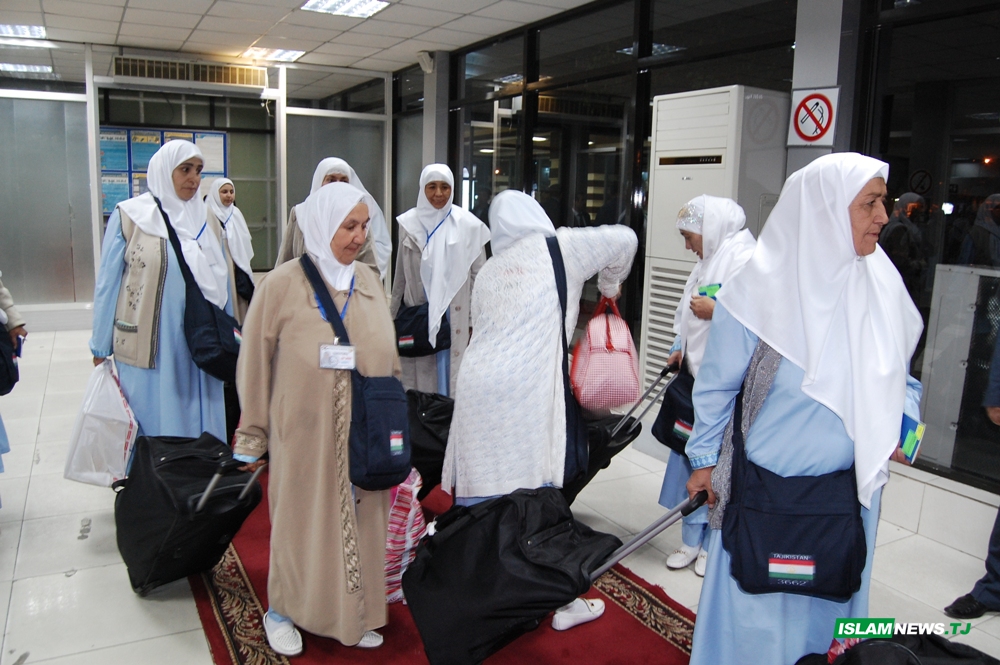
DUSHANBE, September 18, 2013, Asia-Plus – 6,000 Tajik nationals are expected to perform Hajj this year, Mavlon Mukhtorov, deputy head of the Committee on Religious Affairs (CRA) under the Government of Tajikistan told Asia-Plus Wednesday afternoon.
“Tajikistan’s population is nearing 8 million and 99.4 percent of them are Muslims. Proceeding from these figures, we hoped that Tajikistan’s quota for Hajj-2013 will be 7,800 but Saudi Arabia has slashed the number of Hajj pilgrims, including from Tajikistan, by 20 percent, citing massive construction work aimed at expanding grand Mecca mosque as a reason behind the decision,” said Mukhtorov. “Therefore, only 6,000 Tajik nationals will perform Hajj this year.”
The first group of Tajik Hajj pilgrims is expected to fly to Jeddah, Saudi Arabia on September 21. Tajik national air carrier, Tajik Air, and Tajik private air company, Somon Air, will carry Tajik Hajj pilgrims to Saudi Arabia.
According to information posted on the Committee on Religious Affairs (CRA)’s website, the cost of a round-trip ticket for Dushanbe-Jeddah-Dushanbe has increased by 241.00 somoni. Besides, the Saudi Ministry of Hajj has reportedly raised the cost of one Hajj seat by 240.00 somoni.
This year, Tajik pilgrims will have to pay 17,625 somoni (equivalent to more than 3,710 USD).
This amount reportedly includes travel expenses, board and lodging, medical service, special clothing with the national flag and purchase of animal for sacrificing during the Hajj.
Last year, the Hajj cost was 17,127.70 (equivalent to 3,546 U.S. dollars) and in 2011, the Hajj cost was 3,448 U.S. dollars.
In 2010, the Committee on Religious Affairs introduced age restrictions on those who want to perform the Hajj. Only citizens aged 18 to 80 are able to perform the Hajj.
The Hajj is the annual pilgrimage to Mecca, Saudi Arabia. It is currently the largest annual pilgrimage in the world, and is the fifth pillar of Islam, a religious duty that must be carried out at least once in their lifetime by every able-bodied Muslim who can afford to do so. The Hajj is a demonstration of the solidarity of the Muslim people, and their submission to God. The pilgrimage occurs from the 8th to 12th day of Dhu al-Hijjah, the 12th and last month of the Islamic calendar. Because the Islamic calendar is a lunar calendar, eleven days shorter than the Gregorian calendar, the Gregorian date of the Hajj changes from year to year.
