
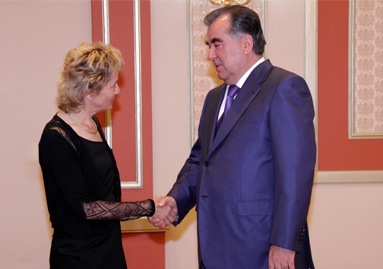
DUSHANBE, July 8, 2014, Asia-Plus /Avaz Yuldoshev/ — On Tuesday July 8, Tajik President Emomali Rahmon met here with visiting head of Switzerland’s Federal Department of Finance (the Swiss finance minister), Ms. Eveline Widmer-Schlumpf.
According to the Tajik president’s official website, the sides discussed state and prospects of further expansion of bilateral cooperation between Tajikistan and Switzerland. Issues related to trade and economic cooperation and investment were reportedly a major topic of the meeting.
Tajik leader noted that Tajikistan considered Switzerland as one of its main partners in Europe and was interested in further expansion of bilateral cooperation with that country.
Currently, dozens of Switzerland-supported projects for a total amount of 67 million U.S. dollars are being implemented in Tajikistan.
Over the first five months of this year, a two-way trade between Tajikistan and Switzerland has amounted to 141 million U.S. dollars, which was 4.3 times more than in the same period last year.
Eveline Widmer-Schlumpf is a Swiss lawyer, politician, and member of the Swiss Federal Council since 2008. She served as President of the Swiss Confederation for the year 2012.
The Federal Department of Finance (FDF) is one of the seven departments of the Swiss federal government. The department is headquartered in Bern and is headed by a member of the Swiss Federal Council, Switzerland”s finance minister.
Switzerland has been active in Tajikistan since 1993, when it delivered humanitarian aid during the civil war. In 1997 Tajikistan became a member of the Swiss led group of countries in the Bretton Woods Institutions, and at this point Switzerland established a Cooperation Office in Dushanbe, marking the shift from emergency relief to long-term development cooperation. The main Swiss actors present in Tajikistan are the Swiss Agency for Development and Cooperation (SDC), the Swiss State Secretariat for Economic Affairs (SECO) and the Human Security Division of the Federal Department of Foreign Affairs. Working closely together as one Switzerland, the role of these agencies has been and is to implement programs, which support a transition towards a pluralistic and economically viable state, contribute to poverty alleviation, and to help build institutions and systems which respond to the population’s needs.
Switzerland’s strategy for 2012 – 2015 in Tajikistan focuses on four priority areas: health; safe drinking water; rule of law; and private sector development.
