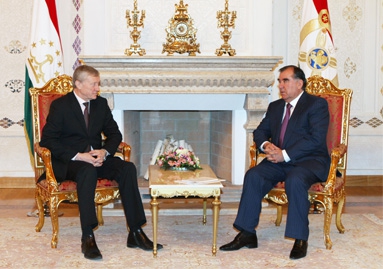
DUSHANBE, December 16, 2014, Asia-Plus – Tajik President Emomali Rahmon yesterday met here with Nikolai Bordyuzha, Secretary-General of the Collective Security Treaty Organization (CSTO).
According to the Tajik president’s official website, Rahmon and Bordyuzha discussed issues related to preparations for the next CSTO summit that will take place in Moscow in the near future.
The CSTO summit is expected to focus on military, military-technical, and military-economic cooperation between the Organization member nations as well as strengthening of regional security, including information security in the region.
The issue of helping Tajikistan strengthen its border with Afghanistan will also be among major topics of the upcoming summit, the source said.
Bordyuzha told journalists after his meeting with Emomali Rahmon that they had discussed a broad range of issues related to activities of the CSTO on providing security of all member nations of the Organization.
During a meeting in a narrow circle, the CSTO presidents will discuss a number of interesting mutual issues, including the decision on helping Tajikistan strengthen its common border with Afghanistan, Bordyuzha said.
The regional security organization was initially set up in 1992 in a meeting in Tashkent and Uzbekistan once already suspended its membership in 1999. However, Tashkent returned to the CSTO again in 2006 The regional security organization was initially formed in 1992 for a five-year period by the members of the CIS Collective Security Treaty (CST) — Armenia, Kazakhstan, Kyrgyzstan, Russia, Tajikistan, and Uzbekistan, which were joined by Azerbaijan, Georgia, and Belarus the following year. A 1994 treaty reaffirmed the desire of all participating states to abstain from the use or threat of force, and prevented signatories from joining any “other military alliances or other groups of states” directed against members states. The CST was then extended for another five-year term in April 1999, and was signed by the presidents of Armenia, Belarus, Kazakhstan, Kyrgyzstan, Russia, and Tajikistan. In October 2002, the group was renamed as the CSTO. Uzbekistan that suspended its membership in 1999 returned to the CSTO again in 2006 after it came under international criticism for its brutal crackdown of antigovernment demonstrations in the eastern city of Andijon in May 2005. On June 28, 2012, Uzbekistan announced that it has suspended its membership of the CSTO, saying the organization ignores Uzbekistan and does not consider its views. The CSTO is currently an observer organization at the United Nations General Assembly.