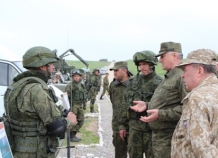
DUSHANBE, April 21, 2016, Asia-Plus — Colonel-General Vladimir Zarudnitskiy, Commander of Russia’s Central Military District, arrived in Tajikistan on April 20 to inspect preparedness of the Russian contingent for the main phase of the ongoing training exercise for military intelligence units from five member nations of the Collective Security Treaty Organization (CSTO), dubbed
Search 2016
, according to the Central Military District press center.
The main phase of the ongoing military intelligence war game is taking place today at the Lohour training ground, some 30 kilometers of Dushanbe.
Colonel-General Vladimir Zarudnitskiy is also scheduled to hold working meetings senior representatives of the CSTO Unified Staff and representatives of the CSTO member nations.
We will recall that Tajik servicemen together with servicemen from Armenia, Belarus, Kazakhstan, Kyrgyzstan and Russia are taking part in the ongoing military intelligence war game, which is the first of its kind.
1,500 servicemen from CSTO member states Armenia, Belarus, Kazakhstan, Kyrgyzstan, Russia, and Tajikistan are reportedly taking part in the exercise that was launched on April 18 and will conclude on April 22.
The Central Military District is one of Russia”s Military Districts. The district was formed in president’s decree №1144 signed on September 20, 2010. The district includes the territories of the former Siberian Military District.
In June 2015, U.S. expert Leslie H. Gelb wrote that the role of the Central Military District is to “orchestrate Russian engagement in local conflicts within Central Asia, to manage Russia’s bases in Tajikistan and Kyrgyzstan, and to supply reinforcements from its two armies either to the east or the west in the event of war” and that their purpose is to “forestall instability that might spill over into Russia and to remind everyone that Russia”s forces in the region are mightier than China”s.”
The regional security organization was initially formed in 1992 for a five-year period by the members of the CIS Collective Security Treaty (CST) — Armenia, Kazakhstan, Kyrgyzstan, Russia, Tajikistan, and Uzbekistan, which were joined by Azerbaijan, Georgia, and Belarus the following year. A 1994 treaty reaffirmed the desire of all participating states to abstain from the use or threat of force, and prevented signatories from joining any “other military alliances or other groups of states” directed against members states. The CST was then extended for another five-year term in April 1999, and was signed by the presidents of Armenia, Belarus, Kazakhstan, Kyrgyzstan, Russia, and Tajikistan. In October 2002, the group was renamed as the CSTO. Uzbekistan that suspended its membership in 1999 returned to the CSTO again in 2006 after it came under international criticism for its brutal crackdown of antigovernment demonstrations in the eastern city of Andijon in May 2005. On June 28, 2012, Uzbekistan announced that it has suspended its membership of the CSTO, saying the organization ignores Uzbekistan and does not consider its views. The CSTO is currently an observer organization at the United Nations General Assembly.