CIS leaders have agreed to adapt the Commonwealth of Independent States (CIS) to the new realities.
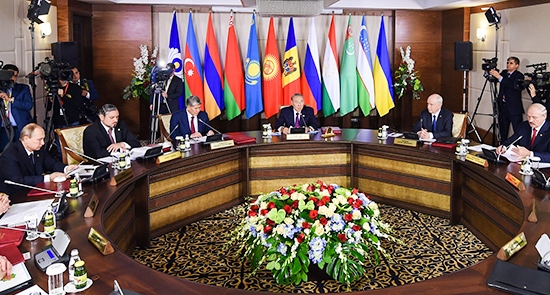
The CIS summit that took place in the Kyrgyz capital Bishkek on September 16 concluded with signing of 16 documents.
The CIS Executive Secretary, Sergei Lebedev, said the CIS Council of Heads of State also adopted four statements on anti-terrorism and other issues.
Member states discussed the state of affairs in the CIS and the necessity of adaptation of the Commonwealth to the new realities, he said.
"I am pleased to say that all heads of delegations unanimously noted the relevance of the CIS."
The statements, which were adopted almost unanimously by all the heads of the delegations, include the 25th anniversary of the CIS, which assesses the activities of the Commonwealth, states the need to improve and strengthen it.
CIS leaders signed statements on the results of the special session of the United Nations General Assembly, on further joint efforts to counter international terrorism and on the 70th anniversary of the Nuremberg Trials.
The summit participants included presidents of Armenia, Azerbaijan, Belarus, Kazakhstan, Kyrgyzstan, Russia and Tajikistan as well as Moldova’s prime minister, deputy chairman of the cabinet of ministers of Turkmenistan, foreign minister of Uzbekistan, and Ukraine’s ambassador to Kyrgyzstan.
Tajik President Emomali Rahmon was accompanied by Deputy Prime Minister Azim Ibrohim, Foreign Minister Sirojiddin Aslov, Presidential Adviser for Foreign Policy Azamsho Sharifi, the Chairperson of the Agency for Statistics under the President of Tajikistan, Ms. Gulnora Hasanzoda and some other officials, according to the Tajik president’s official website.
The CIS leaders reportedly discussed five issues in a narrow format, including statements and decisions on the holding of the next CIS summit, adaptation of the organization to the realities, and election of the executive secretary.
Russia proposed to extend powers of the CIS Executive Secretary Sergei Lebedev, who has held this position since 2007, for another three years – from 2017 to 2019.
The Bishkek meeting of the CIS Council of Heads of State discussed draft documents related to political, security and humanitarian cooperation between the CIS nations.
Particularly, the CIS leaders discussed reduction of CIS bodies and revision of their work as part of adaptation of the CIS to the new realities. This topic has been initiated by the Kazakh side.
Sixteen documents were signed during the CIS Summit, including the cooperation program in fight against terrorism and other violent forms of extremism until 2019, cooperation program 2016-2020 in fight against cybercrime, several documents on security and law enforcement cooperation.
They also discussed preparations for the 2020 round of population census and expansion of cooperation between regions of the CIS member nations.
Russia will take over as the rotating chair of the organization in 2017 and the next CIS summit will take place in Moscow in October next year.
Established on December 8, 1991 after the dissolution of the Soviet Union, the Commonwealth of Independent States (CIS) is a regional organization. It now consists of Azerbaijan, Armenia, Belarus, Kazakhstan, Kyrgyzstan, Moldova, Russia, Tajikistan, Turkmenistan, Uzbekistan and Ukraine. Georgia pulled out of the organization in 2009.