

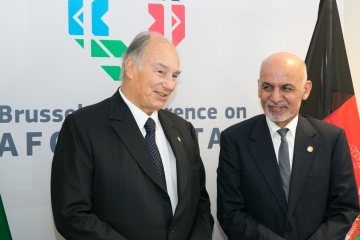
His Highness the Aga Khan confirmed yesterday that the Aga Khan Development Network (AKDN) would continue its long-standing commitment to Afghanistan by making new investments in education, health, poverty alleviation, energy and cultural heritage, according to AKDN.
He made these remarks at the Brussels Conference on Afghanistan.
“It is urgent to drive efforts to sustain and develop Afghanistan’s human and social capital,” remarked His Highness the Aga Khan, reiterating a commitment to education in Afghanistan that ranges from early childhood education to the training of doctors and nurses. The AKDN has supported the Ministry of Education’s National Education Strategic Plan in over 850 schools and education centers. It has also trained over 13,000 doctors, nurses, and health workers. For example, the French Medical Institute for Children, which AKDN manages and operates with partners, runs post-graduate medical education that now covers seven disciplines (pediatric medicine, pediatric surgery, anesthesiology, pediatric orthopedics, pediatric cardiology, pathology and radiology).
The Aga Khan also emphasized the importance of civil society. “Decades of experience have taught us that effective civil society is fundamental to lasting progress, helping ensure development that is inclusive and participatory. Civil society can unleash constructive talents from a broad spectrum of organizations and individuals, including the private sector.”
In many sectors, from culture to economic development, AKDN has been an important partner of the Afghan people. Its cultural programs, which operate in Kabul, Herat and Balkh, have restored over 120 historic buildings. Its economic projects – notably the Roshan mobile phone network, which reaches 6.5 million subscribers — span over 240 cities and towns in the country’s 34 provinces.
The Aga Khan also noted the potential for regional solutions to development issues, including infrastructure challenges, and cited the example of Pamir Energy; a public private partnership between the Aga Khan Fund for Economic Development and the Government of Tajikistan, which exports electricity from Tajikistan to nearly 35,000 Afghans.
Since 2001, AKDN and its partners have channeled over US$1 billion into the country. Its social development and humanitarian work is focused in 61 districts in seven provinces, impacting over 3 million people. In health, for example, AKDN’s public private partnerships have provided treatment to over 1.6 million Afghans patients through four hospitals, 12 basic and comprehensive health centers, 11 sub-centers, one prison health clinic and over 125 health posts.