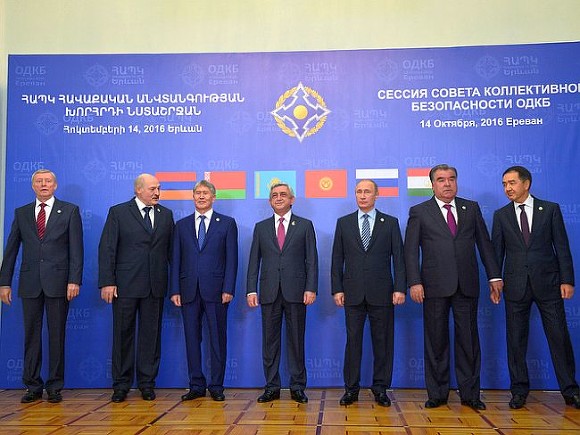
Russian media outlets report that during the meeting in Yerevan, the Collective Security Treaty Organization (CSTO) has adopted a number of documents, including agreements on drafting a unified list of terrorist organizations, a collective security strategy for the period till 2025, and a document on measures to address international terrorism and extremism.
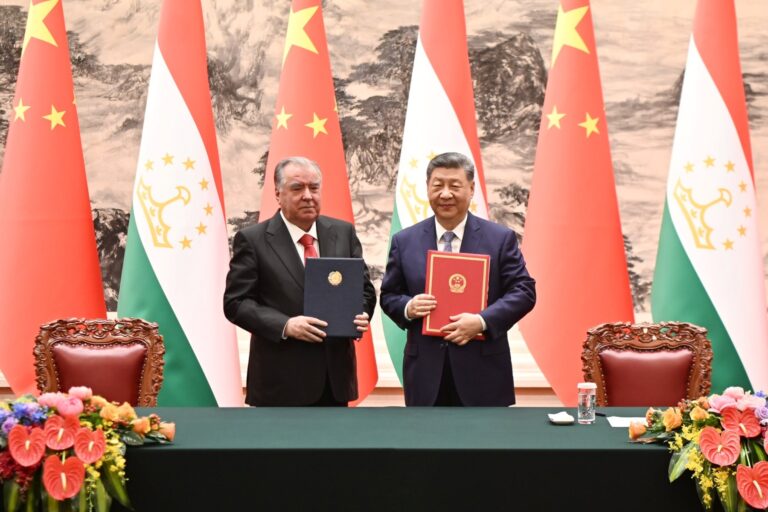
The meeting participants included presidents of Armenia (Serzh Sarkisyan), Belarus (Alexander Lukashenko), Kyrgyzstan (Almazbek Atambayev), Russia (Vladimir Putin) and Tajikistan (Emomali Rahmon).
Kazakhstan was represented by Prime Minister Bakhytzhan Sagintayev.
Kazakh President Nursultan Nazarbayev’s visit to Yerevan was cancelled in advance because of what Nazarbayev's aides described as “a cold.”
Nazarbayev reportedly returned to work at his office in Astana on October 14, three days after official reports said he was being treated for a “cold.”
According to Russian Tass news agency, the leaders of the CSTO member-states decided to set up a joint crisis response center to exchange information on common threats, including terrorism, and make decisions in real time.
Armenian President Serzh Sarkisyan, who hosted the summit, said the issue of a new secretary-general of the CSTO would be discussed at a summit of the Organization in St. Petersburg, Russia at the end of the year.
The meeting resulted in adoption of a joint statement on joint fight against international terrorism and other negative social phenomena, the Kremlin said.
As leaders gathered in Yerevan, Armenia formally transferred its chairmanship of the CSTO's Council of Foreign Ministers to Belarus.
The regional security organization was initially formed in 1992 for a five-year period by the members of the CIS Collective Security Treaty (CST) — Armenia, Kazakhstan, Kyrgyzstan, Russia, Tajikistan, and Uzbekistan, which were joined by Azerbaijan, Georgia, and Belarus the following year. A 1994 treaty reaffirmed the desire of all participating states to abstain from the use or threat of force, and prevented signatories from joining any “other military alliances or other groups of states” directed against members states. The CST was then extended for another five-year term in April 1999, and was signed by the presidents of Armenia, Belarus, Kazakhstan, Kyrgyzstan, Russia, and Tajikistan. In October 2002, the group was renamed as the CSTO. Uzbekistan that suspended its membership in 1999 returned to the CSTO again in 2006 after it came under international criticism for its brutal crackdown of antigovernment demonstrations in the eastern city of Andijon in May 2005. On June 28, 2012, Uzbekistan announced that it has suspended its membership of the CSTO, saying the organization ignores Uzbekistan and does not consider its views. The CSTO is currently an observer organization at the United Nations General Assembly.