Tajik pilaf Inscribed on the Representative List of the Intangible Cultural Heritage of Humanity

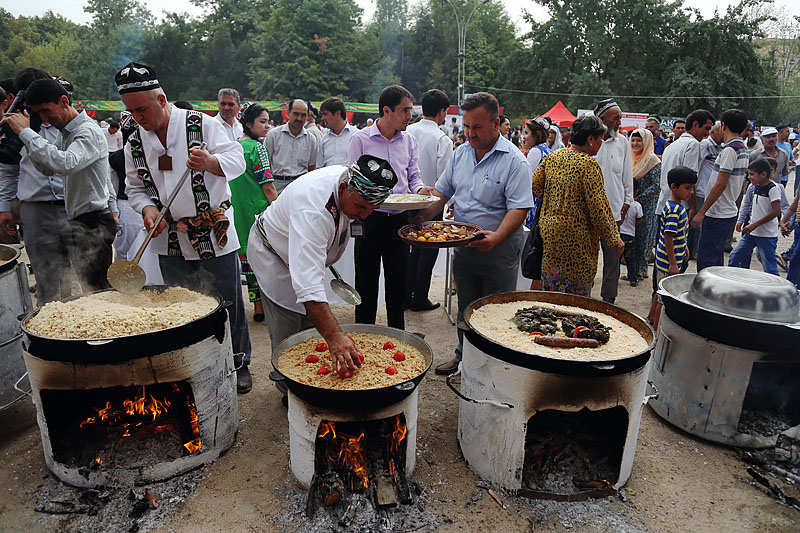
Oshi Palav, a traditional meal in Tajikistan, has been inscribed in 2016 (11.COM) on the Representative List of the Intangible Cultural Heritage of Humanity. According to UNESCO, Oshi palav (pilaf) is a traditional dish of communities in Tajikistan recognized as a part of their cultural heritage. Otherwise known as the ‘King of meals’, it is […]

Asia-Plus

Oshi Palav, a traditional meal in Tajikistan, has been inscribed in 2016 (11.COM) on the Representative List of the Intangible Cultural Heritage of Humanity.

According to UNESCO, Oshi palav (pilaf) is a traditional dish of communities in Tajikistan recognized as a part of their cultural heritage.

Otherwise known as the ‘King of meals’, it is based on a recipe using vegetables, rice, meat and spices but up to 200 varieties of the dish exist.  Considered an inclusive practice that aims to bring people of different backgrounds together, Oshi palav is prepared to be enjoyed at regular mealtimes, as well as social gatherings, celebrations and rituals.

The importance of the dish to communities in Tajikistan is indicative in sayings such as “No Osh, no acquaintance” or “If you have eaten Osh from somebody, you must respect them for 40 years”.  Groups of men or women prepare the dish either in their homes or at teahouses while socializing or playing music and singing.

Knowledge and skills associated with the practice is transmitted on an intergenerational basis in families, in addition to cooking schools from master to apprentice.  Once an apprentice masters Oshi palav, the apprentice hosts a dinner for the trainer and guests during which the trainer receives a skull-cap and traditional dress while the apprentice receives a skimmer (a tool for cooking Oshi palav) symbolizing the apprentice’s independence. 

Join us on social media!

Article translations:

Related Article

Оби зулол
Оби зулол

Most Read

Акика Алиф

Recent Articles

In Tajikistan, a unique surgery was performed for the first time on a child with an extremely rare pathology

Tajik and Russian surgeons successfully performed the most complex reconstruction of the bladder and abdominal wall for a child with recurrent exstrophy.

The ministry of health states that hantavirus does not threaten Tajikistan

Cases of infection with this virus were detected on board the cruise liner Hondius near the Canary Islands.

Tajikistan lags behind other Central Asian countries in number of chain hotels – study

The Republic remains a niche market with a limited number of quality hotels.

Climate risks threaten food security in Central Asia – FAO

Land degradation reduces agricultural productivity. The loss of biodiversity weakens the ecosystems that farmers, livestock breeders, and rural communities depend on.

Potential or illusion? Why the world overlooks Tajikistan’s mineral wealth

The republic may indeed possess significant reserves of rare metals, but there is a catch...

The case of ousted Kyrgyz security boss classified and moves to court

The former head of the GKNB is charged with violent seizure of power and abuse of official position.

Trump states that Iran’s nuclear program is a higher priority than U.S. citizens’ economic issues

Fluctuations in energy prices led to record inflation in the United States in April, the highest in the past three years.

Foot-and-mouth disease, plague, and flu: Central Asia threatened by transboundary animal diseases

FAO urges Central Asian countries to strengthen coordination and epidemiological surveillance.

Tajikistan approves the second phase of the Electric Transport Development Program; $95 million will be allocated for its implementation.

At this stage, the authorities are focusing on charging infrastructure, services for electric vehicles, and the expansion of the electric bus fleet.

Tajikistan and Kazakhstan to sign roadmap for cooperation in the agrarian sector

The parties are interested in expanding investment cooperation and establishing joint ventures.