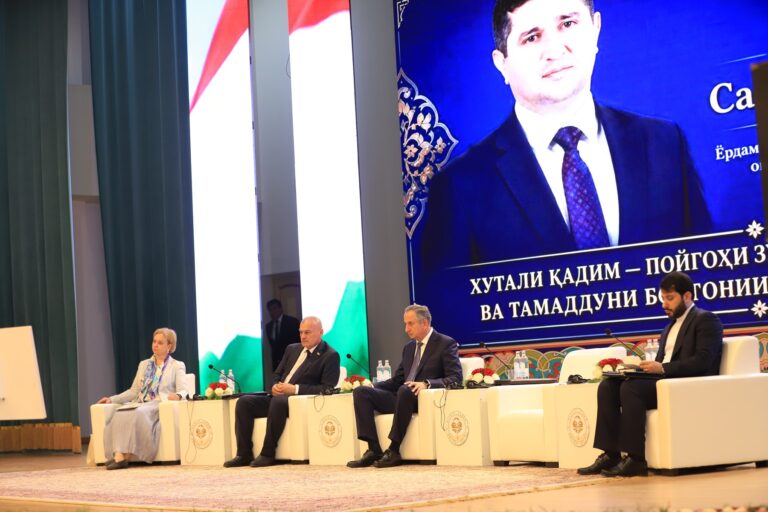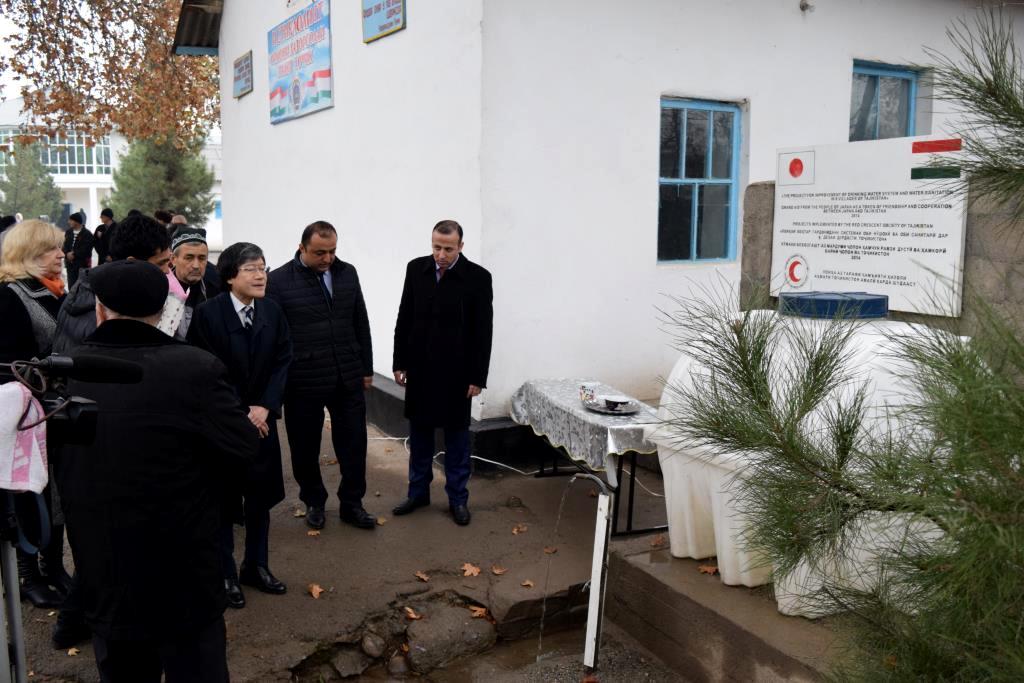
On December 8, Mr. Hajime Kitaoka, Japan’s Ambassador to Tajikistan, attended a handover ceremony to commemorate the successful completion of the project for “Improvement of Drinking Water System and Water Sanitation in 7 Villages of Tajikistan.”
The project that was implemented within the framework of Japan’s “Grant Assistance for Grassroots Human Security Projects (GGP)” covered three western districts subordinate to the center.
Japan’s Embassy in Dushanbe says that as the locational adjustment was made after the project agreement signing, the project actually ended up providing water supply systems in 8 villages rather than 7 as stated in the official project title.
The Government of Japan reportedly provided the total grant amount of USD 89,444 to the Red Crescent Society in Tajikistan for the development of spring water supply system in the vulnerable and remote areas of Tajikistan.
The project was implemented in 8 sites: Bahor and Mehnat villages of Sultonobod jamoat and Qosimobod village of Lohur jamoat in Roudaki district; Bedak and Tutaka villages of Almosi jamoat and Ardjinaki-bolo village of Khonaqoi Kuhi jamoat in Hisor district; Qaratogh village of Qaratogh jamoat in Shahrinav district; and Chirtak village of Navobod jamoat of Tursunzoda.
In order to supply the abovementioned villages with pure drinking water that corresponds to sanitary requirements, the water supply system was created and the system of effective water usage was developed. As a result, now residents of 8 remote villages have access to sufficient safe water.
During the ceremony, Ambassador Kitaoka stated that Japan’s GGP projects have been able to make a true difference by providing assistance in the development of different spheres, including infrastructure, education, agriculture, health and social sectors. He also added that these projects also play a vital role in further strengthening of the bilateral partnership between the Republic of Tajikistan and Japan.
Along with the local residents and representatives of local jamoat, the handover ceremony was also attended by Mr. Qurbonjon Bahodur, Secretary-General of Tajikistan’s Red Crescent Society, and Mr. Parviz Akramzoda, First Deputy Mayor of Tursunzoda, who extended words of gratitude to the government and people of Japan for their support.
Grant Assistance for Grass-roots Human Security Projects (GGP) is provided to local governments, educational/ medical institutions and International NGOs in developing countries. GGP supports projects in the human security sectors at the grassroots level that aim to improve livelihood of the local population. As of today, GGP has supported 352 projects in Tajikistan, for which more than US$ 28.5 million has been provided since 1996.