
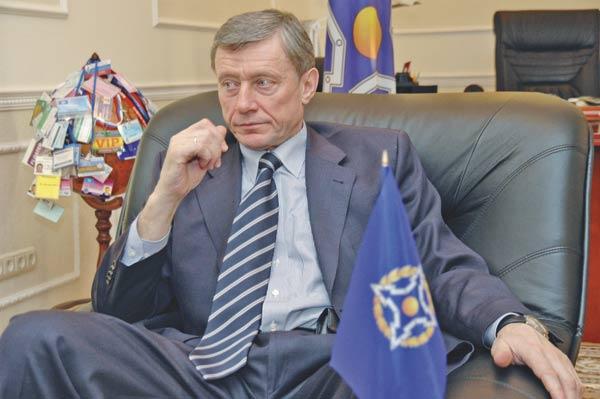
Nikolai Bordyuzha leaves his post as CSTO secretary-general

Deputy Secretary-General of the Collective Security Treaty Organization (CSTO) Valery Semerikov started fulfilling the duties of the chief of the Organization on Sunday, the CSTO press service said. The term of CSTO Secretary-General Nikolai Bordyuzha expired on December 31, 2016. Bordyuzha has been the CSTO Secretary-General since 2003. At the organization’s Moscow summit in December […]

Asia-Plus

Deputy Secretary-General of the Collective Security Treaty Organization (CSTO) Valery Semerikov started fulfilling the duties of the chief of the Organization on Sunday, the CSTO press service said.

The term of CSTO Secretary-General Nikolai Bordyuzha expired on December 31, 2016.

Bordyuzha has been the CSTO Secretary-General since 2003.

At the organization’s Moscow summit in December 2015, a decision was taken to extend Bordyuzha’s term until January 1, 2017.

In late December, Bordyuzha said the issue on the new chief of the organization would be solved in April 2017 at the meeting of the CSTO Council.

Kremlin Spokesman Dmitry Peskov said earlier that several candidacies were considered for the post of the CSTO new chief but no decision had been made yet.

The regional security organization was initially formed in 1992 for a five-year period by the members of the CIS Collective Security Treaty (CST) — Armenia, Kazakhstan, Kyrgyzstan, Russia, Tajikistan, and Uzbekistan, which were joined by Azerbaijan, Georgia, and Belarus the following year.  A 1994 treaty reaffirmed the desire of all participating states to abstain from the use or threat of force, and prevented signatories from joining any “other military alliances or other groups of states” directed against members states.  The CST was then extended for another five-year term in April 1999, and was signed by the presidents of Armenia, Belarus, Kazakhstan, Kyrgyzstan, Russia, and Tajikistan.  In October 2002, the group was renamed as the CSTO.  Uzbekistan that suspended its membership in 1999 returned to the CSTO again in 2006 after it came under international criticism for its brutal crackdown of antigovernment demonstrations in the eastern city of Andijon in May 2005.  On June 28, 2012, Uzbekistan announced that it has suspended its membership of the CSTO, saying the organization ignores Uzbekistan and does not consider its views.  The CSTO is currently an observer organization at the United Nations General Assembly.
Article translations:

Related Article

Оби зулол

Most Read

Join us on social media!

Aura

Recent Articles

Sanctions lifted: Dushanbe City Bank resumes international operations

The bank is returning to full-scale international operations.

Gasoline and diesel fuel in Dushanbe rose in price by 8.9% due to the war in the Middle East

The rise in global oil prices and, consequently, the cost of petroleum products has triggered the closure of the Strait of Hormuz.

The Ministry of Labor organizes consultations for migrants returning from Russia at Dushanbe airport

Employees of the Migration Service explain the requirements of Russian legislation and offer job vacancies in their homeland.

Tajikistan and Uzbekistan discuss simplification of customs procedures and implementation of VIN.TJ system

The VIN.TJ system is designed to simplify the process of vehicle registration and control.

Tajikistan climbs four places in the global fixed internet speed ranking

This is the country's best performance in the past five years.

President of Tajikistan launches hydro unit No. 7 at Nurek HPP

As of today, three units have been completely replaced at the country's largest hydroelectric power station.

Italian Opera in Dushanbe: Shohrukh Yunusov invites to an evening of musical revelations

The evening will feature the most recognizable Italian works alongside world and Tajik classics.

The European Union lifts sanctions on Tajik banks

This is attributed to successful reforms and improved financial transparency in the country.

Meta announced plans to lay off about 10% of its staff

The reason cited is the high costs of artificial intelligence development.