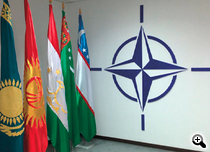
Central Asians see NATO as a threat rather than as a source of protection

EurasiaNet.org reports that according to a new survey by the American firm Gallup, Central Asians are more likely to see NATO as more of a threat than as protection. The survey reportedly polled residents of all the ex-Soviet republics except for Turkmenistan and Uzbekistan. All of the Central Asian states saw NATO as more of […]

EurasiaNet.org

EurasiaNet.org reports that according to a new survey by the American firm Gallup, Central Asians are more likely to see NATO as more of a threat than as protection.

The survey reportedly polled residents of all the ex-Soviet republics except for Turkmenistan and Uzbekistan.

All of the Central Asian states saw NATO as more of a threat than as protection.  Tajikistan was the most anti-NATO state, with 34 percent seeing it as a threat and eight percent as protection.  Next is Kyrgyzstan, at 19 percent protection and 30 percent threat; then Kazakhstan, 25 percent protection and 31 percent threat.

It's hard to imagine what NATO would possibly threaten in Central Asia.  And while it's tempting to attribute this to exposure to Russian narratives about NATO, Tajikistan is the least Russian-speaking of all these countries, and Kazakhstan the most Russian-speaking, so that explanation isn't satisfying. 

Note that NATO closed down its Central Asia liaison office in Tashkent last year, deciding that it would henceforth operate all of its modest cooperation programs in the region from Brussels.

Armenia also had a mostly negative response, with 20 percent saying NATO is a threat and only eight percent as a protection.  Armenia's government makes not-insignificant efforts to maintain real cooperation with NATO, in spite of being a member of the NATO rival Collective Security Treaty Organization.  But the fact that the only NATO country on Armenia's border is Turkey no doubt colors public opinion on the alliance.

Aside from the NATO member countries (the Baltic states), the country most positively disposed toward the Western alliance was Georgia, with 37 percent of respondents seeing it as protection and only eight percent as a threat.

The only other non-Baltic ex-Soviet state where respondents were more likely to see NATO as protection instead of a threat was Azerbaijan, by a 21 percent to 16 percent margin.  Azerbaijan is also the most indifferent country in the region to NATO, with a full 44 percent of those polled saying it is neither a threat nor a protector.

Article translations:

Related Article

Оби зулол

Most Read

Join us on social media!

Aura

Recent Articles

Sanctions lifted: Dushanbe City Bank resumes international operations

The bank is returning to full-scale international operations.

Gasoline and diesel fuel in Dushanbe rose in price by 8.9% due to the war in the Middle East

The rise in global oil prices and, consequently, the cost of petroleum products has triggered the closure of the Strait of Hormuz.

The Ministry of Labor organizes consultations for migrants returning from Russia at Dushanbe airport

Employees of the Migration Service explain the requirements of Russian legislation and offer job vacancies in their homeland.

Tajikistan and Uzbekistan discuss simplification of customs procedures and implementation of VIN.TJ system

The VIN.TJ system is designed to simplify the process of vehicle registration and control.

Tajikistan climbs four places in the global fixed internet speed ranking

This is the country's best performance in the past five years.

President of Tajikistan launches hydro unit No. 7 at Nurek HPP

As of today, three units have been completely replaced at the country's largest hydroelectric power station.

Italian Opera in Dushanbe: Shohrukh Yunusov invites to an evening of musical revelations

The evening will feature the most recognizable Italian works alongside world and Tajik classics.

The European Union lifts sanctions on Tajik banks

This is attributed to successful reforms and improved financial transparency in the country.

Meta announced plans to lay off about 10% of its staff

The reason cited is the high costs of artificial intelligence development.