
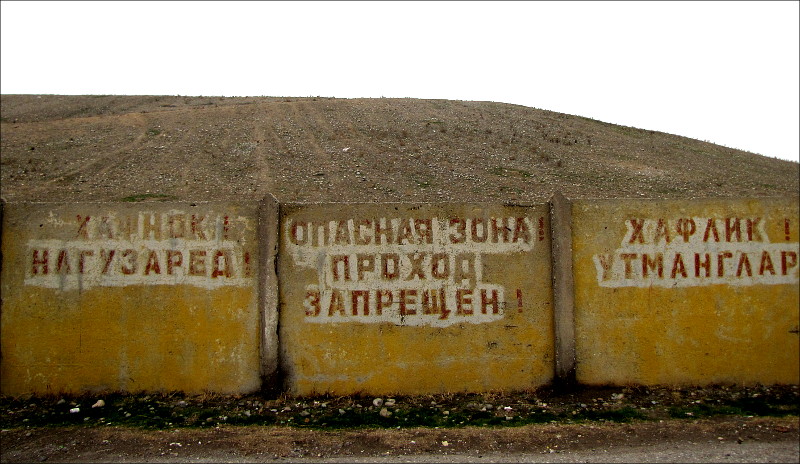
The International Atomic Energy Agency (IAEA)’s Coordination Group for Uranium Legacy Sites (CGULS) has visited northern Tajikistan this month to assist with preparations for remediation of uranium legacy sites.
According to the IAEA’s website, the objective of remediation is to reduce the risks to the public and the environment arising from radiation of residual contamination and physical hazards present at the sites.
With the support of the Nuclear and Radiation Safety Agency of the Academy of Sciences of Tajikistan and the operator of the legacy sites, State-Enterprise TAJREDMET, three international experts visited legacy sites called Map 1-9, Degmay and Taboshar. In less than two weeks, they reportedly looked at a range of objects, from exposed bodies of tailings through to remnants of uranium extraction mills and other ancillary infrastructure.
As an outcome of the mission, the expert team is now preparing independent indicative cost estimates that will help Tajikistan in their planning for remediation. Tajikistan continues to implement a work program to place an interim cover on the uranium tailings at Degmay to reduce the dust hazard to the surrounding communities and the environment.
Through CGULS, the IAEA works in close cooperation with Central Asia’s nations, the State Atomic Energy Corporation ROSATOM of the Russian Federation, the European Commission and the European Bank for Reconstruction and Development. “Together, we are working to remediate and establish safe regulatory control of these sites, which are the legacy of uranium production activities carried out from the 1950s to the 1990s,” said Michelle Roberts, Waste Safety Specialist at the IAEA.
Information collected from the visit to Tajikistan and from a similar one to Kyrgyzstan in October 2016, supports the development of a strategic plan for remediation of uranium legacy sites in Central Asia. The plan aims at providing confidence, through a strategic and integrated approach, that remediation will be addressed in a timely, coordinated, cost-effective and sustainable manner.
The plan will be utilized by the European Bank for Reconstruction and Development to secure pledges for the Environmental Remediation Account, established in 2015 to fund remediation activities in Central Asia.
