
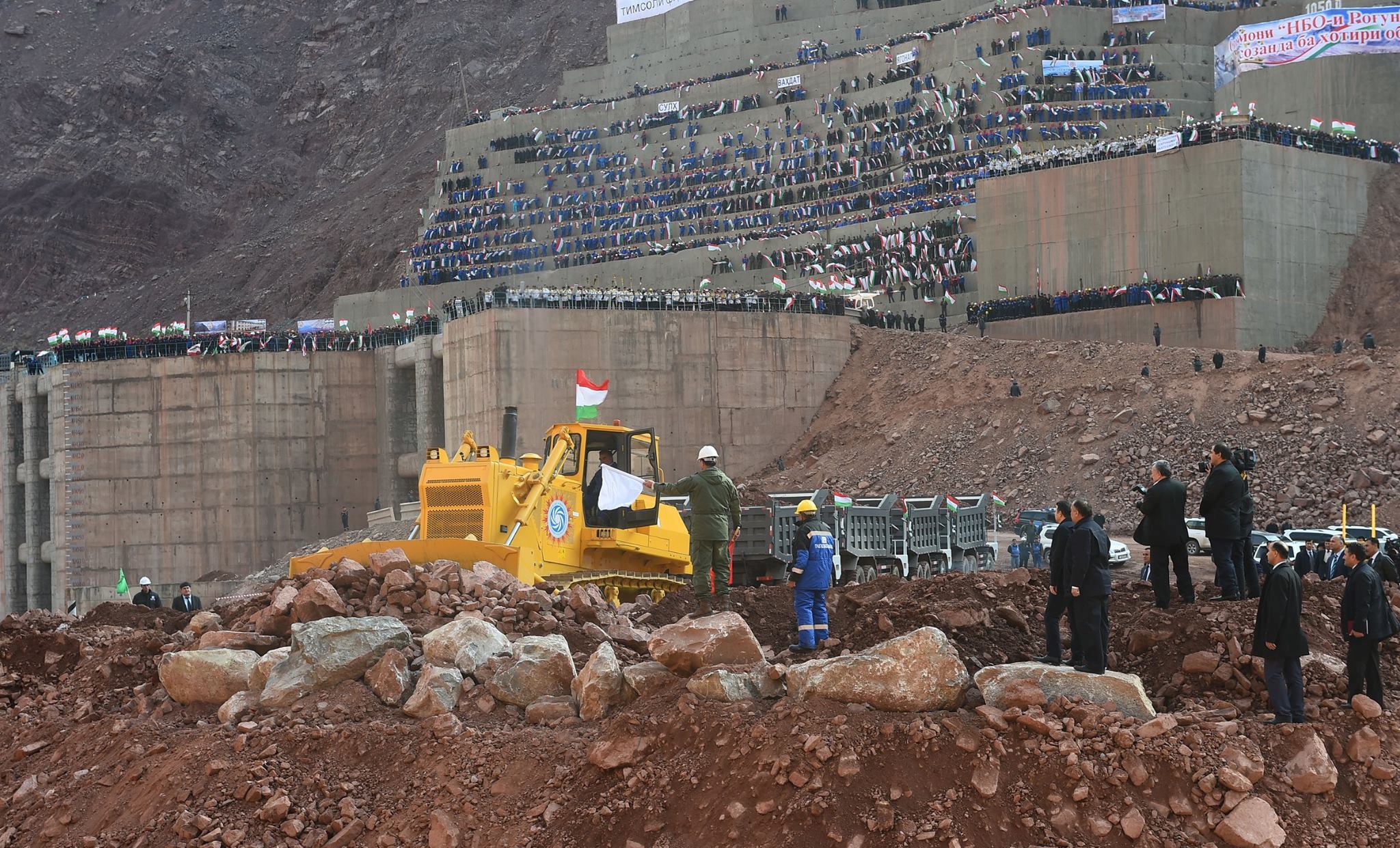
Tajik Foreign Minister Sirojiddin Aslov has defended the Roghun hydropower project (HPP), which has been questioned by neighboring Uzbekistan for years.
According to Radio Liberty, Aslov told reporters in Brussels on May 15 that Dushanbe has always taken into account the interests of neighboring downstream countries.
Tajik foreign minister reportedly said that Dushanbe had painstakingly prepared the project's implementation with the help of the World Bank, UN, and European countries.
Aslov said that there is enough water in Central Asia for all five countries — Tajikistan, Uzbekistan, Kyrgyzstan, Turkmenistan, and Kazakhstan — and that “the problem is irrational use.”
“We have to do our best together to implement measures for saving the water resources in each country of the region, and I hope that each country of our region recognizes this important issue,” he said.
Tajikistan has suffered from electricity shortages for years. Roghun is meant to put an end to that, producing enough power to satisfy the country's energy needs with electricity to spare for export to Afghanistan and Pakistan.
Tajik authorities hope that, if completed, the Roghun HPP will give Tajikistan a stable energy supply.
The Roghun hydropower project was first started 40 years ago. But the collapse of the Soviet Union, the Tajik civil war and problems in securing investments have delayed construction. Last summer Italy-based infrastructure company Salini Impregilo won the contract to complete the dam at a cost of $3.9bn.
Its construction officially started in late October. When work is finished six giant turbines will produce electricity. Some electricity could flow from 2018, but it will take another seven and a half years for the dam to reach its full height, the contractors say.
Uzbekistan and Kazakhstan fear that water could be diverted from their cotton and wheat fields. The Vakhsh River is a major tributary to the Amu Darya River, one of the region's two major water courses. But a World Bank assessment gave the go-ahead two years ago.
